Department of Chemical Sciences, The Center for Radical Reactions and the Schlesinger Family Center for Compact Accelerators, Radiation Sources and Applications, Ariel University, Ramat HaGolan Street, Ariel 40700, Israel.
Department of Chemistry, Nuclear Research Centre Negev, Beer-Sheva 84190, Israel.
Acc Chem Res. 2020 Oct 20;53(10):2189-2200. doi: 10.1021/acs.accounts.0c00344. Epub 2020 Sep 25.
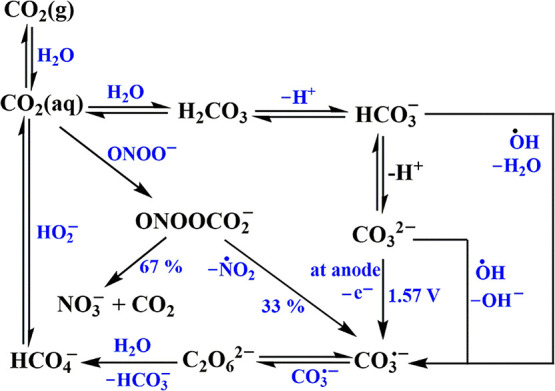
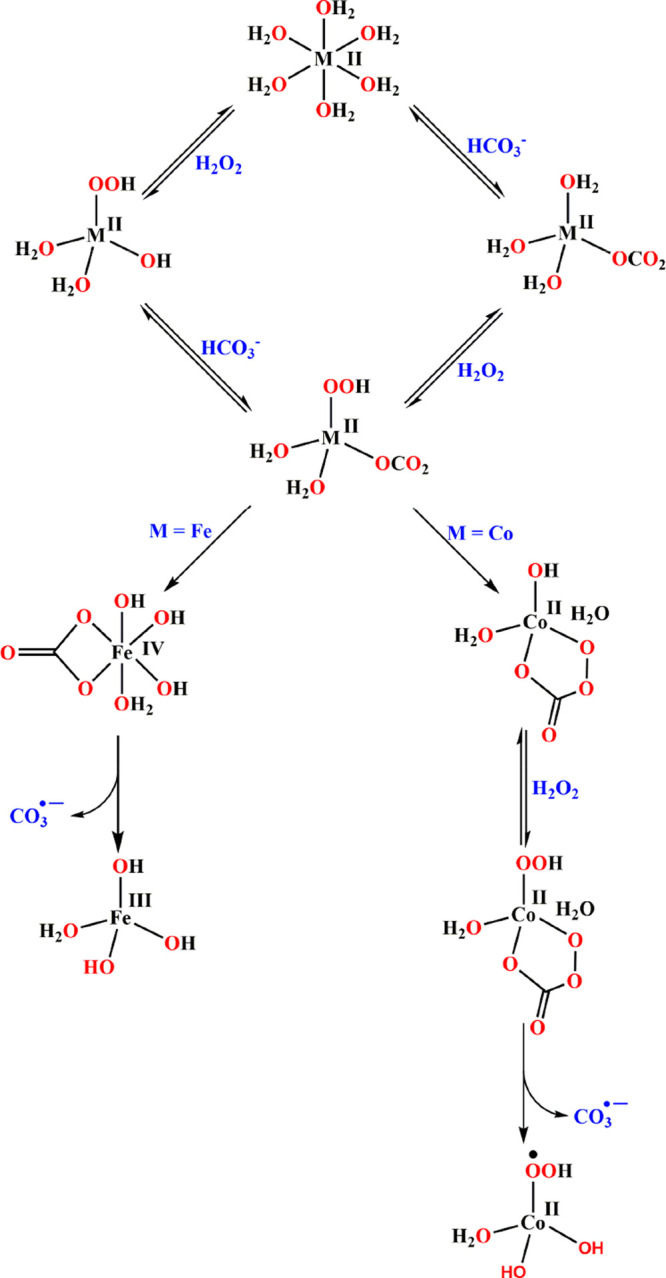
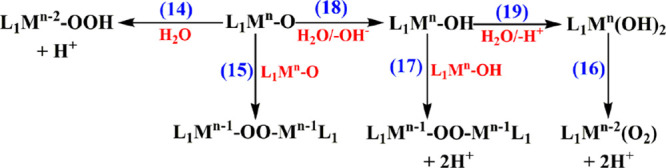
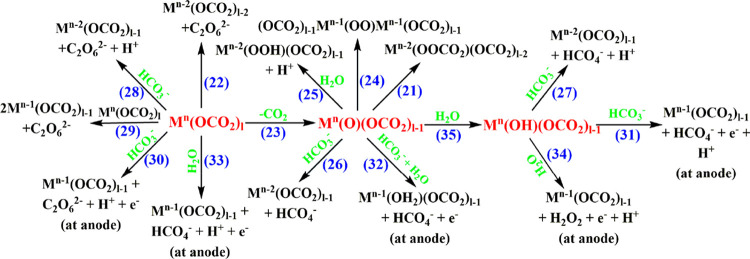
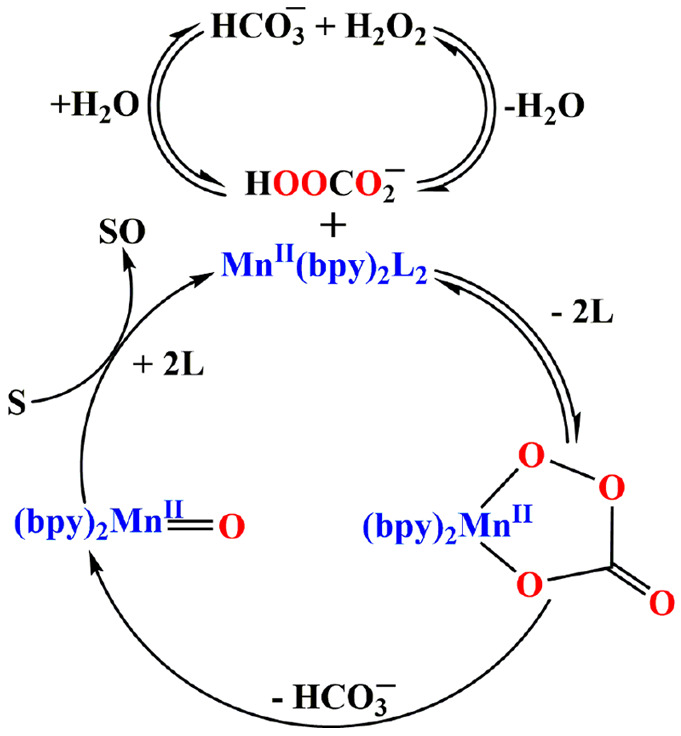
CO, HCO, and CO are present in all aqueous media at pH > 4 if no major effort is made to remove them. Usually the presence of CO/HCO/CO is either forgotten or considered only as a buffer or proton transfer catalyst. Results obtained in the last decades point out that carbonates are key participants in a variety of oxidation processes. This was first attributed to the formation of carbonate anion radicals via the reaction OH + CO → CO + OH. However, recent studies point out that the involvement of carbonates in oxidation processes is more fundamental. Thus, the presence of HCO/CO changes the mechanisms of Fenton and Fenton-like reactions to yield CO directly even at very low HCO/CO concentrations. CO is a considerably weaker oxidizing agent than the hydroxyl radical and therefore a considerably more selective oxidizing agent. This requires reconsideration of the sources of oxidative stress in biological systems and might explain the selective damage induced during oxidative stress. The lower oxidation potential of CO probably also explains why not all pollutants are eliminated in many advanced oxidation technologies and requires rethinking of the optimal choice of the technologies applied. The role of percarbonate in Fenton-like processes and in advanced oxidation processes is discussed and has to be re-evaluated. Carbonate as a ligand stabilizes transition metal complexes in uncommon high oxidation states. These high-valent complexes are intermediates in electrochemical water oxidation processes that are of importance in the development of new water splitting technologies. HCO and CO are also very good hole scavengers in photochemical processes of semiconductors and may thus become key participants in the development of new processes for solar energy conversion. In this Account, an attempt to correlate these observations with the properties of carbonates is made. Clearly, further studies are essential to fully uncover the potential of HCO/CO in desired oxidation processes.
在 pH 值大于 4 的所有水介质中,如果没有进行大量努力去除它们,CO、HCO 和 CO 都会存在。通常情况下,人们要么忽略 CO/HCO/CO 的存在,要么仅仅将其视为缓冲剂或质子转移催化剂。过去几十年的研究结果表明,碳酸盐是多种氧化过程的关键参与者。这首先归因于 OH + CO → CO + OH 反应形成的碳酸盐阴离子自由基。然而,最近的研究指出,碳酸盐在氧化过程中的参与更为基础。因此,即使在非常低的 HCO/CO 浓度下,HCO/CO 的存在也会改变 Fenton 和类 Fenton 反应的机制,直接产生 CO。CO 的氧化能力比羟基自由基弱得多,因此是一种选择性更强的氧化剂。这需要重新考虑生物系统中氧化应激的来源,并可能解释氧化应激过程中诱导的选择性损伤。CO 较低的氧化电位可能也解释了为什么在许多高级氧化技术中并非所有污染物都被消除,这需要重新思考应用技术的最佳选择。过碳酸盐在类 Fenton 过程和高级氧化过程中的作用也进行了讨论,需要重新评估。作为配体,碳酸盐稳定了处于不常见高氧化态的过渡金属配合物。这些高价配合物是电化学水氧化过程中的中间体,在开发新型水分解技术中具有重要意义。HCO 和 CO 也是半导体光化学过程中非常好的空穴清除剂,因此可能成为开发新型太阳能转化过程的关键参与者。在本综述中,尝试将这些观察结果与碳酸盐的性质联系起来。显然,需要进一步的研究来充分揭示 HCO/CO 在所需氧化过程中的潜力。