Department of Anesthesiology, Hirosaki University Graduate School of Medicine, Zaifu-cho 5, Hirosaki, 036-8562, Japan.
Department of Transfusion and Cell Therapy Medicine, Hirosaki University Graduate School of Medicine, Hirosaki, Japan.
J Anesth. 2021 Feb;35(1):35-42. doi: 10.1007/s00540-020-02856-x. Epub 2020 Sep 25.
This study was conducted to time-course changes of clotting function of withdrawing blood for acute normovolemic hemodilution (ANH).
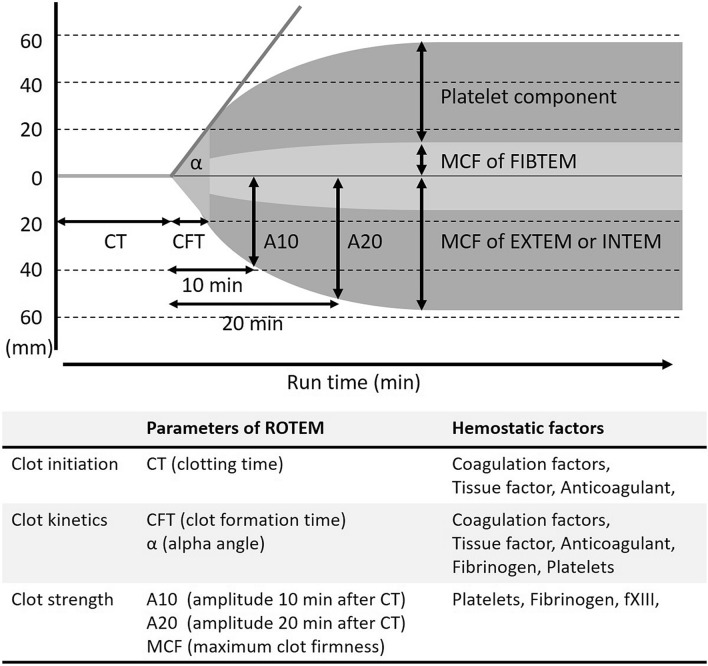
Twelve enrolled patients who underwent ANH from August, 2018 to January, 2019. Blood was withdrawn into blood collection pack and shaken at 60-80 rpm for 24 h in room temperature. Clot formation was evaluated using rotational thromboelastometry (ROTEM™) just after blood withdrawal (control) and 4, 8, 12 and 24 h after blood withdrawal. We compared with the control value and each value of extrinsically-activated test with tissue factor (EXTEM), intrinsically-activated test using ellagic acid (INTEM) and fibrin-based extrinsically activated test with tissue factor (FIBTEM).
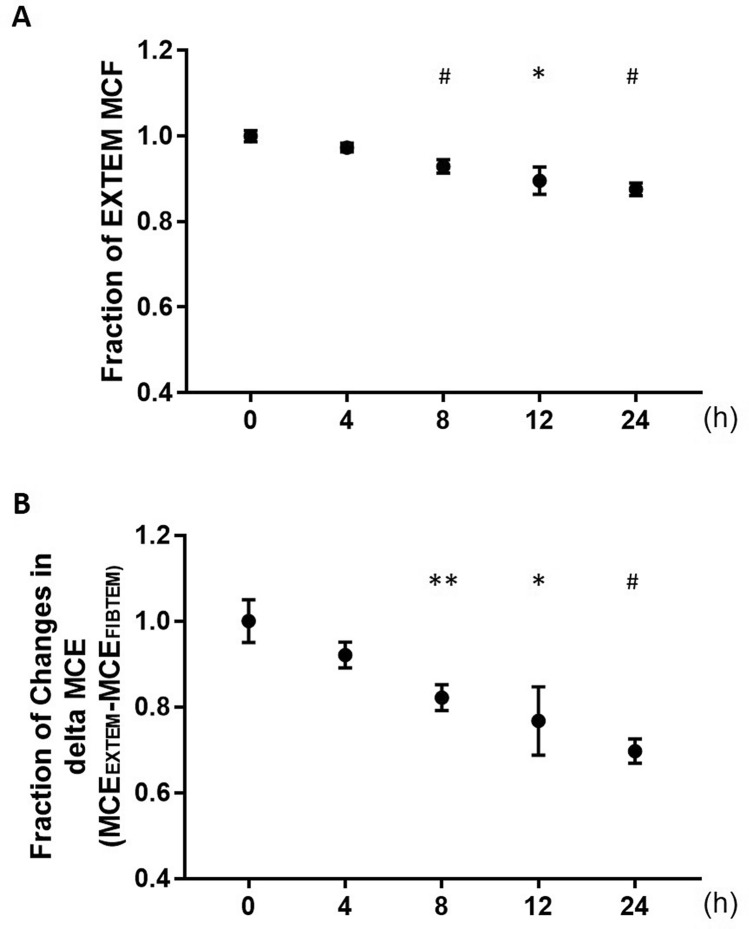
Maximum clot firmness (MCF) of FIBTEM did not change significantly. MCF of EXTEM was significantly decreased time-dependent manner but all MCF of EXTEM were within a normal range. Maximum percent change in MCF of EXTEM was 12.4% [95% confidence interval (CI): 9.0-15.8%]. The difference in the maximum clot elasticity (MCE) between EXTEM and FIBTEM (MCE-MCE) was significantly decrease from 8 h after blood withdrawal. Maximum percent change in MCE-MCE was 30.2% (95% CI:17.6-42.9%) at 24 h after blood withdrawal.
Even though the MCE significantly decreased in a time-dependent manner, MCF of FIBTEM and EXTEM was normal up to 24 h storage. The blood of ANH can use for the purpose of hemostasis at least 8 h stored at room temperature after blood withdrawal. Future studies are needed to elucidate the clinical impact on the patient after delayed transfusion of ANH blood with regard to patient's hemostasis.
本研究旨在观察急性等容血液稀释(ANH)采血后凝血功能的时程变化。
2018 年 8 月至 2019 年 1 月期间,12 例接受 ANH 的患者参与本研究。将血液采集到采血袋中,在室温下以 60-80rpm 摇动 24 小时。采血后即刻(对照)和 4、8、12 和 24 小时,使用旋转血栓弹性仪(ROTEM)评估血栓形成。我们比较了对照值和组织因子(EXTEM)的外激活试验、鞣花酸(INTEM)的内激活试验和组织因子的纤维蛋白原外激活试验(FIBTEM)的每个值。
FIBTEM 的最大凝血块硬度(MCF)无明显变化。EXTEM 的 MCF 呈时间依赖性显著降低,但所有 EXTEM 的 MCF 均在正常范围内。EXTEM 的 MCF 最大百分比变化为 12.4%(95%可信区间:9.0-15.8%)。EXTEM 和 FIBTEM 之间最大凝血弹性(MCE)的差异从采血后 8 小时开始显著减小。采血后 24 小时,MCE-MCE 的最大百分比变化为 30.2%(95%可信区间:17.6-42.9%)。
即使 MCE 呈时间依赖性显著降低,但 FIBTEM 和 EXTEM 的 MCF 在 24 小时储存时仍正常。ANH 采血后至少 8 小时室温储存,血液可用于止血目的。未来需要研究延迟输注 ANH 血液对患者止血的临床影响。