Niehoff Nicole M, Gammon Marilie D, Keil Alexander P, Nichols Hazel B, Engel Lawrence S, Taylor Jack A, White Alexandra J, Sandler Dale P
Department of Epidemiology, University of North Carolina, 135 Dauer Drive, Chapel Hill, NC 27599.
Epigenetic and Stem Cell Biology Laboratory, National Institute of Environmental Health Sciences, Research Triangle Park, North Carolina 27709.
Environ Epidemiol. 2019 Aug;3(4). doi: 10.1097/ee9.0000000000000053. Epub 2019 Jun 28.
Telomeres are vital for genomic integrity and telomere length has been linked to many adverse health outcomes. Some hazardous air pollutants, or air toxics, increase oxidative stress and inflammation, two possible determinants of shortened telomere length. No studies have examined air toxic-telomere length associations in a non-occupational setting.
This study included 731 Sister Study participants (enrolled 2003-2007) who were randomly selected to assess telomere length in baseline blood samples. Multiplex qPCR was used to determine telomere to single copy gene (T/S) ratios. Census tract concentration estimates of 29 air toxics from the 2005 National Air Toxics Assessment were linked to baseline residential addresses. Air toxics were classified into tertile-based categories of the exposure. Multivariable linear regression was used to estimate coefficients and 95% confidence intervals (CI) in single pollutant models. Multipollutant groups were identified with regression trees.
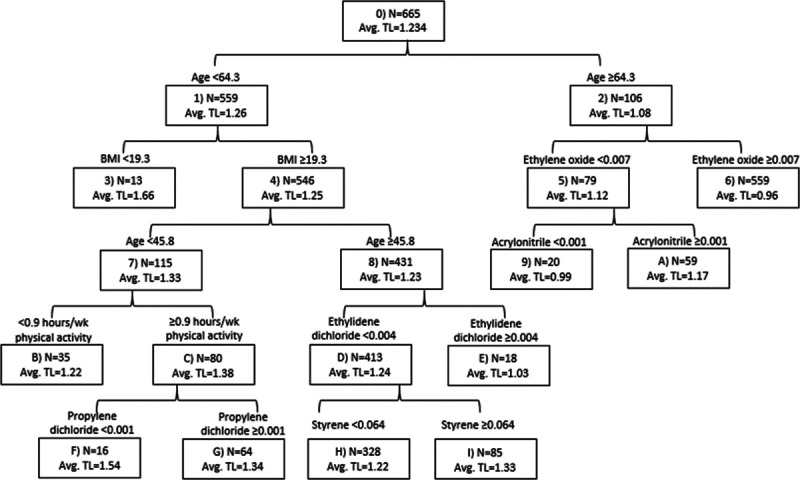
The average T/S ratio was 1.24. Benzidine (T3vsT1 = -0.08; 95% CI: -0.14, -0.01) and 1,4-dioxane (T3vsT1 = -0.06; 95% CI: -0.13, 0.00) in particular, as well as carbon tetrachloride, chloroprene, ethylene dibromide, and propylene dichloride, were associated with shorter relative telomere length. Benzidine (=0.02) and 1,4-dioxane (=0.06) demonstrated some evidence of a monotonic trend. The regression tree identified age, BMI, physical activity, ethylene oxide, acrylonitrile, ethylidene dichloride, propylene dichloride, and styrene in multipollutant groups related to telomere length.
In this first study of air toxics and telomere length in a non-occupational setting, several air toxics, particularly 1,4-dioxane and benzidine, were associated with shorter relative telomere length.
端粒对于基因组完整性至关重要,端粒长度与许多不良健康结局相关。一些有害空气污染物或空气毒物会增加氧化应激和炎症,这两者可能是端粒长度缩短的决定因素。尚无研究在非职业环境中考察空气毒物与端粒长度的关联。
本研究纳入了731名姐妹研究参与者(2003 - 2007年入组),他们被随机选取以评估基线血样中的端粒长度。采用多重定量聚合酶链反应来确定端粒与单拷贝基因(T/S)的比率。2005年国家空气毒物评估中的29种空气毒物的人口普查区浓度估计值与基线居住地址相关联。空气毒物按暴露三分位数分类。在单污染物模型中,使用多变量线性回归来估计系数和95%置信区间(CI)。用回归树确定多污染物组。
平均T/S比率为1.24。特别是联苯胺(T3对比T1 = -0.08;95% CI:-0.14,-0.01)和1,4 - 二氧六环(T3对比T1 = -0.06;95% CI:-0.13,0.00),以及四氯化碳、氯丁二烯、二溴乙烷和二氯丙烷,与较短的相对端粒长度相关。联苯胺(P = 0.02)和1,4 - 二氧六环(P = 0.06)显示出单调趋势的一些证据。回归树确定了与端粒长度相关的多污染物组中的年龄、体重指数、身体活动、环氧乙烷、丙烯腈、1,1 - 二氯乙烷、二氯丙烷和苯乙烯。
在这项非职业环境中空气毒物与端粒长度的首次研究中,几种空气毒物,特别是1,4 - 二氧六环和联苯胺,与较短的相对端粒长度相关。