Nearlab, Department of Electronics, Information and Bioengineering, Politecnico di Milano, Milano, Italy.
Scientific Institute IRCCS E. Medea, Bosisio Parini, Italy.
PLoS One. 2020 Sep 28;15(9):e0239064. doi: 10.1371/journal.pone.0239064. eCollection 2020.
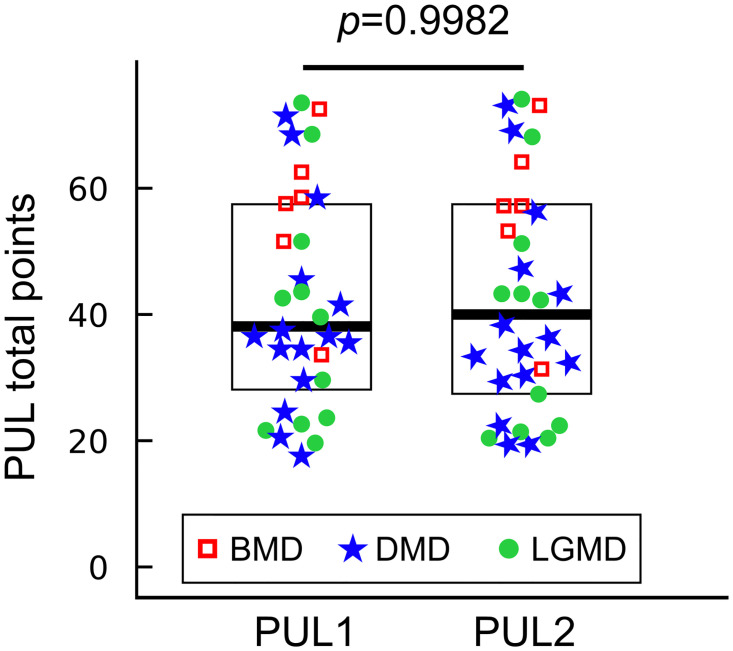
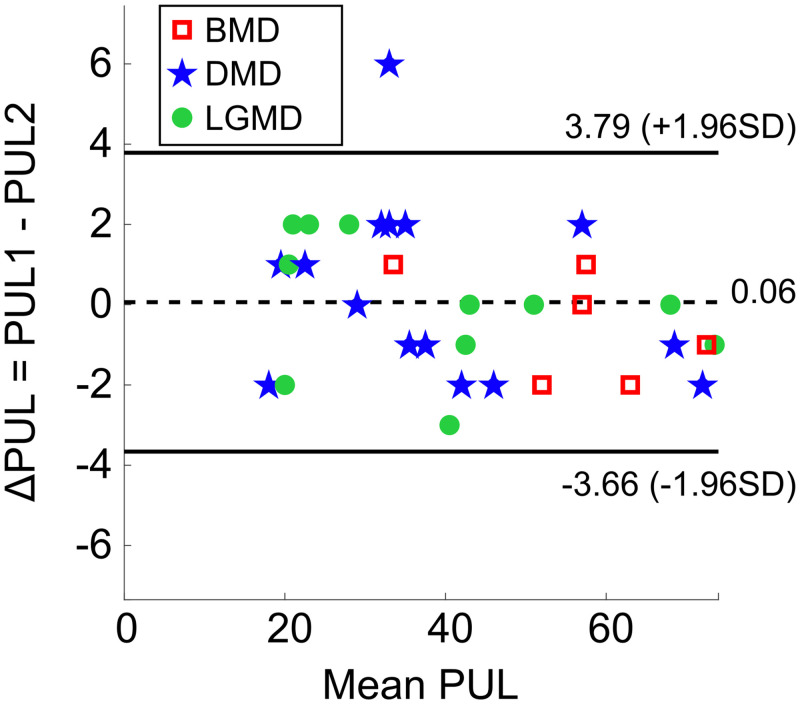
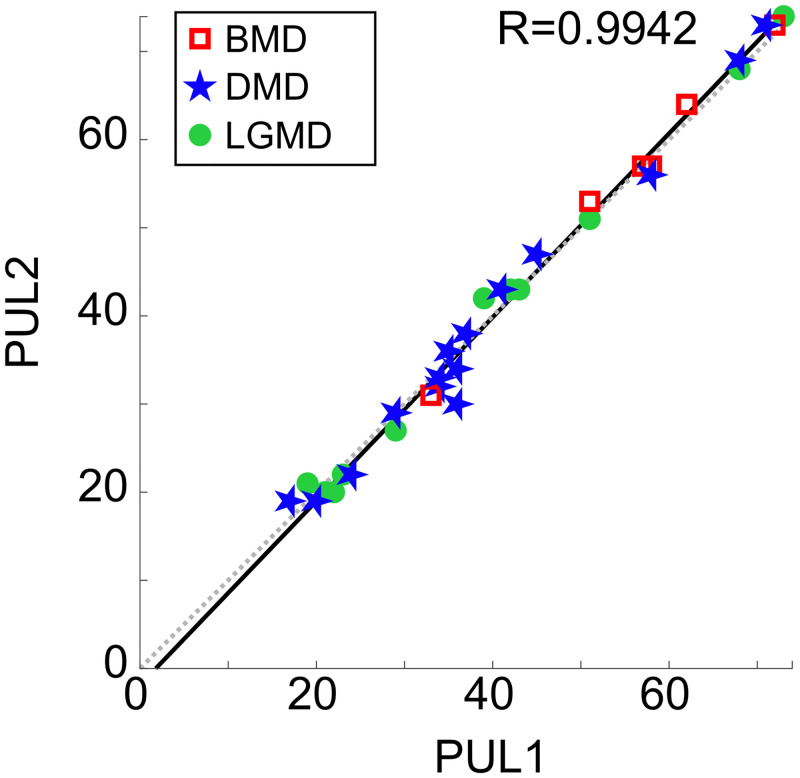
The Performance of the Upper Limb (PUL) module is an externally-assessed clinical scale, initially designed for the Duchenne muscular dystrophy population. It provides an upper extremity functional score suitable for both weaker ambulatory and non-ambulatory phases up to the severely impaired patients. It is capable of characterizing overall progression and severity of disease and of tracking the stereotypical proximal-to-distal progressive loss of upper limb function in muscular dystrophy. Since the PUL module has been validated only with Duchenne patients, its use also for Becker and Limb-Girdle muscular dystrophy patients has been here evaluated, to verify its reliability and extend its use. In particular, two different assessors performed this scale on 32 dystrophic subjects in two consecutive days. The results showed that the PUL module has high reliability, both absolute and relative, based on the calculation of Pearson's r (0.9942), Intraclass Correlation Coefficient (0.9943), Standard Error of Measurement (1.36), Minimum Detectable Change (3.77), and Coefficient of Variation (3%). The Minimum Detectable Change, in particular, can be used in clinical trials to perform a comprehensive longitudinal evaluation of the effects of interventions with the lapse of time. According to this analysis, an intervention is effective if the difference in the PUL score between subsequent evaluation points is equal or higher than 4 points; otherwise, the observed effect is not relevant. Inter-rater reliability with ten different assessors was evaluated, and it has been demonstrated that deviation from the mean is lower than calculated Minimum Detectable Change. The present work provides evidence that the PUL module is a reliable and valid instrument for measuring upper limb ability in people with different forms of muscular dystrophy. Therefore, the PUL module might be extended to other pathologies and reliably used in multicenter settings.
上肢功能表现(PUL)模块是一种外部评估的临床量表,最初专为杜氏肌营养不良症患者设计。它提供了一种适合于较弱的活动期和非活动期以及严重受损患者的上肢功能评分。它能够描述疾病的总体进展和严重程度,并跟踪肌肉萎缩症中上肢功能从近端到远端的典型进行性丧失。由于 PUL 模块仅在杜氏肌营养不良症患者中进行了验证,因此还评估了其在 Becker 和肢带型肌营养不良症患者中的使用可靠性,并扩展了其使用范围。特别是,两名不同的评估员在两天内对 32 名肌营养不良症患者进行了该量表的评估。结果表明,PUL 模块具有高度的可靠性,无论是绝对可靠性还是相对可靠性,基于 Pearson r(0.9942)、组内相关系数(0.9943)、测量标准误差(1.36)、最小可检测变化(3.77)和变异系数(3%)的计算。特别是最小可检测变化可用于临床试验,以随着时间的推移对干预措施的效果进行全面的纵向评估。根据这项分析,如果后续评估点之间的 PUL 评分差异等于或高于 4 分,则认为干预是有效的;否则,观察到的效果不相关。对十名不同评估员的组间可靠性进行了评估,结果表明,与平均值的偏差低于计算的最小可检测变化。本研究为 PUL 模块是一种可靠且有效的测量不同类型肌营养不良症患者上肢能力的工具提供了证据。因此,PUL 模块可能会扩展到其他疾病,并在多中心环境中可靠使用。