Department of Public Health, Sefako Makgatho Health Sciences University, Ga-Rankuwa, Pretoria 0204, South Africa.
Int J Environ Res Public Health. 2020 Sep 24;17(19):6980. doi: 10.3390/ijerph17196980.
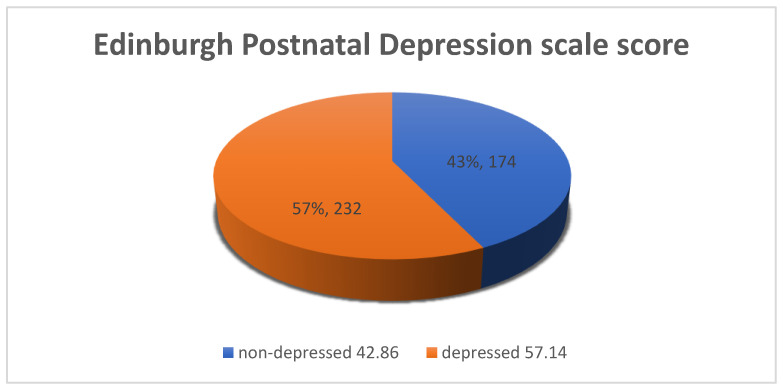
Although postnatal depression (PND) is a worldwide public health problem, it is relatively higher in developing countries, including countries in Sub-Saharan Africa. Postnatal depression is not routinely screened for in primary healthcare facilities in South Africa, despite its reported compromise on mother and child health. The purpose of this study was to determine the prevalence of, as well as factors associated with, postnatal depression in a sample of clinic attendees in a sub district in Tshwane, South Africa. A quantitative and cross-sectional survey was conducted in a sample of 406 women in three healthcare facilities. The Edinburgh Postnatal Depression Scale (EPDS) was used to collect data from women who had infants between the ages of 0 and 12 months. The cut-off point for the EPDS for the depressed category was a score of 13 out of a maximum of 30. The majority of the women (57.14%, = 232) had scores of 13 and above, which is indicative of postnatal depressive symptoms. On logistic regression, postnatal depressive symptoms were significantly associated with lack of support in difficult times ( < 0.001, 95% CI 10.57-546.51), not having the preferred sex of the baby ( = 0.001, 95% CI 0.37-0.58), low household income ( < 0.001, 95% CI 1.23-1.67), and an older baby ( = 0.005, 95% CI 1.21-1.49). The results show the high proportion of women who have postnatal depression but remain undiagnosed and untreated, and therefore confirm the need for routine screening for postnatal depressive symptoms in primary healthcare facilities, which are used by the majority of women in South Africa.
虽然产后抑郁症(PND)是一个全球性的公共卫生问题,但在发展中国家,包括撒哈拉以南非洲国家,其发病率相对较高。尽管产后抑郁症会影响母婴健康,但南非的初级保健机构并没有对其进行常规筛查。本研究旨在确定南非茨瓦内一个分区的诊所就诊者中产后抑郁症的患病率以及与产后抑郁症相关的因素。在三家医疗保健机构中,对 406 名年龄在 0 至 12 个月之间的婴儿的母亲进行了定量和横断面调查。使用爱丁堡产后抑郁量表(EPDS)从妇女那里收集数据。EPDS 的抑郁类别截断值为 30 分中得分为 13 分或以上。大多数妇女(57.14%,=232)的得分在 13 分及以上,表明存在产后抑郁症状。在逻辑回归中,产后抑郁症状与困难时期缺乏支持(<0.001,95%CI 10.57-546.51)、婴儿性别不合期望(=0.001,95%CI 0.37-0.58)、家庭收入低(<0.001,95%CI 1.23-1.67)和婴儿年龄较大(=0.005,95%CI 1.21-1.49)显著相关。结果表明,有很大比例的妇女患有产后抑郁症但未被诊断和治疗,因此证实了在南非大多数妇女使用的初级保健设施中常规筛查产后抑郁症状的必要性。