Babapoor-Farrokhran Savalan, Port Zachary, Wiener Philip C, Amanullah Aman, Mainigi Sumeet K
Division of Cardiology, Department of Medicine, Einstein Medical Center, 5501 Old York Road, Philadelphia, PA 19141 USA.
Sidney Kimmel Medical College, Thomas Jefferson University, Philadelphia, PA 19107 USA.
SN Compr Clin Med. 2020;2(11):2387-2390. doi: 10.1007/s42399-020-00531-6. Epub 2020 Sep 24.
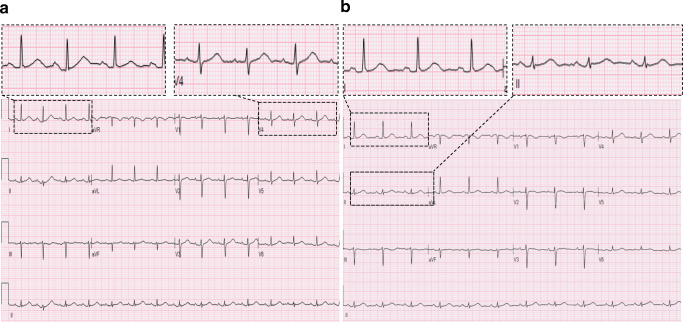
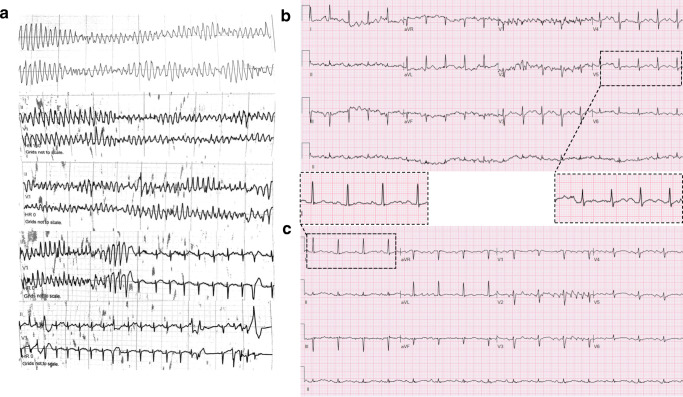
Arrhythmias or conduction system disease are not the most common manifestation of COVID-19 infection in patients requiring hospital admission. Torsade de pointes typically occurs in bursts of self-limiting episodes with symptoms of dizziness and syncope. However, it may occasionally progress to ventricular fibrillation and sudden death. In this article, we report a case of COVID-19 patient who developed polymorphic ventricular tachycardia with torsade de pointes morphology with normal QTc interval in the setting of fever. An 81-year-old woman was admitted with symptoms of COVID-19. She was treated with hydroxychloroquine, azithromycin, and doxycycline at an outside facility and finished the treatment 5 days prior to admission to our facility. Her course was complicated by atrial fibrillation with rapid ventricular response requiring cardioversion. Later, she developed two episodes of polymorphic ventricular tachycardia with TdP morphology with normal QTc. There was a correlation with fever triggering the ventricular tachycardia. We advocated aggressive fever control given the QTc was normal and stable. Following fever control, the patient remained stable and had no abnormal rhythm. COVID-19 patients are prone to different arrhythmias including life-threatening ventricular arrhythmias with normal left ventricular systolic function and normal QTc, and they should be monitored for fever and electrolyte abnormality during their hospital stay.
心律失常或传导系统疾病并非需要住院治疗的新冠病毒感染患者最常见的表现。尖端扭转型室速通常以一阵阵自限性发作的形式出现,伴有头晕和晕厥症状。然而,它偶尔可能进展为心室颤动和猝死。在本文中,我们报告了一例新冠病毒感染患者,该患者在发热情况下出现了具有尖端扭转型室速形态的多形性室性心动过速,QTc间期正常。一名81岁女性因新冠病毒感染症状入院。她在外部机构接受了羟氯喹、阿奇霉素和强力霉素治疗,并在入住我们机构前5天完成了治疗。她的病程因房颤伴快速心室反应而复杂化,需要进行心脏复律。后来,她出现了两次具有TdP形态、QTc正常的多形性室性心动过速发作。室性心动过速与发热触发有关。鉴于QTc正常且稳定,我们主张积极控制发热。发热得到控制后,患者保持稳定,未出现异常心律。新冠病毒感染患者容易出现不同的心律失常,包括左心室收缩功能正常且QTc正常的危及生命的室性心律失常,在住院期间应监测其发热和电解质异常情况。