Mahmoud Kareem, Hammouda Tarek, Kandil Hossam, Mashaal Marwa
Cairo University, Cairo, Egypt.
Egypt Heart J. 2020 Sep 29;72(1):62. doi: 10.1186/s43044-020-00098-6.
Aortic root abscess (ARA) is a major complication of infective endocarditis that is associated with increased morbidity and mortality. Limited data are present about patient characteristics and outcomes in this lethal disease. We aimed to study the clinical and echocardiographic characteristics of patients with ARA compared to patients with left-sided infective endocarditis without ARA. We included patients with a definite diagnosis of left-sided infective endocarditis according to modified Duke's criteria. The patients were classified into two groups according to the presence of ARA (ARA and NO-ARA groups). All the patients were studied regarding their demographic data, clinical characteristics, laboratory and imaging data, and complications.
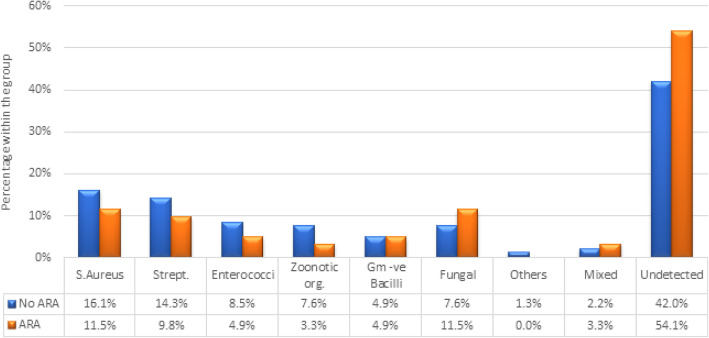
We included 285 patients with left-sided infective endocarditis. The incidence of ARA was 21.4% (61 patients). Underlying heart disease, mechanical prosthesis, bicuspid aortic valve, and prior IE were significantly higher in ARA. The level of CRP was higher in ARA (p = 0.03). ARA group showed more aortic valve vegetations (73.8% vs. 37.1%, p < 0.001), more aortic paravalvular leakage (26.7% vs. 4.5%, p < 0.001), and less mitral valve vegetations (21.3% vs. 68.8%, p < 0.001). Logistic regression analysis showed that the odds of ARA increased in the following conditions: aortic paravalvular leak (OR 3.9, 95% CI 1.2-13, p = 0.03), mechanical prosthesis (OR 3.6, 95% CI 1.5-8.7, p = 0.005), aortic valve vegetations (OR 3.0, 95% CI 1.2-8.0, p = 0.02), and undetected organism (OR 2.3, 95% CI 1.1-4.6, p = 0.02), while the odds of ARA decreased with mitral valve vegetations (OR 0.2, 95% CI 0.08-0.5, p = 0.001). We did not find a difference between both groups regarding the incidence of major complications, including in-hospital mortality.
In our study, ARA occurred in one fifth of patients with left-sided IE. Patients with mechanical prosthesis, aortic paravalvular leakage, aortic vegetations, and undetected organisms had higher odds of ARA, while patients with mitral vegetations had lower odds of ARA.
主动脉根部脓肿(ARA)是感染性心内膜炎的一种主要并发症,与发病率和死亡率增加相关。关于这种致命疾病的患者特征和预后的数据有限。我们旨在研究与无ARA的左侧感染性心内膜炎患者相比,ARA患者的临床和超声心动图特征。我们纳入了根据改良的杜克标准确诊为左侧感染性心内膜炎的患者。根据是否存在ARA将患者分为两组(ARA组和无ARA组)。对所有患者的人口统计学数据、临床特征、实验室和影像学数据以及并发症进行了研究。
我们纳入了285例左侧感染性心内膜炎患者。ARA的发生率为21.4%(61例患者)。在ARA患者中,潜在心脏病、机械瓣膜置换、二叶式主动脉瓣和既往感染性心内膜炎的发生率显著更高。ARA患者的CRP水平更高(p = 0.03)。ARA组显示主动脉瓣赘生物更多(73.8%对37.1%,p < 0.001),主动脉瓣周漏更多(26.7%对4.5%,p < 0.001),二尖瓣赘生物更少(21.3%对68.8%,p < 0.001)。逻辑回归分析显示,在以下情况下ARA的发生几率增加:主动脉瓣周漏(OR 3.9,95%CI 1.2 - 13,p = 0.03)、机械瓣膜置换(OR 3.6,95%CI 1.5 - 8.7,p = 0.005)、主动脉瓣赘生物(OR 3.0,95%CI 1.2 - 8.0,p = 0.02)和未检测到病原体(OR 2.3,95%CI 1.1 - 4.6,p = 0.02),而二尖瓣赘生物会降低ARA的发生几率(OR 0.2,95%CI 0.08 - 0.5,p = 0.001)。我们未发现两组在包括住院死亡率在内的主要并发症发生率方面存在差异。
在我们的研究中,ARA发生在五分之一的左侧感染性心内膜炎患者中。有机械瓣膜置换、主动脉瓣周漏、主动脉赘生物和未检测到病原体的患者发生ARA的几率更高,而有二尖瓣赘生物的患者发生ARA的几率更低。