Mayo Clinic College of Medicine, Departments of Neuroscience and Pharmacology, Jacksonville, FL 32224, USA.
Molecules. 2020 Sep 25;25(19):4412. doi: 10.3390/molecules25194412.
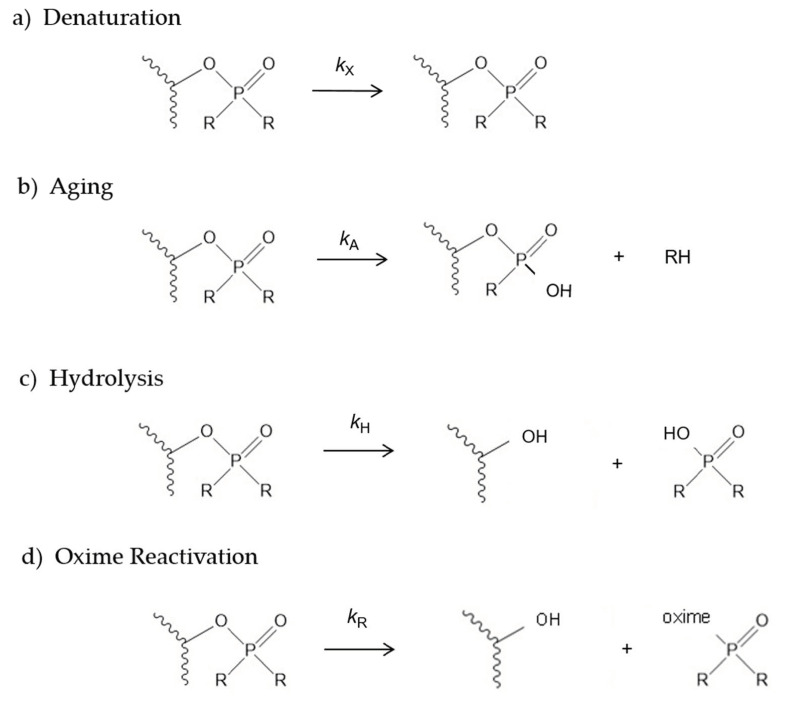
Organophosphates (OPs) are esters of substituted phosphates, phosphonates or phosphoramidates that react with acetylcholinesterase (AChE) by initially transferring the organophosphityl group to a serine residue in the enzyme active site, concomitant with loss of an alcohol or halide leaving group. With substituted phosphates, this transfer is followed by relatively slow hydrolysis of the organophosphoryl AChE, or dephosphorylation, that is often accompanied by an aging reaction that renders the enzyme irreversibly inactivated. Aging is a dealkylation that converts the phosphate triester to a diester. OPs are very effective AChE inhibitors and have been developed as insecticides and chemical warfare agents. We examined three reactions of two organophosphoryl AChEs, dimethyl- and diethylphosphorylated AChE, by comparing rate constants and solvent deuterium oxide isotope effects for hydrolysis, aging and oxime reactivation with pralidoxime (2-PAM). Our study was motivated (1) by a published x-ray crystal structure of diethylphosphorylated AChE, which showed severe distortion of the active site that was restored by the binding of pralidoxime, and (2) by published isotope effects for decarbamoylation that decreased from 2.8 for -monomethylcarbamoyl AChE to 1.1 for ,-diethylcarbamoyl AChE. We previously reconciled these results by proposing a shift in the rate-limiting step from proton transfer for the small carbamoyl group to a likely conformational change in the distorted active site of the large carbamoyl enzyme. This proposal was tested but was not supported in this report. The smaller dimethylphosphoryl AChE and the larger diethylphosphoryl AChE gave similar isotope effects for both oxime reactivation and hydrolysis, and the isotope effect values of about two indicated that proton transfer was rate limiting for both reactions.
有机磷化合物 (OPs) 是取代的磷酸酯、膦酸酯或磷酰胺酯,它们通过最初将有机磷酰基转移到酶活性部位的丝氨酸残基上与乙酰胆碱酯酶 (AChE) 反应,同时失去醇或卤化物离去基团。对于取代的磷酸酯,这种转移随后是有机磷酰化 AChE 的相对缓慢水解,或去磷酸化,通常伴随着使酶不可逆失活的老化反应。老化是一种脱烷基化反应,将磷酸三酯转化为二酯。OPs 是非常有效的 AChE 抑制剂,已被开发为杀虫剂和化学战剂。我们通过比较水解、老化和肟再激活的速率常数和溶剂氘氧化物同位素效应,研究了两种有机磷酰化 AChE(二甲基和二乙基磷酸化 AChE)的三个反应,并用羟肟酸(2-PAM)。我们的研究动机是:(1)发表的二乙基磷酸化 AChE 的 X 射线晶体结构显示出活性部位的严重扭曲,这种扭曲通过羟肟酸的结合得到了恢复,(2)发表的脱羧酰胺化的同位素效应从 - 单甲基碳酰基 AChE 的 2.8 降低到 , - 二乙基碳酰基 AChE 的 1.1。我们之前通过提出从小碳酰基组的质子转移到较大碳酰基酶扭曲的活性部位的可能构象变化,将限速步骤从质子转移转移到限速步骤,从而调和了这些结果。这一建议在本报告中没有得到验证。较小的二甲基磷酸化 AChE 和较大的二乙基磷酸化 AChE 对肟再激活和水解都有相似的同位素效应,约为 2 的同位素效应值表明质子转移是这两种反应的限速步骤。