Division of Epidemiology, Department of Population and Quantitative Health Sciences, University of Massachusetts Medical School, 368 Plantation Street, Worcester, MA, 01605, USA.
Sherman Center, University of Massachusetts Medical School, 55 Lake Avenue North, 6th floor, Worcester, MA, 01655, USA.
BMC Fam Pract. 2020 Sep 29;21(1):204. doi: 10.1186/s12875-020-01274-y.
The average delay in diagnosis for patients with axial spondyloarthritis (axSpA) is 7 to 10 years. Factors that contribute to this delay are multifactorial and include the lack of diagnostic criteria (although classification criteria exist) for axSpA and the difficulty in distinguishing inflammatory back pain, a key symptom of axSpA, from other highly prevalent forms of low back pain. We sought to describe reasons for diagnostic delay for axSpA provided by primary care physicians.
We conducted a qualitative research study which included 18 US primary care physicians, balanced by gender. Physicians provided informed consent to participate in an in-depth interview (< 60 min), conducted in person (n = 3) or over the phone (n = 15), in 2019. The analysis focuses on thoughts about factors contributing to diagnostic delay in axSpA.
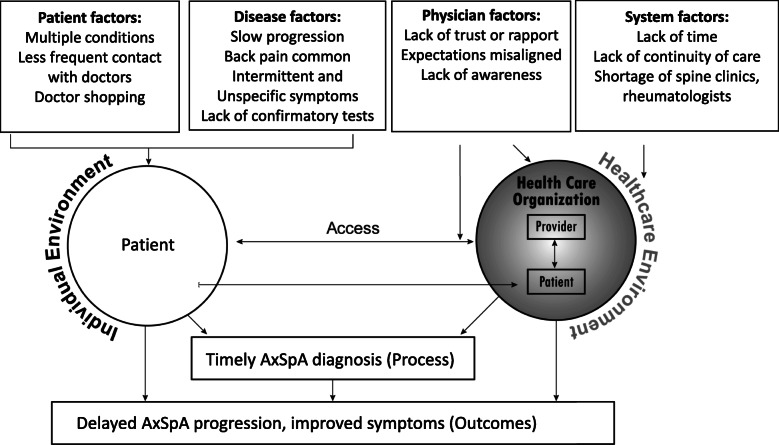
Physicians noted that the disease characteristics contributing to diagnostic delay include: back pain is common and axSpA is less prevalent, slow progression of axSpA, intermittent nature of axSpA pain, and in the absence of abnormal radiographs of the spine or sacroiliac joints, there is no definitive test for axSpA. Patient characteristics believed to contribute to diagnostic delay included having multiple conditions in need of attention, infrequent interactions with the health care system, and "doctor shopping." Doctors noted that patients wait until the last moments of the clinical encounter to discuss back pain. Problematic physician characteristics included lack of rapport with patients, lack of setting appropriate expectations, and attribution of back pain to other factors. Structural/system issues included short appointments, lack of continuity of care, insufficient insurance coverage for tests, lack of back pain clinics, and a shortage of rheumatologists.
Primary care physicians agreed that lengthy axSpA diagnosis delays are challenging to address owing to the multifactorial causes (e.g., disease characteristics, patient characteristics, lack of definitive tests, system factors).
强直性脊柱炎(axSpA)患者的平均诊断延误时间为 7 至 10 年。导致这种延误的因素是多方面的,包括缺乏 axSpA 的诊断标准(尽管存在分类标准),以及难以区分炎症性背痛,这是 axSpA 的一个关键症状,与其他高发形式的腰痛区分开来。我们旨在描述初级保健医生对 axSpA 诊断延误的原因。
我们进行了一项定性研究,其中包括 18 名美国初级保健医生,按性别均衡分配。医生同意参与深入访谈(<60 分钟),并提供了知情同意书,访谈于 2019 年进行,访谈方式为面对面(n=3)或电话(n=15)。分析重点是关于导致 axSpA 诊断延误的因素的想法。
医生指出,导致诊断延误的疾病特征包括:背痛很常见,axSpA 不太常见;axSpA 进展缓慢;axSpA 疼痛呈间歇性;并且在没有脊柱或骶髂关节异常射线照片的情况下,没有 axSpA 的明确诊断测试。被认为导致诊断延误的患者特征包括有多种需要关注的疾病、与医疗保健系统的互动不频繁、以及“频繁更换医生”。医生指出,患者在临床就诊的最后时刻才讨论背痛。有问题的医生特征包括与患者缺乏融洽关系、缺乏适当的期望设定、以及将背痛归因于其他因素。结构/系统问题包括预约时间短、缺乏连续性护理、测试的保险覆盖不足、缺乏腰痛诊所以及风湿病专家短缺。
初级保健医生一致认为,由于多方面的原因(例如疾病特征、患者特征、缺乏明确的测试、系统因素),冗长的 axSpA 诊断延误难以解决。