Transplantation Center, The Third Xiangya Hospital, Central South University, No. 138 Tongzipo Road, Changsha, Hunan, 410013, P. R. China.
SING Lab, The Hong Kong University of Science and Technology, Hong Kong, P. R. China.
J Transl Med. 2020 Sep 29;18(1):370. doi: 10.1186/s12967-020-02542-2.
Kidney transplantation is the optimal treatment to cure the patients with end-stage renal disease (ESRD). However, the infectious complication, especially pneumonia, is the main cause of mortality in the early stage. Immune monitoring by relevant biomarkers provides direct evidence of immune status. We aimed to study the association between immune monitoring and pneumonia in kidney transplant patients through machine learning models.
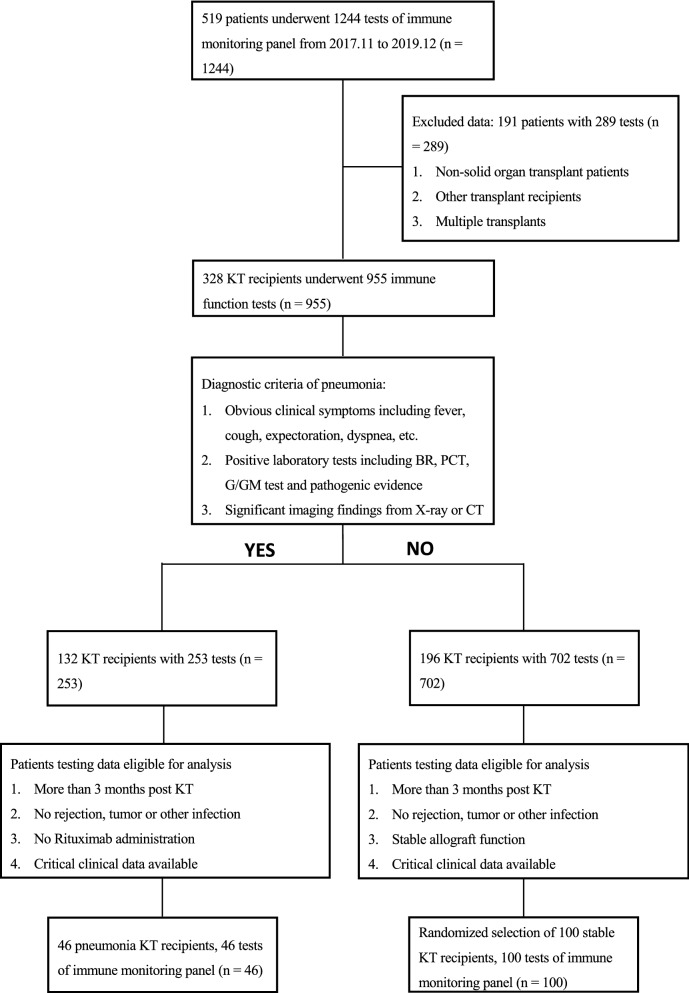
A total of 146 patients receiving the immune monitoring panel in our center, including 46 pneumonia recipients and 100 stable recipients, were retrospectively reviewed to develop the models. All the models were validated by external data containing 10 pneumonia recipients and 32 stable recipients. The immune monitoring panel consisted of the percentages and absolute cell counts of CD3CD4 T cells, CD3CD8 T cells, CD19 B cells and natural killer (NK) cells, and median fluorescence intensity (MFI) of human leukocyte antigen (HLA)-DR on monocytes and CD64 on neutrophils. The machine learning models including support vector machine (SVM), logistic regression (LR), multi-layer perceptron (MLP) and random forest (RF) were applied for analysis.
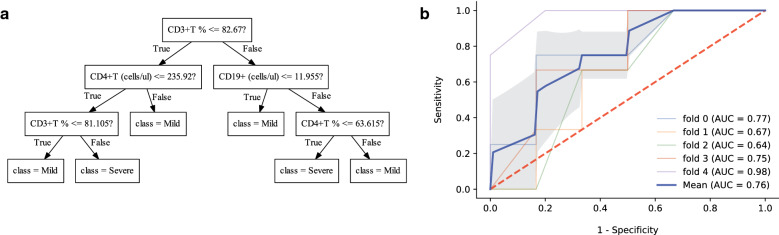
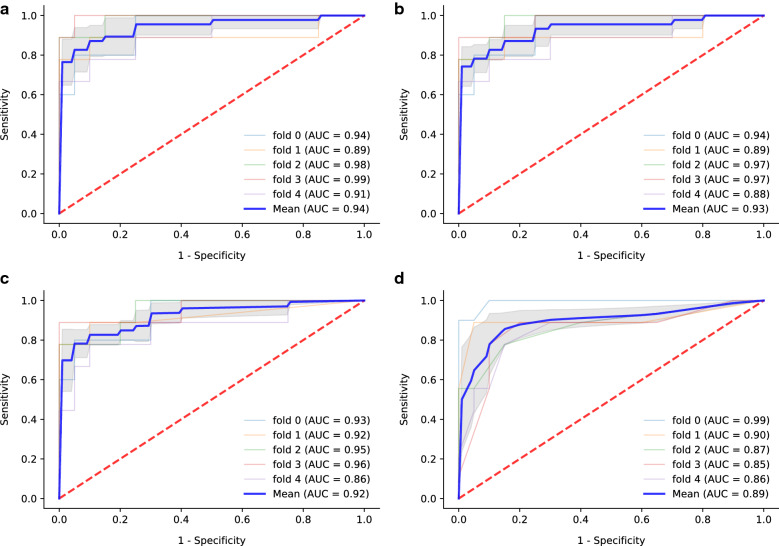
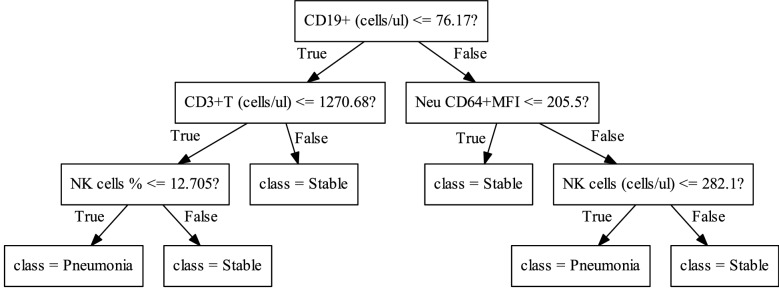
The pneumonia and stable groups showed significant difference in cell counts of each subpopulation and MFI of monocyte HLA-DR and neutrophil CD64. The SVM model by monocyte HLA-DR (MFI), neutrophil CD64 (MFI), CD8 T cells (cells/μl), NK cells (cell/μl) and TBNK (T cells, B cells and NK cells, cells/μl) had the best performance with the average area under the curve (AUC) of 0.940. The RF model best predicted the patients who would progress into severe pneumonia, with the average AUC of 0.760. All the models had good performance validated by external data.
The immune monitoring panel was tightly associated with pneumonia in kidney transplant recipients. The models developed by machine learning techniques identified patients at risk and predicted the prognosis. Based on the results of immune monitoring, better individualized therapy might be achieved.
肾移植是治疗终末期肾病(ESRD)患者的最佳方法。然而,感染并发症,特别是肺炎,是早期死亡的主要原因。通过相关生物标志物进行免疫监测为免疫状态提供了直接证据。我们旨在通过机器学习模型研究肾移植患者免疫监测与肺炎之间的关系。
回顾性分析了我院接受免疫监测面板的 146 例患者,其中肺炎患者 46 例,稳定患者 100 例,用于建立模型。所有模型均通过包含 10 例肺炎患者和 32 例稳定患者的外部数据进行验证。免疫监测面板包括 CD3CD4 T 细胞、CD3CD8 T 细胞、CD19 B 细胞和自然杀伤(NK)细胞的百分比和绝对细胞计数,以及单核细胞 HLA-DR 的中荧光强度(MFI)和中性粒细胞 CD64。应用支持向量机(SVM)、逻辑回归(LR)、多层感知机(MLP)和随机森林(RF)等机器学习模型进行分析。
肺炎组和稳定组各亚群细胞计数和单核细胞 HLA-DR、中性粒细胞 CD64 的 MFI 存在显著差异。单核细胞 HLA-DR(MFI)、中性粒细胞 CD64(MFI)、CD8 T 细胞(细胞/μl)、NK 细胞(细胞/μl)和 TBNK(T 细胞、B 细胞和 NK 细胞,细胞/μl)的 SVM 模型具有最佳性能,平均 AUC 为 0.940。RF 模型对进展为重症肺炎的患者具有最佳预测能力,平均 AUC 为 0.760。所有模型在外部数据验证中均具有良好的性能。
免疫监测面板与肾移植受者肺炎密切相关。机器学习技术建立的模型可识别有风险的患者,并预测预后。基于免疫监测结果,可能实现更好的个体化治疗。