Faculty of Science and Technology, Free University of Bolzano, 39100, Bolzano, Italy.
Sci Rep. 2020 Sep 29;10(1):15970. doi: 10.1038/s41598-020-72904-9.
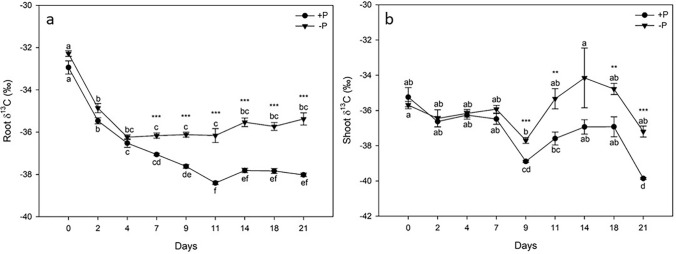
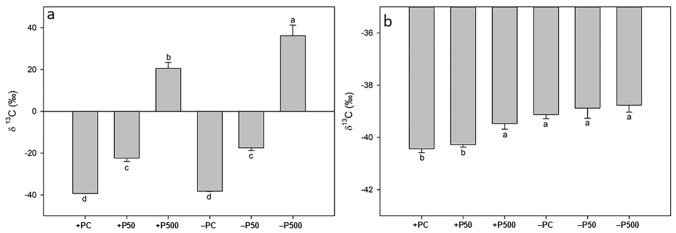
Plant roots are able to exude vast amounts of metabolites into the rhizosphere in response to phosphorus (P) deficiency. Causing noteworthy costs in terms of energy and carbon (C) for the plants. Therefore, it is suggested that exudates reacquisition by roots could represent an energy saving strategy of plants. This study aimed at investigating the effect of P deficiency on the ability of hydroponically grown tomato plants to re-acquire specific compounds generally present in root exudates by using C-labelled molecules. Results showed that P deficient tomato plants were able to take up citrate (+ 37%) and malate (+ 37%), particularly when compared to controls. While glycine (+ 42%) and fructose (+ 49%) uptake was enhanced in P shortage, glucose acquisition was not affected by the nutritional status. Unexpectedly, results also showed that P deficiency leads to a C enrichment in both tomato roots and shoots over time (shoots-+ 2.66‰, roots-+ 2.64‰, compared to control plants), probably due to stomata closure triggered by P deficiency. These findings highlight that tomato plants are able to take up a wide range of metabolites belonging to root exudates, thus maximizing C trade off. This trait is particularly evident when plants grew in P deficiency.
植物根系能够在受到磷(P)缺乏的情况下,向根际分泌大量代谢物。这对植物的能量和碳(C)消耗造成了显著的成本。因此,有人认为根系重新吸收代谢物可能是植物的一种节能策略。本研究旨在调查 P 缺乏对水培番茄植物重新获取通常存在于根系分泌物中的特定化合物的能力的影响,使用 C 标记的分子。结果表明,与对照相比,缺磷的番茄植物能够吸收柠檬酸(+37%)和苹果酸(+37%)。而甘氨酸(+42%)和果糖(+49%)的吸收在 P 短缺时增强,但葡萄糖的吸收不受营养状况的影响。出乎意料的是,结果还表明,随着时间的推移,P 缺乏会导致番茄的根和地上部分中的 C 富集(地上部分+2.66‰,根+2.64‰,与对照植物相比),可能是由于 P 缺乏导致气孔关闭。这些发现强调了番茄植物能够吸收广泛的属于根系分泌物的代谢物,从而最大限度地减少 C 的交换。当植物在 P 缺乏的情况下生长时,这种特性尤为明显。