Therapeutics Initiative, Drug Assessment Working Group, University of British Columbia, Vancouver, Canada.
Department of Anesthesiology, Pharmacology & Therapeutics, Faculty of Medicine, University of British Columbia, Vancouver, Canada.
Pharmacol Res Perspect. 2020 Oct;8(5):e00651. doi: 10.1002/prp2.651.
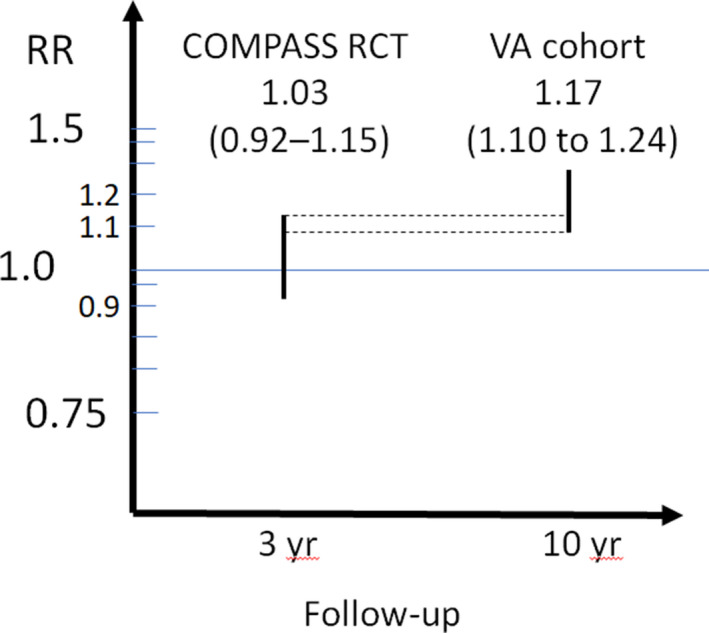
Proton pump inhibitors (PPIs) were primarily approved for short-term use (2 to 8 weeks). However, PPI use continues to expand. Widely believed to be safe, we reviewed emerging evidence on increased mortality with PPI long-term use. Our 2016 systematic PPI drug class review found that mortality was not reported as an outcome in randomized controlled trials (RCTs) that directly compared different PPIs. We sought more recent and comprehensive data on PPI harm outcomes from research syntheses as a follow-on. A search was conducted from January 2014 to January 2020. We searched MEDLINE, EMBASE, and Cochrane Central for evidence from systematic reviews (SRs) and primary studies reporting all-cause mortality in adults treated with a PPI for any indication (duration >12 weeks) compared to patients without PPI treatment (no use, placebo, or H2RA use). Two independent investigators assessed study eligibility, synthesized evidence, and assessed the quality of the included studies. Data on all-cause mortality were sought, analyzed, critically examined, and interpreted herein. From 1304 articles, one SR was identified that reported on all-cause mortality. The SRs pooled three observational studies with data to 1 year: odds ratio, 95% confidence interval (CI) 1.53-1.84. A RCT, the COMPASS (Cardiovascular Outcomes for People Using Anticoagulant Strategies) RCT with data to 3 years: hazard ratio (HR) 1.03, 95% CI 0.92-1.15. The US Veterans Affairs cohort study using a large national dataset with data to 10 years found a HR of 1.17, 95% CI (1.10-1.24) and (NNH) of 22. The most common causes of death were from cardiovascular and chronic kidney diseases, with an excess death of 15 and 4 per 1000 patients, respectively, over the 10-year period. Harms arising from real-world medication use are best evaluated using a pharmacovigilance "convergence of proof" approach using data from a variety of sources and various study designs. Given that most PPI indications for use recommended a treatment duration of less than 12 weeks, it seems clear that PPIs were significantly overused in older patients. The median exposure time to PPI ranged from 1 to 4.6 years. Signals of serious harms including increased mortality with long-term PPI use are reported in observational studies. The COMPASS trial findings are not inconsistent with contemporaneous findings from observational studies. The COMPASS RCT was unlikely to detect an increase in mortality given the trial was not powered to detect this outcome. The potential increase in mortality in older patients associated with prolonged PPI exposure needs to be conveyed to health professionals. Clinicians and patients may be able to reverse the relentless expansion of long-term PPI exposure by reviewing indications and considering potential harms as well as benefits.
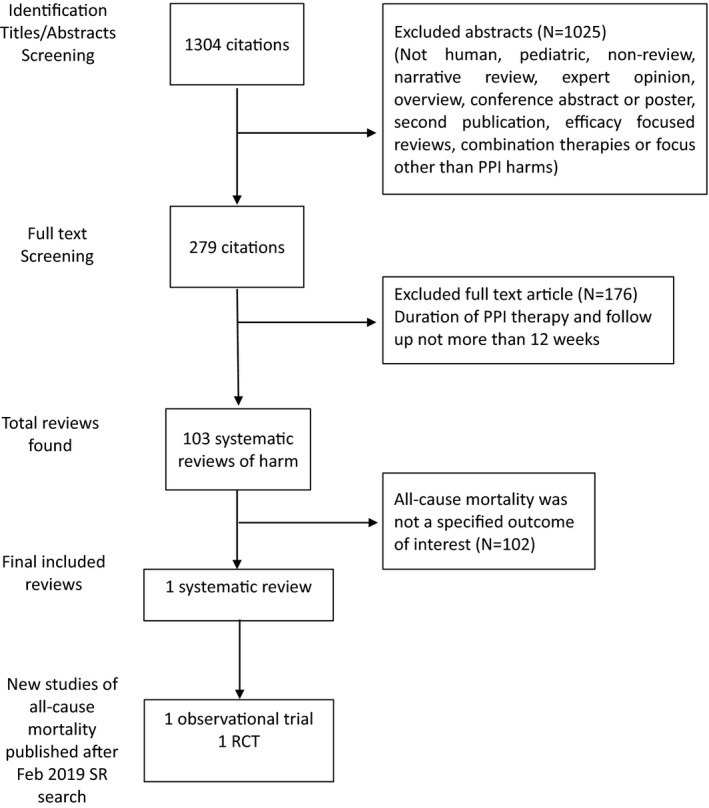
质子泵抑制剂 (PPIs) 最初被批准用于短期使用(2 至 8 周)。然而,PPI 的使用仍在继续扩大。由于广泛认为它们是安全的,我们审查了 PPI 长期使用与死亡率增加相关的新出现的证据。我们 2016 年的质子泵抑制剂药物类别系统评价发现,随机对照试验 (RCT) 并未将死亡率作为直接比较不同 PPI 的结果进行报告。因此,我们作为后续工作,从研究综合中寻找关于 PPI 危害结果的最新和更全面的数据。从 2014 年 1 月至 2020 年 1 月进行了搜索。我们在 MEDLINE、EMBASE 和 Cochrane Central 中搜索了系统评价 (SR) 和初级研究的证据,这些研究报告了在任何适应症(持续时间> 12 周)下接受 PPI 治疗的成年人与未接受 PPI 治疗的患者(未使用、安慰剂或 H2RA 治疗)的全因死亡率。两名独立的调查员评估了研究的合格性、综合证据,并评估了纳入研究的质量。本文旨在寻求和分析全因死亡率数据,并对其进行批判性评估和解释。从 1304 篇文章中,确定了一篇报告全因死亡率的 SR。该 SR 汇总了三项观察性研究的数据,随访时间为 1 年:比值比,95%置信区间(CI)为 1.53-1.84。一项 RCT,即 COMPASS(抗凝策略人群的心血管结局)RCT,随访时间为 3 年:风险比(HR)为 1.03,95%CI 为 0.92-1.15。一项使用大型全国数据集的美国退伍军人事务队列研究,随访时间为 10 年,发现 HR 为 1.17,95%CI(1.10-1.24)和(NNH)为 22。最常见的死亡原因是心血管疾病和慢性肾病,在 10 年期间,每 1000 名患者中分别有 15 名和 4 名患者因该疾病而过早死亡。最好使用来自各种来源和各种研究设计的数据的药物警戒“证据汇聚”方法来评估来自真实世界药物使用的危害。鉴于大多数 PPI 推荐的使用期限少于 12 周,因此 PPI 在老年患者中的使用显然过多。PPI 的中位暴露时间为 1 至 4.6 年。观察性研究报告了长期使用 PPI 会出现严重危害的信号,包括死亡率增加。COMPASS 试验的结果与同期观察性研究的结果并不矛盾。由于该试验没有检测到死亡率增加的功效,因此不太可能检测到 COMPASS RCT 中死亡率的增加。与长期 PPI 暴露相关的老年患者潜在的死亡率增加需要向医疗保健专业人员传达。临床医生和患者可以通过审查适应症并考虑潜在的危害和益处,来扭转长期 PPI 暴露的无休止扩张。