Department of Physiology, Michigan State University, East Lansing, Michigan.
Department of Anesthesiology, The Wexner Medical Center, The Ohio State University, Columbus, Ohio.
Am J Physiol Gastrointest Liver Physiol. 2020 Dec 1;319(6):G655-G668. doi: 10.1152/ajpgi.00041.2020. Epub 2020 Sep 30.
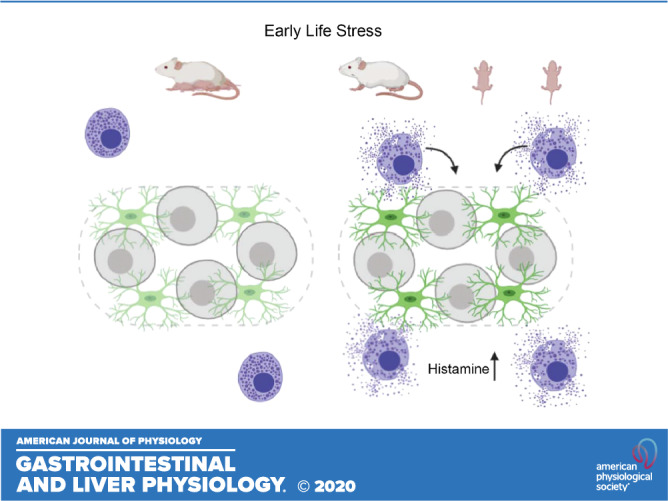
Early-life adversity contributes to the development of functional bowel disorders later in life through unresolved mechanisms. Here, we tested the hypothesis that early-life adversity alters anatomical and functional interactions between mast cells and enteric glia. The effects of early-life stress were studied using the neonatal maternal separation (NMS) stress mouse model. Anatomical relationships between mast cells and enteric glia were assessed using immunohistochemistry and mast cell reporter mice (;). Immunohistochemistry was used to assess the expression of histamine, histamine 1 (H1) receptors, and glial fibrillary acidic protein. Functional responses of glia to mast cell mediators were assessed in calcium imaging experiments using ; mice and cultured human enteric glial cells. NMS increases mast cell numbers at the level of the myenteric plexus and their proximity to myenteric ganglia. Myenteric glia respond to mediators released by activated mast cells that are blocked by H1 receptor antagonists in mice and humans and by blocking neuronal activity with tetrodotoxin in mouse tissue. Histamine replicates the effects of mast cell supernatants on enteric glia, and NMS increases histamine production by mast cells. NMS reduces glial responses to mast cell mediators in mouse tissue, while potentiating responses in cultured human enteric glia. NMS increases myenteric glial fibrillary acidic protein expression and reduces glial process length but does not cause neurodegeneration. Histamine receptor expression is not altered by NMS and is localized to neurons in mice, but glia in humans. Early-life stress increases the potential for interactions between enteric glia and mast cells, and histamine is a potential mediator of mast cell-glial interactions through H1 receptors. We propose that glial-mast cell signaling is a mechanism that contributes to enteric neuroplasticity driven by early-life adversity. Early-life adversity places an individual at risk for developing functional gastrointestinal disorders later in life through unknown mechanisms. Here, we show that interactions between mast cells and glia are disrupted by early-life stress in mice and that histamine is a potential mediator of mast cell-glial interactions.
早期生活逆境通过未解决的机制导致生命后期功能性肠病的发展。在这里,我们测试了以下假设,即早期生活逆境会改变肥大细胞和肠神经胶质之间的解剖和功能相互作用。使用新生期母体分离(NMS)应激小鼠模型研究早期生活应激的影响。使用肥大细胞报告小鼠()和免疫组织化学评估肥大细胞与肠神经胶质之间的解剖关系。免疫组织化学用于评估组胺、组胺 1(H1)受体和神经胶质纤维酸性蛋白的表达。使用;和培养的人肠神经胶质细胞在钙成像实验中评估神经胶质对肥大细胞介质的功能反应。NMS 增加了肌间神经丛水平的肥大细胞数量及其与肌间神经节的接近程度。肌间神经胶质对被 H1 受体拮抗剂阻断的激活肥大细胞释放的介质以及用河豚毒素阻断神经元活性的反应在小鼠组织中。组胺复制了肥大细胞上清液对肠神经胶质的作用,并且 NMS 增加了肥大细胞产生的组胺。NMS 减少了小鼠组织中神经胶质对肥大细胞介质的反应,而在培养的人肠神经胶质中增强了反应。NMS 增加了肌间神经胶质纤维酸性蛋白的表达并减少了神经胶质突起的长度,但不会引起神经退行性变。NMS 不改变组胺受体表达,并且在小鼠中定位于神经元,但在人类中定位于神经胶质。早期生活应激增加了肠神经胶质和肥大细胞之间相互作用的潜力,并且组胺是通过 H1 受体介导肥大细胞-神经胶质相互作用的潜在介质。我们提出,神经胶质-肥大细胞信号是由早期生活逆境驱动的肠神经可塑性的一种机制。早期生活逆境通过未知机制增加了个体在生命后期发展功能性胃肠道疾病的风险。在这里,我们表明,肥大细胞和神经胶质之间的相互作用在小鼠中被早期生活应激破坏,并且组胺是肥大细胞-神经胶质相互作用的潜在介质。