Center of Cardiology, Beijing Chaoyang Hospital, Beijing, People's Republic of China.
Thorac Cardiovasc Surg. 2021 Sep;69(6):511-517. doi: 10.1055/s-0040-1716390. Epub 2020 Sep 30.
The present study aimed to compare the effectiveness and safety of low molecular-weight-heparin (LMWH) and unfractionated heparin (UFH) in acute myocardial infarction (AMI) patients receiving intra-aortic balloon counterpulsation (IABP).
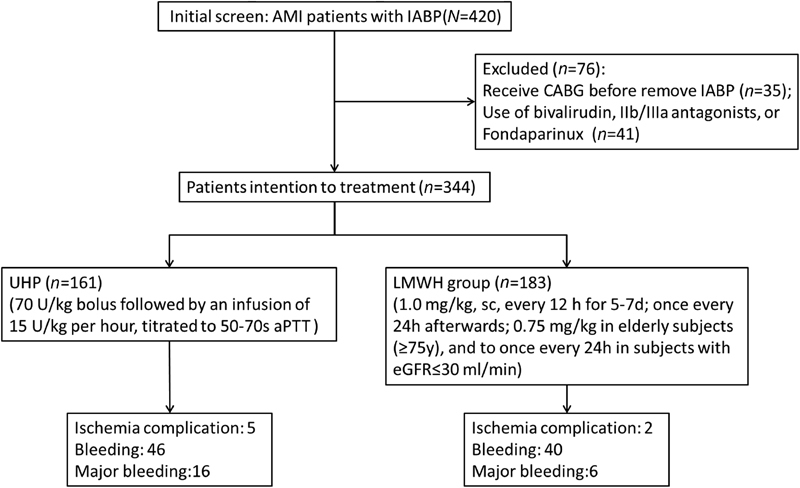
We retrospectively analyzed a total of 344 patients receiving IABP for cardiogenic shock, severe heart failure, ventricular septal rupture, or mitral valve prolapse due to AMI. A total of 161 patients received UFH (a bolus injection 70 U/kg immediately after IABP, followed by infusion at a rate of 15 U/kg/hour and titration to for 50 to 70 seconds of activated partial thromboplastin time. A total of 183 patients received LMWH (subcutaneous injection of 1.0 mg/kg every 12 hours for 5 to 7 days and 1.0 mg/kg every 24 hours thereafter). Events of ischemia, arterial thrombosis or embolism, and bleeding during IABP were evaluated. Major bleeding was defined as a hemoglobin decrease by >50 g/L (vs. prior to IABP) or bleeding that caused hemodynamic shock or life-threatening or requiring blood transfusion.
Subjects receiving UFH and LMWH did not differ in baseline characteristics. Ischemia was noted in five (3.1%) and two (1.1%) subjects in UFH and LMWH groups, respectively. Arterial thromboembolism occurred in three (1.9%) subjects in the UFH group, but not in the LMWH group. Logistic regression analysis failed to reveal an association between ischemia or bleeding with heparin type. Major bleeding occurred in 16 (9.9%) and six (3.3%) patients in the UFH and LWMH groups, respectively ( = 0.014). Regression analysis indicated that LMWH is associated with less major bleeding.
LMWH could reduce the risk of major bleeding in patients receiving IABP. Whether LMWH could reduce arterial thromboembolism needs further investigation.
本研究旨在比较急性心肌梗死(AMI)患者接受主动脉内球囊反搏(IABP)治疗时,低分子肝素(LMWH)和普通肝素(UFH)的有效性和安全性。
我们回顾性分析了 344 例因 AMI 导致心源性休克、严重心力衰竭、室间隔破裂或二尖瓣脱垂而接受 IABP 治疗的患者。其中 161 例患者接受 UFH(IABP 后立即给予 70 U/kg 的负荷剂量,随后以 15 U/kg/h 的速度输注,并将活化部分凝血活酶时间调整至 50-70 秒),183 例患者接受 LMWH(皮下注射 1.0mg/kg,每 12 小时 1 次,持续 5-7 天,然后每 24 小时 1 次)。评估 IABP 期间缺血、动脉血栓形成或栓塞和出血事件。大出血定义为血红蛋白下降>50g/L(与 IABP 前相比)或出血导致血流动力学休克或危及生命或需要输血。
接受 UFH 和 LMWH 的患者在基线特征上没有差异。UFH 和 LMWH 组分别有 5(3.1%)和 2(1.1%)例患者发生缺血。UFH 组有 3(1.9%)例患者发生动脉血栓栓塞,但 LMWH 组无此事件。Logistic 回归分析未发现肝素类型与缺血或出血之间存在关联。UFH 和 LMWH 组分别有 16(9.9%)和 6(3.3%)例患者发生大出血(=0.014)。回归分析表明,LMWH 与大出血风险降低相关。
LMWH 可降低接受 IABP 治疗的患者大出血风险。LMWH 是否可降低动脉血栓栓塞的风险需要进一步研究。