Nuffield Department of Clinical Neurosciences, University of Oxford, Oxford, United Kingdom.
Department of Psychology, University of Cambridge, Cambridge, United Kingdom.
Elife. 2020 Oct 1;9:e58321. doi: 10.7554/eLife.58321.
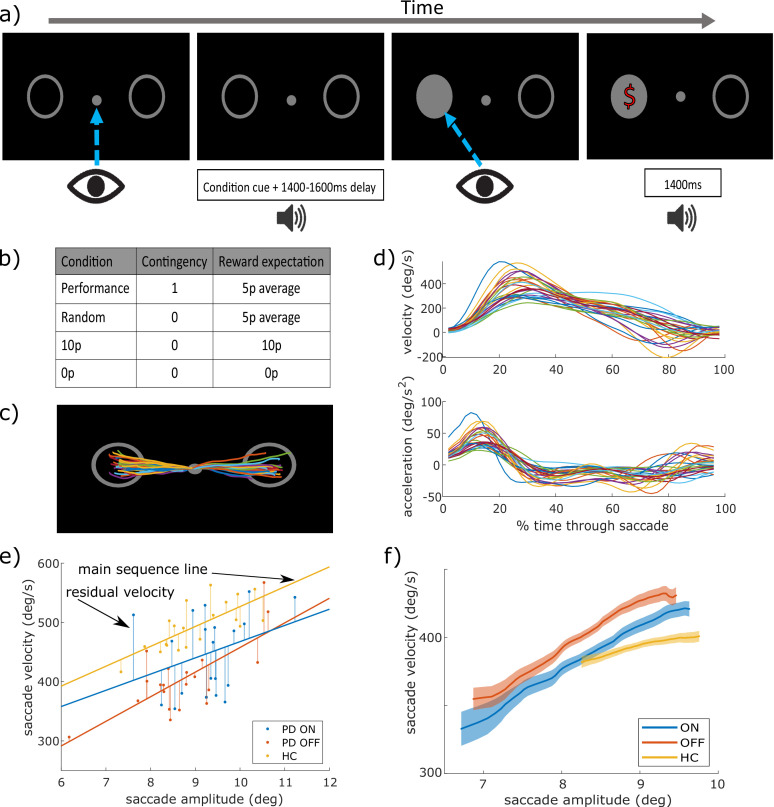
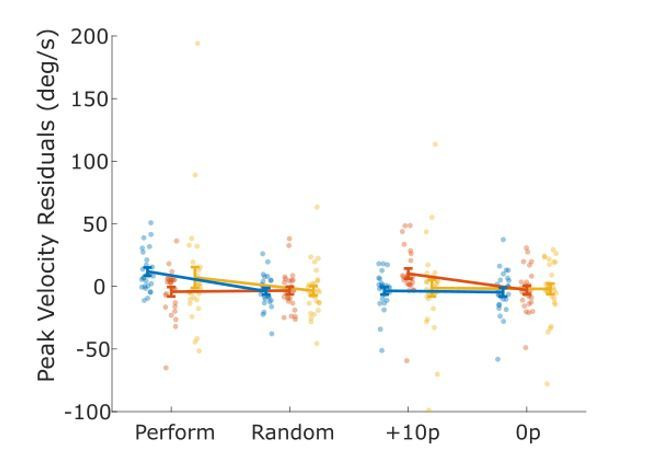
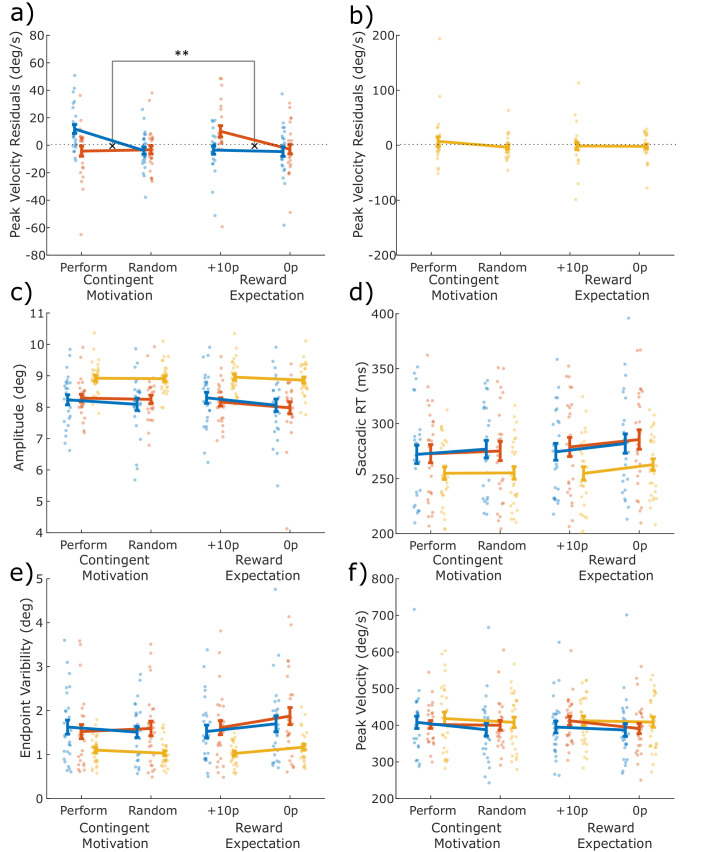
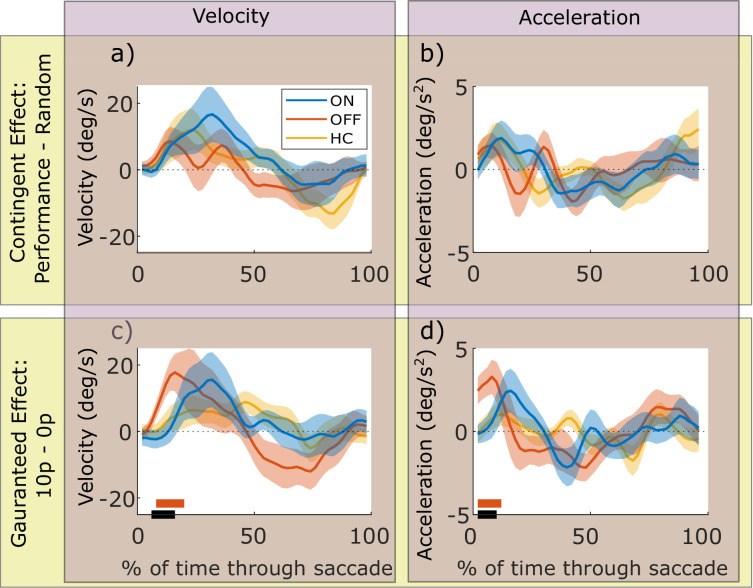
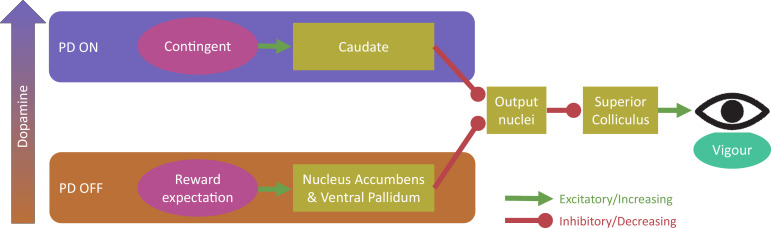
We can be motivated when reward depends on performance, or merely by the prospect of a guaranteed reward. Performance-dependent (contingent) reward is instrumental, relying on an internal action-outcome model, whereas motivation by guaranteed reward may minimise opportunity cost in reward-rich environments. Competing theories propose that each type of motivation should be dependent on dopaminergic activity. We contrasted these two types of motivation with a rewarded saccade task, in patients with Parkinson's disease (PD). When PD patients were ON dopamine, they had greater response vigour (peak saccadic velocity residuals) for rewards, whereas when PD patients were OFF medication, they had greater vigour for rewards. These results support the view that reward expectation and contingency drive distinct motivational processes, and can be dissociated by manipulating dopaminergic activity. We posit that dopamine promotes goal-directed motivation, but dampens reward-driven vigour, contradictory to the prediction that increased tonic dopamine amplifies reward expectation.
当奖励取决于表现或仅仅是有保证的奖励的前景时,我们可以受到激励。依赖于表现的(有条件的)奖励是工具性的,依赖于内部的行为-结果模型,而通过保证的奖励来激励则可以在奖励丰富的环境中最小化机会成本。竞争理论提出,每种类型的激励都应该依赖于多巴胺能活动。我们使用一个有奖励的扫视任务来对比这两种类型的激励,该任务在帕金森病(PD)患者中进行。当 PD 患者的多巴胺处于 ON 状态时,他们对奖励的反应活力(最大扫视速度残差)更大,而当 PD 患者停药时,他们对 奖励的活力更大。这些结果支持这样的观点,即奖励预期和条件驱动不同的激励过程,可以通过操纵多巴胺能活动来分离。我们假设多巴胺促进目标导向的动机,但抑制了奖励驱动的活力,这与增加的紧张型多巴胺放大奖励预期的预测相矛盾。