Gómez-Limia Lucía, Cutillas Roxana, Carballo Javier, Franco Inmaculada, Martínez Sidonia
Food Technology, Faculty of Science, University Campus as Lagoas s/n, University of Vigo, 32004 Ourense, Spain.
CITACA-Agri-Food Research and Transfer Cluster, Campus Auga, University of Vigo, 32004 Ourense, Spain.
Foods. 2020 Sep 29;9(10):1377. doi: 10.3390/foods9101377.
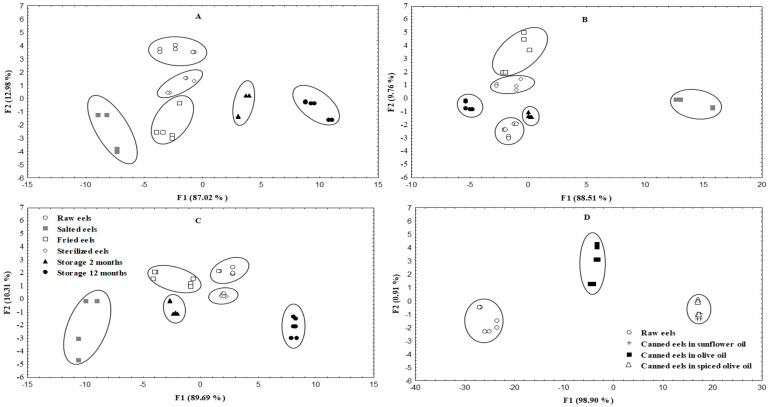
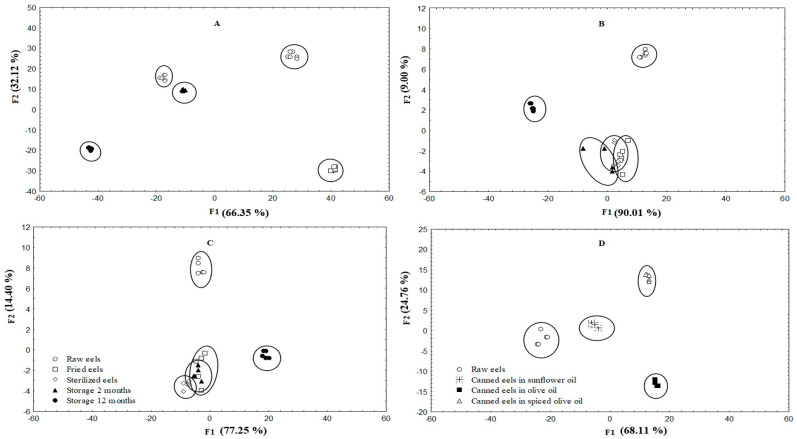
This study evaluated the effects of the canning process and different filling media on the free amino acid and biogenic amine contents of eels. The main free amino acids were histidine, taurine and arginine, which constituted 72% of the free amino acids in raw eels. All steps in the canning process significantly altered the free amino acid content of eels, relative to raw samples. The changes were influenced by the step, the composition of the frying or filling medium and the storage time. The biogenic amine contents were very low in all samples. Histamine was not detected in either raw eels or canned eels. The highest values were obtained for 2-phenylethylamine. The step of the canning process, the composition of the frying or filling medium and storage time also determined the changes in the biogenic amine contents. The biogenic amines indices were low, indicating the good quality of canned eels.
本研究评估了罐装加工过程及不同填充介质对鳗鱼游离氨基酸和生物胺含量的影响。主要的游离氨基酸为组氨酸、牛磺酸和精氨酸,它们占生鳗鱼中游离氨基酸的72%。相对于生鱼样本,罐装加工过程中的所有步骤均显著改变了鳗鱼的游离氨基酸含量。这些变化受加工步骤、油炸或填充介质的成分以及储存时间的影响。所有样本中的生物胺含量都很低。生鳗鱼和罐装鳗鱼中均未检测到组胺。2-苯乙胺的含量最高。罐装加工步骤、油炸或填充介质的成分以及储存时间也决定了生物胺含量的变化。生物胺指标较低,表明罐装鳗鱼质量良好。