Department of Obstetrics and Gynecology, Shengjing Hospital of China Medical University, No. 36, Sanhao Street, Heping District, Shenyang, 110004, China.
Department of Urology, First Hospital of China Medical University, Shenyang, China.
Mol Cancer. 2020 Oct 1;19(1):146. doi: 10.1186/s12943-020-01262-x.
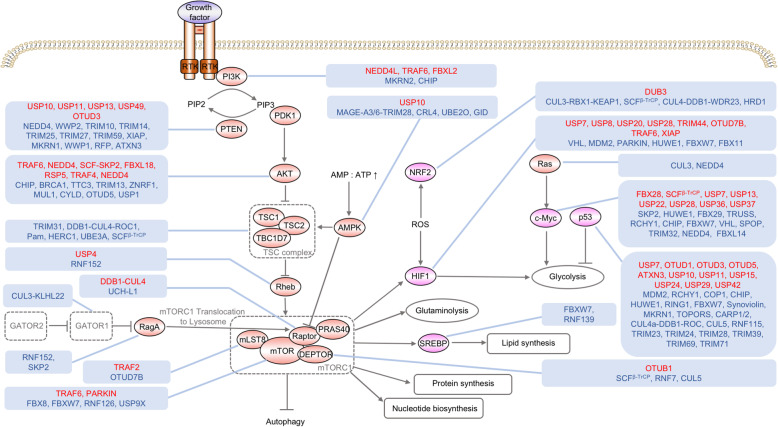
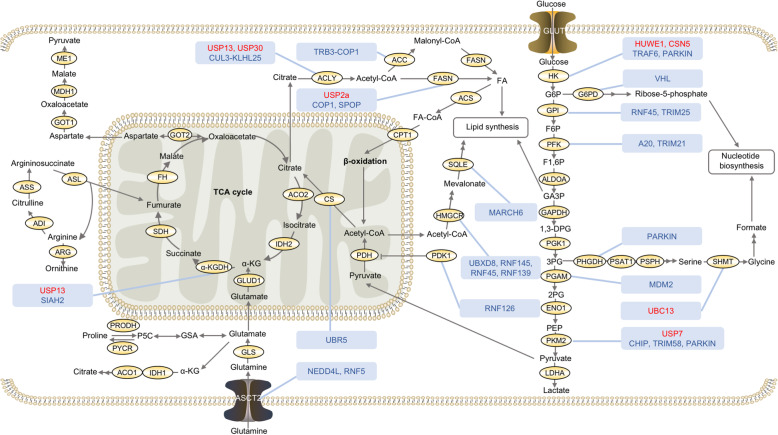
Metabolic reprogramming, including enhanced biosynthesis of macromolecules, altered energy metabolism, and maintenance of redox homeostasis, is considered a hallmark of cancer, sustaining cancer cell growth. Multiple signaling pathways, transcription factors and metabolic enzymes participate in the modulation of cancer metabolism and thus, metabolic reprogramming is a highly complex process. Recent studies have observed that ubiquitination and deubiquitination are involved in the regulation of metabolic reprogramming in cancer cells. As one of the most important type of post-translational modifications, ubiquitination is a multistep enzymatic process, involved in diverse cellular biological activities. Dysregulation of ubiquitination and deubiquitination contributes to various disease, including cancer. Here, we discuss the role of ubiquitination and deubiquitination in the regulation of cancer metabolism, which is aimed at highlighting the importance of this post-translational modification in metabolic reprogramming and supporting the development of new therapeutic approaches for cancer treatment.
代谢重编程,包括大分子生物合成增强、能量代谢改变和氧化还原稳态维持,被认为是癌症的标志,维持着癌细胞的生长。多种信号通路、转录因子和代谢酶参与了癌症代谢的调节,因此,代谢重编程是一个高度复杂的过程。最近的研究观察到,泛素化和去泛素化参与了癌细胞代谢重编程的调节。作为最重要的翻译后修饰之一,泛素化是一个多步骤的酶促过程,参与多种细胞生物学活动。泛素化和去泛素化的失调导致多种疾病,包括癌症。在这里,我们讨论了泛素化和去泛素化在调节癌症代谢中的作用,旨在强调这种翻译后修饰在代谢重编程中的重要性,并为癌症治疗的新治疗方法的发展提供支持。