Division of Nephrology Dialysis and Transplantation, Department of Medical Sciences, Città Della Salute e della Scienza Hospital, University of Turin, Corso Bramante, 88-10126, Turin, Italy.
Laboratory of Nephrology and Immunopathology, Città Della Salute e della Scienza Hospital, Turin, Italy.
Sci Rep. 2020 Oct 1;10(1):16362. doi: 10.1038/s41598-020-73335-2.
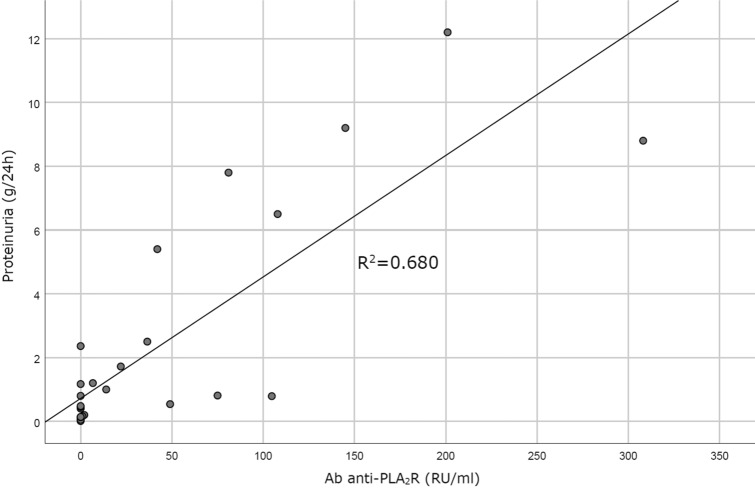
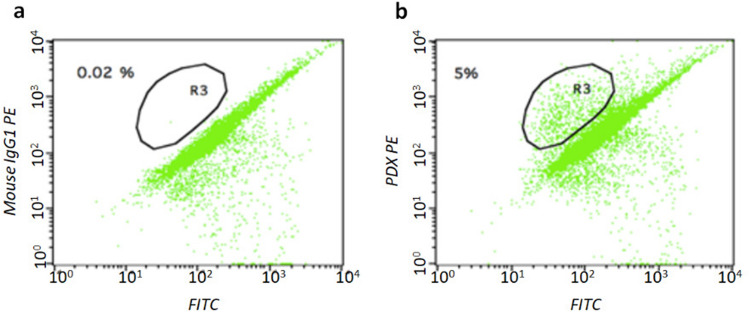
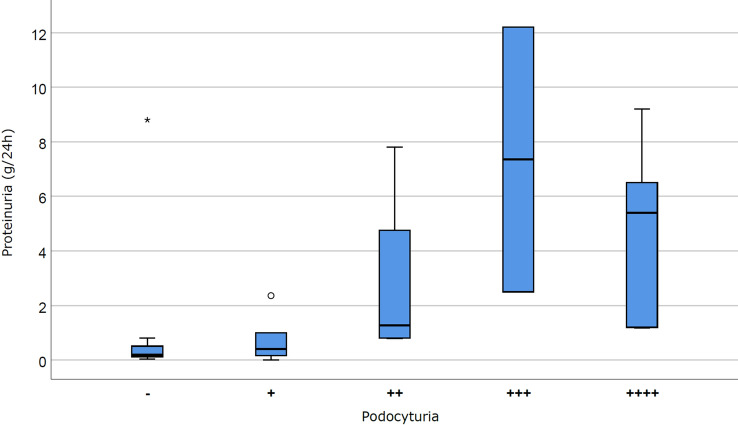
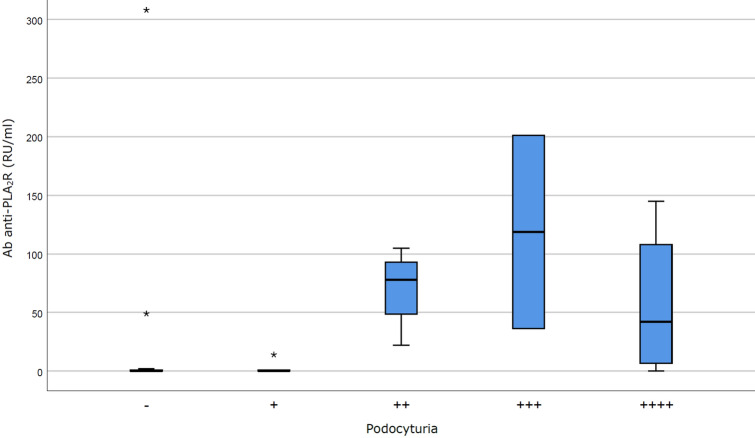
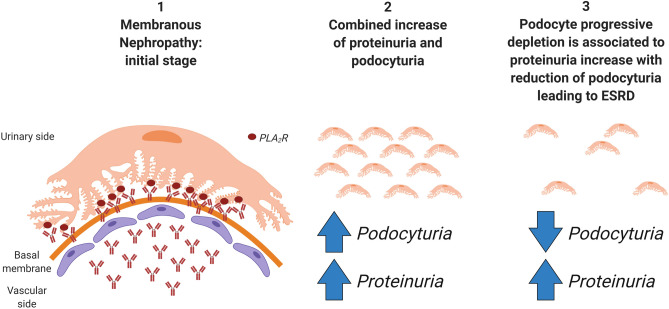
Idiopathic membranous nephropathy (iMN) is considered an immune-mediated disease where circulating autoantibodies against podocyte targets (mainly the PLAR) cause the deposition of in-situ subepithelial immune-complexes. The consequent podocyte damage may cause cell detachment in urine (Podocyturia-PdoU). PdoU has been assessed in different kidney diseases, but limited data are available in iMN. In this study all patients with a diagnosis of iMN between 15/12/1999-16/07/2014 were tested for PLAR antibodies (Ab anti-PLAR, ELISA kit) and PdoU by flow cytometry with anti-podocalyxin antibody. A semi-quantitative PdoU score was defined according to the percentage of podocalyxin positive cells normalized to the total volume of sample and set relative to the urine creatinine measured in the supernatant. PdoU was positive in 17/27 patients (63%; 1+ score in 6/27-22.2%, 2+ in 4/27-14.8%, 3+ in 2/27-7.4%, 4+ in 5/27-18.5%). Only 2/7 patients with complete remission showed a positive PdoU (1+) while all six patients without remission have significant PdoU. PdoU+ was statistically correlated with the absence of remission and Ab anti-PLAR + (p < 0.05) but PdoU, analysed as a continuous variable, showed a non-linear correlation with proteinuria or PLAR antibody levels also in the cohort of patients with two available PdoU tests. In conclusion, PdoU could be detected in iMN and seems to be associated with commonly considered markers of disease activity (proteinuria and Ab anti-PLAR) with a non-linear correlation. Despite data should be confirmed in large and prospective cohorts, according to the podocyte depletion hypothesis PdoU may represent an early marker of immunological activation with potential prognostic utility.
特发性膜性肾病(iMN)被认为是一种免疫介导的疾病,其中循环自身抗体针对足细胞靶标(主要是 PLAR)导致原位上皮下免疫复合物的沉积。随后的足细胞损伤可能导致尿液中的细胞脱落(足细胞尿-PdoU)。已经在不同的肾脏疾病中评估了 PdoU,但在 iMN 中可用的数据有限。在这项研究中,对 1999 年 12 月 15 日至 2014 年 7 月 16 日期间诊断为 iMN 的所有患者进行了 PLAR 抗体(Ab anti-PLAR,ELISA 试剂盒)和通过抗足细胞蛋白抗体的流式细胞术检测 PdoU。根据相对于上清液中测量的尿肌酐归一化的总样本体积,定义了半定量 PdoU 评分,并将其相对于足细胞蛋白阳性细胞的百分比设置为阳性。在 27 例患者中有 17 例(63%)为 PdoU 阳性(1+评分 6/27-22.2%,2+评分 4/27-14.8%,3+评分 2/27-7.4%,4+评分 5/27-18.5%)。仅 2/7 例完全缓解的患者显示 PdoU 阳性(1+),而所有 6 例未缓解的患者均有明显的 PdoU。PdoU+与无缓解呈统计学相关,与 Ab anti-PLAR+相关(p<0.05),但 PdoU 作为连续变量,在具有两个可获得的 PdoU 检测的患者队列中与蛋白尿或 PLAR 抗体水平呈非线性相关。总之,在 iMN 中可以检测到 PdoU,并且似乎与通常考虑的疾病活动标志物(蛋白尿和 Ab anti-PLAR)相关,具有非线性相关性。尽管数据应在大型和前瞻性队列中得到证实,但根据足细胞耗竭假说,PdoU 可能代表免疫激活的早期标志物,具有潜在的预后效用。