Tada Mariko, Suda Yuki, Kirihara Kenji, Koshiyama Daisuke, Fujioka Mao, Usui Kaori, Araki Tsuyoshi, Kasai Kiyoto, Uka Takanori
Department of Neuropsychiatry, Graduate School of Medicine, University of Tokyo, Tokyo, Japan.
International Research Center for Neurointelligence (IRCN), Bunkyo, Japan.
Front Psychiatry. 2020 Aug 26;11:874. doi: 10.3389/fpsyt.2020.00874. eCollection 2020.
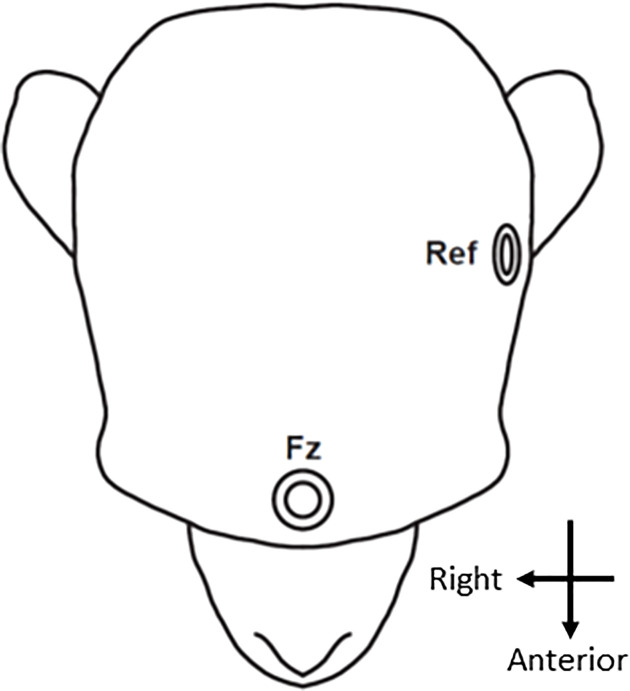
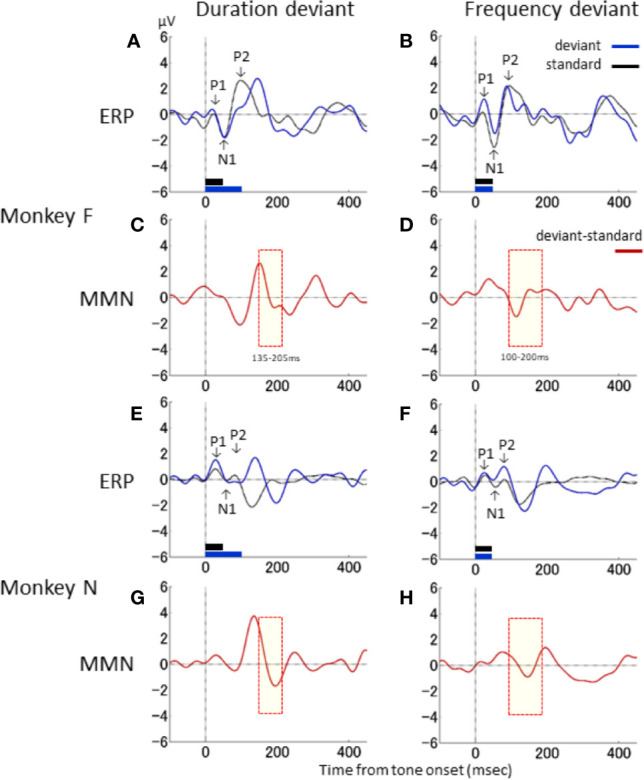
Mismatch negativity (MMN) is a negative deflection of the auditory event-related potential (ERP) elicited by an abrupt change in a sound presented repeatedly. In patients with schizophrenia, MMN is consistently reduced, which makes it a promising biomarker. A non-human primate (NHP) model of MMN based on scalp electroencephalogram (EEG) recordings can provide a useful translational tool, given the high structural homology of the prefrontal and auditory cortices between NHPs, such as macaques, and humans. However, in previous MMN studies, the NHP models used did not allow for comparison with humans because of differences in task settings. Moreover, duration-deviant MMN (dMMN), whose reduction is larger than that in the frequency-deviant MMN (fMMN) in patients with schizophrenia, has never been demonstrated in NHP models. In this study, we determined whether dMMN can be observed in macaque scalp EEG recordings. EEGs were recorded from frontal electrodes (Fz) in two Japanese macaques. Consistent with clinical settings, auditory stimuli consisted of two pure tones, a standard and a deviant tone, in an oddball paradigm. The deviant and standard tones differed in duration (50 and 100 ms for the standard and deviant tones, respectively). A robust dMMN with a latency of around 200 ms, comparable to that in humans, was observed in both monkeys. A comparison with fMMN showed that the dMMN latency was the longer of the two. By bridging the gap between basic and clinical research, our results will contribute to the development of innovative therapeutic strategies for schizophrenia.
失匹配负波(MMN)是由重复呈现的声音突然变化所引发的听觉事件相关电位(ERP)的负向偏转。在精神分裂症患者中,MMN持续降低,这使其成为一种有前景的生物标志物。鉴于猕猴等非人灵长类动物(NHP)与人类前额叶和听觉皮层的高度结构同源性,基于头皮脑电图(EEG)记录的MMN非人灵长类动物模型可提供一种有用的转化工具。然而,在以往的MMN研究中,由于任务设置的差异,所使用的NHP模型无法与人类进行比较。此外,在NHP模型中从未证实过持续时间偏差MMN(dMMN),在精神分裂症患者中,其降低幅度大于频率偏差MMN(fMMN)。在本研究中,我们确定了在猕猴头皮EEG记录中是否能观察到dMMN。从两只日本猕猴的额电极(Fz)记录EEG。与临床设置一致,在奇偶数范式中,听觉刺激由两个纯音组成,一个标准音和一个偏差音。偏差音和标准音在持续时间上不同(标准音和偏差音分别为50和100毫秒)。在两只猴子中均观察到潜伏期约为200毫秒的稳健dMMN,与人类相当。与fMMN比较显示,dMMN潜伏期在两者中较长。通过弥合基础研究与临床研究之间的差距,我们的结果将有助于精神分裂症创新治疗策略的开发。