Oran Rona, Weiss Benjamin P, Shprits Yuri, Miljković Katarina, Tóth Gábor
Department of Earth, Atmospheric, and Planetary Sciences, Massachusetts Institute of Technology, Cambridge, MA, USA.
Department of Earth, Planetary, and Space Sciences, University of California, Los Angeles, CA, USA.
Sci Adv. 2020 Oct 2;6(40). doi: 10.1126/sciadv.abb1475. Print 2020 Oct.
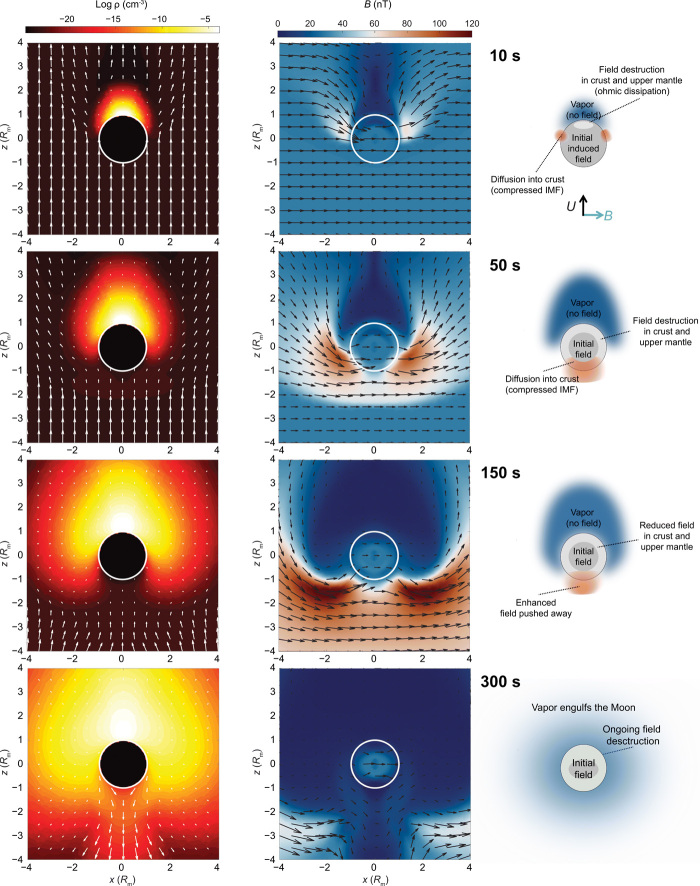
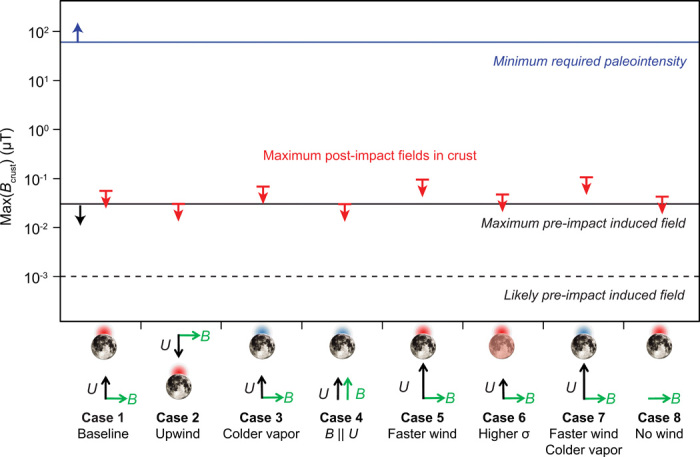
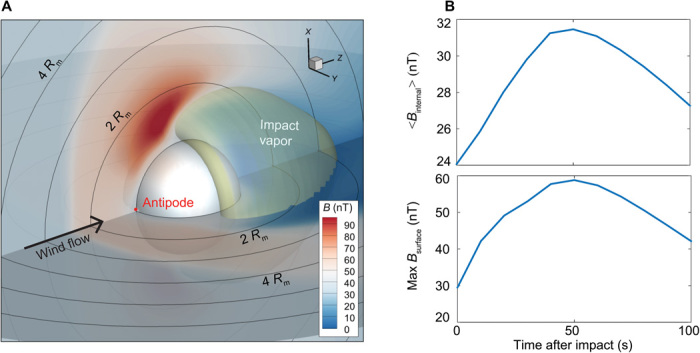
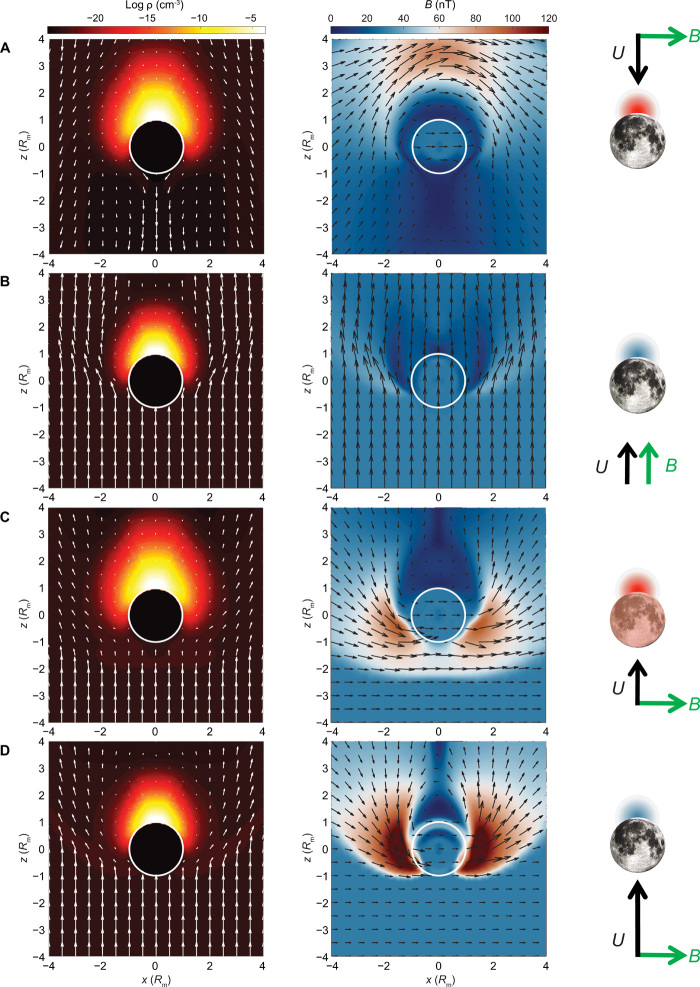
The crusts of the Moon, Mercury, and many meteorite parent bodies are magnetized. Although the magnetizing field is commonly attributed to that of an ancient core dynamo, a longstanding hypothesized alternative is amplification of the interplanetary magnetic field and induced crustal field by plasmas generated by meteoroid impacts. Here, we use magnetohydrodynamic and impact simulations and analytic relationships to demonstrate that although impact plasmas can transiently enhance the field inside the Moon, the resulting fields are at least three orders of magnitude too weak to explain lunar crustal magnetic anomalies. This leaves a core dynamo as the only plausible source of most magnetization on the Moon.
月球、水星以及许多陨石母体的地壳都被磁化了。虽然磁化场通常被认为是由古老的核心发电机产生的,但长期以来一直存在的一种假设替代方案是,流星体撞击产生的等离子体对行星际磁场和感应地壳场进行放大。在这里,我们使用磁流体动力学和撞击模拟以及解析关系来证明,尽管撞击等离子体可以短暂增强月球内部的磁场,但产生的磁场至少比解释月球地壳磁异常所需的磁场弱三个数量级。这使得核心发电机成为月球上大多数磁化的唯一合理来源。