From the Division of Critical Care and Hospitalist Neurology (D.J.R., H.K., A.B., S.A., S.P., J.C.), Department of Neurology, New York-Presbyterian Hospital and Vagelos College of Physicians and Surgeons, Columbia University; Department of Neurology (A.B.), Vagelos College of Physicians and Surgeons, Columbia University; Department of Neurological Surgery (N.Y., E.S.C.), New York-Presbyterian Hospital and Vagelos College of Physicians and Surgeons, Columbia University; and Department of Anesthesiology (K.E., G.W.), Columbia University Irving Medical Center/NewYork-Presbyterian Hospital, New York, New York.
J Trauma Acute Care Surg. 2021 Jan 1;90(1):e7-e12. doi: 10.1097/TA.0000000000002963.
Critically ill coronavirus disease 2019 (COVID-19) patients have frequent thrombotic complications and laboratory evidence of hypercoagulability. The relationship of coagulation tests and thrombosis requires investigation to identify best diagnostic and treatment approaches. We assessed for hypercoagulable characteristics in critically ill COVID-19 patients using rotational thromboelastometry (ROTEM) and explored relationships of D-dimer and ROTEM measurements with thrombotic complications.
Critically ill adult COVID-19 patients receiving ROTEM testing between March and April 2020 were analyzed. Patients receiving therapeutic anticoagulation before ROTEM were excluded. Rotational thromboelastometry measurements from COVID-19 patients were compared with non-COVID-19 patients matched by age, sex, and body mass index. Intergroup differences in ROTEM measurements were assessed using t tests. Correlations of D-dimer levels to ROTEM measurements were assessed in COVID-19 patients who had available concurrent testing. Intergroup differences of D-dimer and ROTEM measurements were explored in COVID-19 patients with and without thrombosis.
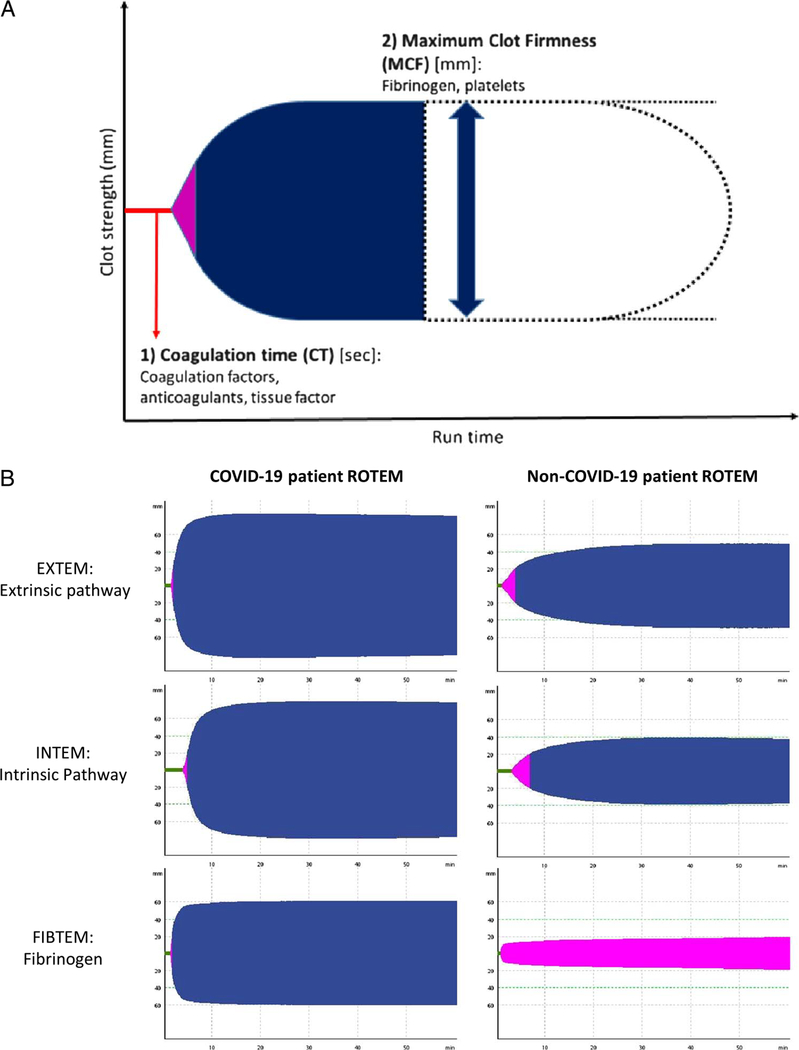
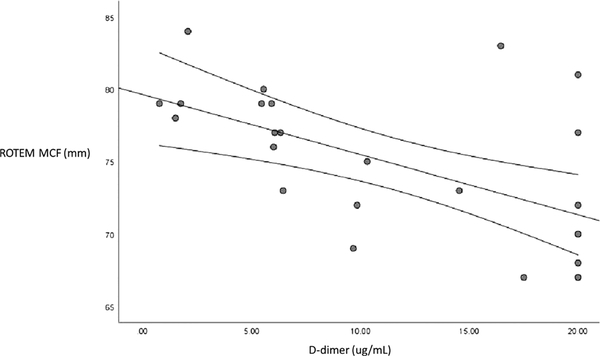
Of 30 COVID-19 patients receiving ROTEM, we identified hypercoagulability from elevated fibrinogen compared with non-COVID-19 patients (fibrinogen assay maximum clot firmness [MCF], 47 ± 13 mm vs. 20 ± 7 mm; mean intergroup difference, 27.4 mm; 95% confidence interval [CI], 22.1-32.7 mm; p < 0.0001). In our COVID-19 cohort, thrombotic complications were identified in 33%. In COVID-19 patients developing thrombotic complications, we identified higher D-dimer levels (17.5 ± 4.3 μg/mL vs. 8.0 ± 6.3 μg/mL; mean difference, 9.5 μg/mL; 95% CI, 13.9-5.1; p < 0.0001) but lower fibrinogen assay MCF (39.7 ± 10.8 mm vs. 50.1 ± 12.0 mm; mean difference, -11.2 mm; 95% CI, -2.1 to -20.2; p = 0.02) compared with patients without thrombosis. We identified negative correlations of D-dimer levels and ROTEM MCF in these patients (r = -0.61; p = 0.001).
We identified elevated D-dimer levels and hypercoagulable blood clot characteristics from increased fibrinogen on ROTEM testing in critically ill COVID-19 patients. However, we identified lower, albeit still hypercoagulable, ROTEM measurements of fibrinogen in COVID-19 patients with thrombotic complications compared with those without. Further work is required to externally validate these findings and to investigate the mechanistic drivers for these relationships to identify best diagnostic and treatment approaches for these patients.
Epidemiologic, level IV.
危重症 2019 年冠状病毒病(COVID-19)患者经常发生血栓并发症和实验室证据表明存在高凝状态。凝血试验与血栓之间的关系需要进行调查,以确定最佳的诊断和治疗方法。我们使用旋转血栓弹性测定法(ROTEM)评估危重症 COVID-19 患者的高凝特征,并探讨 D-二聚体和 ROTEM 测量值与血栓并发症的关系。
分析了 2020 年 3 月至 4 月期间接受 ROTEM 检测的危重症成年 COVID-19 患者。排除了在 ROTEM 检测前接受抗凝治疗的患者。将 COVID-19 患者的 ROTEM 测量值与年龄、性别和体重指数相匹配的非 COVID-19 患者进行比较。使用 t 检验评估 ROTEM 测量值的组间差异。在有同期检测结果的 COVID-19 患者中,评估 D-二聚体水平与 ROTEM 测量值的相关性。在有和没有血栓形成的 COVID-19 患者中,探讨 D-二聚体和 ROTEM 测量值的组间差异。
在接受 ROTEM 检测的 30 例 COVID-19 患者中,我们发现与非 COVID-19 患者相比,纤维蛋白原升高导致高凝状态(纤维蛋白原测定最大凝块硬度[MCF],47±13mm 比 20±7mm;平均组间差异,27.4mm;95%置信区间[CI],22.1-32.7mm;p<0.0001)。在我们的 COVID-19 队列中,33%的患者发生了血栓并发症。在发生血栓并发症的 COVID-19 患者中,我们发现 D-二聚体水平升高(17.5±4.3μg/ml 比 8.0±6.3μg/ml;平均差异,9.5μg/ml;95%CI,13.9-5.1;p<0.0001),但纤维蛋白原测定 MCF 降低(39.7±10.8mm 比 50.1±12.0mm;平均差异,-11.2mm;95%CI,-2.1 至-20.2;p=0.02)。与无血栓形成的患者相比,我们在这些患者中发现 D-二聚体水平和 ROTEM MCF 呈负相关(r=-0.61;p=0.001)。
我们发现,在危重症 COVID-19 患者中,通过 ROTEM 检测可发现 D-二聚体水平升高和纤维蛋白原升高导致的高凝状态。然而,我们发现 COVID-19 患者发生血栓并发症时,纤维蛋白原的 ROTEM 测量值较低,但仍处于高凝状态。需要进一步的工作来验证这些发现,并研究这些关系的机制驱动因素,以确定这些患者的最佳诊断和治疗方法。
观察性,IV 级。