Pediatrics and Rare Diseases Group, Sanford Research, Sioux Falls, SD, USA; Amicus Therapeutics, Philadelphia, PA, USA.
Pediatrics and Rare Diseases Group, Sanford Research, Sioux Falls, SD, USA.
Mol Ther. 2021 Jan 6;29(1):162-175. doi: 10.1016/j.ymthe.2020.09.033. Epub 2020 Sep 24.
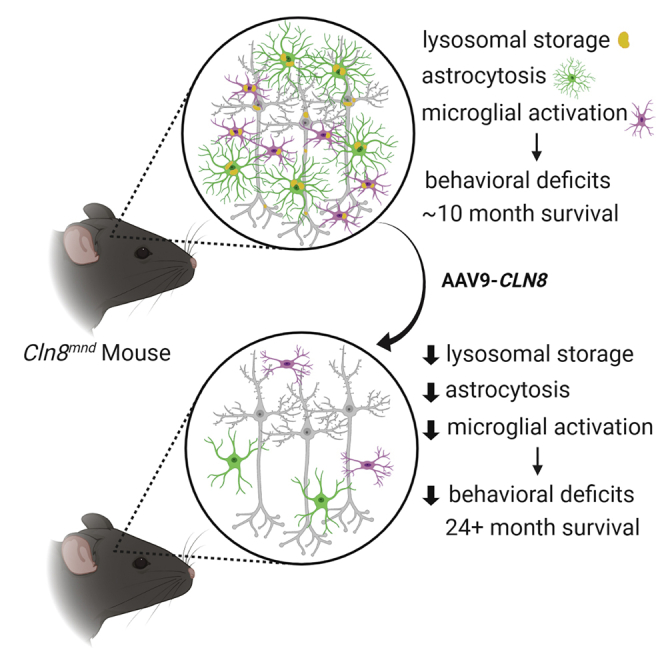
CLN8 disease is a rare form of neuronal ceroid lipofuscinosis caused by biallelic mutations in the CLN8 gene, which encodes a transmembrane endoplasmic reticulum protein involved in trafficking of lysosomal enzymes. CLN8 disease patients present with myoclonus, tonic-clonic seizures, and progressive declines in cognitive and motor function, with many cases resulting in premature death early in life. There are currently no treatments that can cure the disease or substantially slow disease progression. Using a mouse model of CLN8 disease, we tested the safety and efficacy of an intracerebroventricularly (i.c.v.) delivered self-complementary adeno-associated virus serotype 9 (scAAV9) gene therapy vector driving expression of human CLN8. A single neonatal injection was safe and well tolerated, resulting in robust transgene expression throughout the CNS from 4 to 24 months, reducing histopathological and behavioral hallmarks of the disease and restoring lifespan from 10 months in untreated animals to beyond 24 months of age in treated animals. While it is unclear whether some of these behavioral improvements relate to preserved visual function, improvements in learning/memory, or other central or peripheral benefits, these results demonstrate, by far, the most successful degree of rescue reported in an animal model of CLN8 disease, and they support further development of gene therapy for this disorder.
CLN8 病是一种罕见的神经元蜡样质脂褐质沉积症,由 CLN8 基因的双等位基因突变引起,该基因编码一种参与溶酶体酶运输的跨膜内质网蛋白。CLN8 病患者表现为肌阵挛、强直阵挛发作和认知及运动功能进行性下降,许多病例导致生命早期过早死亡。目前尚无能够治愈该疾病或显著减缓疾病进展的治疗方法。我们使用 CLN8 病的小鼠模型,测试了鞘内(i.c.v.)给予自我互补腺相关病毒血清型 9(scAAV9)基因治疗载体表达人 CLN8 的安全性和疗效。单次新生期注射是安全且耐受良好的,导致从 4 到 24 个月整个中枢神经系统内有强大的转基因表达,减少疾病的组织病理学和行为特征,并将未治疗动物的寿命从 10 个月延长至治疗动物的 24 个月以上。虽然尚不清楚这些行为改善中的一些是否与保留的视觉功能、学习/记忆改善或其他中枢或外周益处有关,但这些结果表明,迄今为止,在 CLN8 病的动物模型中报告了最成功的挽救程度,并且支持进一步开发该疾病的基因治疗。