Division of Pulmonary and Critical Care Medicine, Massachusetts General Hospital, Boston, MA; Division for Pulmonary, Critical Care, and Sleep Medicine, Department of Medicine, Beth Israel Deaconess Medical Center, Boston, MA; Harvard Medical School, Boston, MA.
Division for Pulmonary, Critical Care, and Sleep Medicine, Department of Medicine, Beth Israel Deaconess Medical Center, Boston, MA; Harvard Medical School, Boston, MA.
Chest. 2021 Feb;159(2):749-756. doi: 10.1016/j.chest.2020.09.251. Epub 2020 Oct 1.
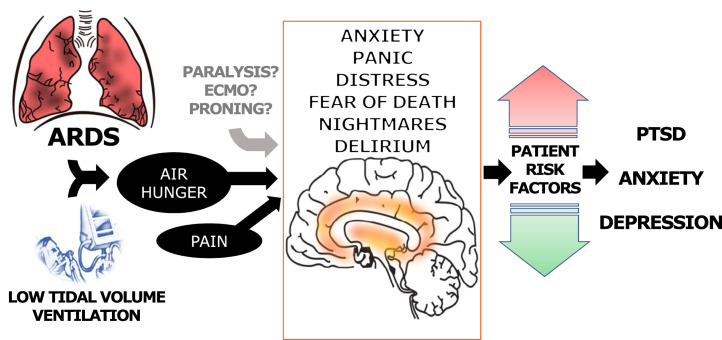
Dyspnea is an uncomfortable sensation with the potential to cause psychological trauma. Patients presenting with acute respiratory failure, particularly when tidal volume is restricted during mechanical ventilation, may experience the most distressing form of dyspnea known as air hunger. Air hunger activates brain pathways known to be involved in posttraumatic stress disorder (PTSD), anxiety, and depression. These conditions are considered part of the post-intensive care syndrome. These sequelae may be even more prevalent among patients with ARDS. Low tidal volume, a mainstay of modern therapy for ARDS, is difficult to avoid and is likely to cause air hunger despite sedation. Adjunctive neuromuscular blockade does not prevent or relieve air hunger, but it does prevent the patient from communicating discomfort to caregivers. Consequently, paralysis may also contribute to the development of PTSD. Although research has identified post-ARDS PTSD as a cause for concern, and investigators have taken steps to quantify the burden of disease, there is little information to guide mechanical ventilation strategies designed to reduce its occurrence. We suggest such efforts will be more successful if they are directed at the known mechanisms of air hunger. Investigation of the antidyspnea effects of sedative and analgesic drugs commonly used in the ICU and their impact on post-ARDS PTSD symptoms is a logical next step. Although in practice we often accept negative consequences of life-saving therapies as unavoidable, we must understand the negative sequelae of our therapies and work to minimize them under our primary directive to "first, do no harm" to patients.
呼吸困难是一种令人不适的感觉,有可能造成心理创伤。急性呼吸衰竭患者,尤其是机械通气时潮气量受限的患者,可能会经历一种被称为“空气饥饿”的最令人痛苦的呼吸困难形式。“空气饥饿”会激活已知与创伤后应激障碍(PTSD)、焦虑和抑郁相关的大脑通路。这些情况被认为是重症监护后综合征的一部分。这些后遗症在 ARDS 患者中可能更为普遍。低潮气量是 ARDS 现代治疗的主要方法,但即使给予镇静治疗,也很难避免这种情况,并可能导致“空气饥饿”。辅助神经肌肉阻滞并不能预防或缓解“空气饥饿”,但它确实阻止了患者向护理人员表达不适。因此,瘫痪也可能导致 PTSD 的发生。尽管研究已经确定 ARDS 后 PTSD 是一个值得关注的问题,并且研究人员已经采取措施量化疾病负担,但几乎没有信息可以指导旨在减少其发生的机械通气策略。我们建议,如果这些努力针对已知的“空气饥饿”机制,那么它们将更有可能取得成功。调查 ICU 中常用的镇静和镇痛药物的抗呼吸困难作用及其对 ARDS 后 PTSD 症状的影响,是合乎逻辑的下一步。尽管在实践中,我们经常接受救生治疗的负面后果是不可避免的,但我们必须了解我们治疗的负面后果,并努力将其最小化,以遵循我们首要的指令,即“首先,不伤害”患者。