Kaur Amarpreet, Kaur Gurmeet, Dhir Shashi Kant, Rai Seema, Sethi Amanpreet, Brar Avneet, Singh Paramdeep
Department of Pediatrics, Guru Gobind Singh Medical College and Hospital, Faridkot, India.
Department of Pediatrics, Government Medical College and Hospital, Amritsar, Punjab, India.
J Emerg Trauma Shock. 2020 Apr-Jun;13(2):146-150. doi: 10.4103/JETS.JETS_89_19. Epub 2020 Jun 10.
Pediatric Risk of Mortality (PRISM) III score is one of the widely used scoring systems to quantify critical illness in the pediatric age group. This study was carried out to find the association of PRISM III score with the outcome (discharge/mortality) and also hospital stay in survivors and nonsurvivors.
The study was conducted in a tertiary care hospital from January 2014 to June 2015.
A total of 524 patients were admitted, and after excluding the patients who met the exclusion criteria, 486 patients were analyzed.
Logistic regression was used to find the association of variables under the PRISM III score with mortality. Linear regression was used to find the association of PRISM III score with length of stay.
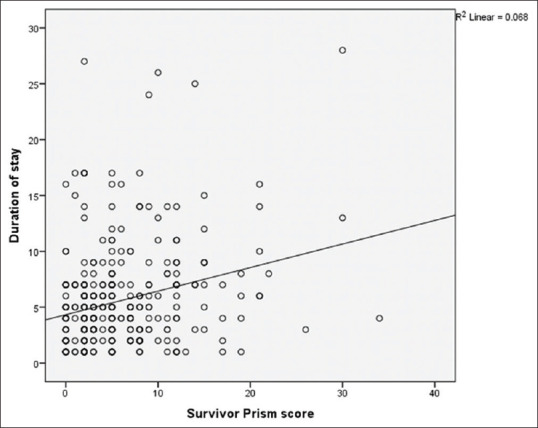
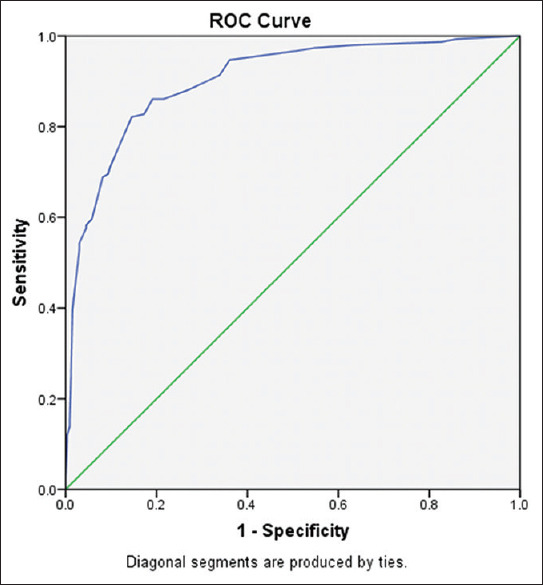
Mortality was 31%; male: female ratio was 1.5:1. Maximum patients presented with respiratory system involvement (26.3%), and maximum mortality (20.3%) was observed in the patients with respiratory involvement. Discrimination by the model between mortality and survival was excellent (receiver operating characteristic curve [0.903]). Maximum risk of mortality was noticed in mechanically ventilated patients (odds ratio [OR]: 10.87) followed by lower systolic blood pressure (OR: 2.72), deranged prothrombin time, partial thromboplastin time (OR: 1.50), deranged mental status (OR: 1.41), and tachycardia (OR: 1.37). Length of stay (LOS) in patients increased till PRISM III score of 25. Average LOS in survivors was 4.327 days which was not accounted by difference in PRISM III score between different patients. With each unit increase in PRISM III score, LOS increased by 5 h.
PRISM III score has excellent capacity to discriminate between survival and mortality. PRISM III score can be used to predict LOS among survivors.
儿科死亡风险(PRISM)III评分是广泛用于量化儿科年龄组危重病的评分系统之一。本研究旨在探讨PRISM III评分与结局(出院/死亡)以及存活者和非存活者住院时间之间的关联。
本研究于2014年1月至2015年6月在一家三级护理医院进行。
共收治524例患者,排除符合排除标准的患者后,对486例患者进行分析。
采用逻辑回归分析PRISM III评分下各变量与死亡率的关联。采用线性回归分析PRISM III评分与住院时间的关联。
死亡率为31%;男女比例为1.5:1。呼吸系统受累的患者最多(26.3%),呼吸系统受累患者的死亡率最高(20.3%)。该模型对死亡率和生存率的区分效果极佳(受试者操作特征曲线[0.903])。机械通气患者的死亡风险最高(比值比[OR]:10.87),其次是收缩压降低(OR:2.72)、凝血酶原时间和部分凝血活酶时间紊乱(OR:1.50)、精神状态紊乱(OR:1.41)和心动过速(OR:1.37)。患者的住院时间(LOS)在PRISM III评分为25之前一直增加。存活者的平均住院时间为4.327天,不同患者之间PRISM III评分的差异对此无影响。PRISM III评分每增加一个单位,住院时间增加5小时。
PRISM III评分具有极佳的区分生存和死亡的能力。PRISM III评分可用于预测存活者的住院时间。