Yamakawa Hiroshi
University of Tokyo, Tokyo, Japan.
The Whole Brain Architecture Initiative, Edogawa-ku, Japan.
Front Comput Neurosci. 2020 Aug 18;14:74. doi: 10.3389/fncom.2020.00074. eCollection 2020.
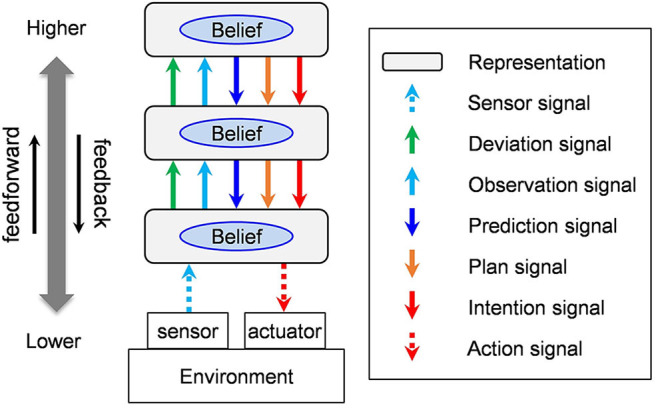
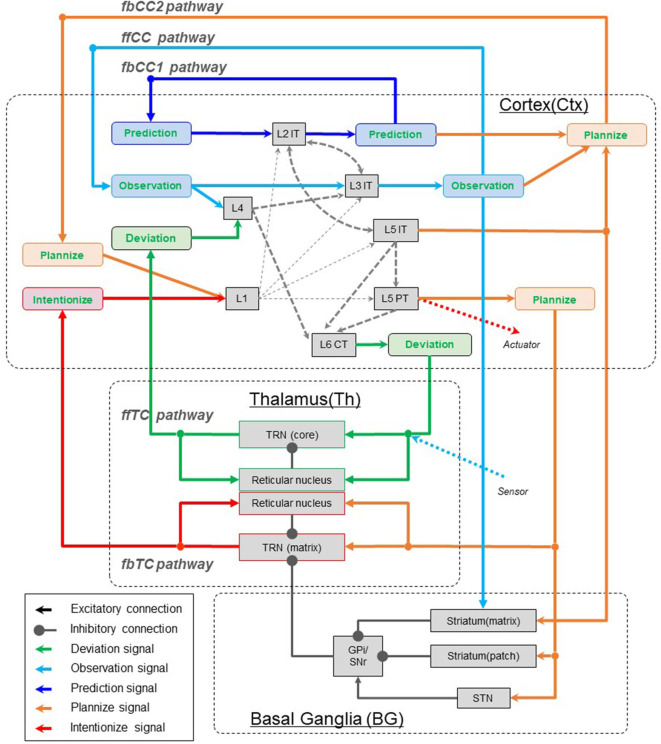
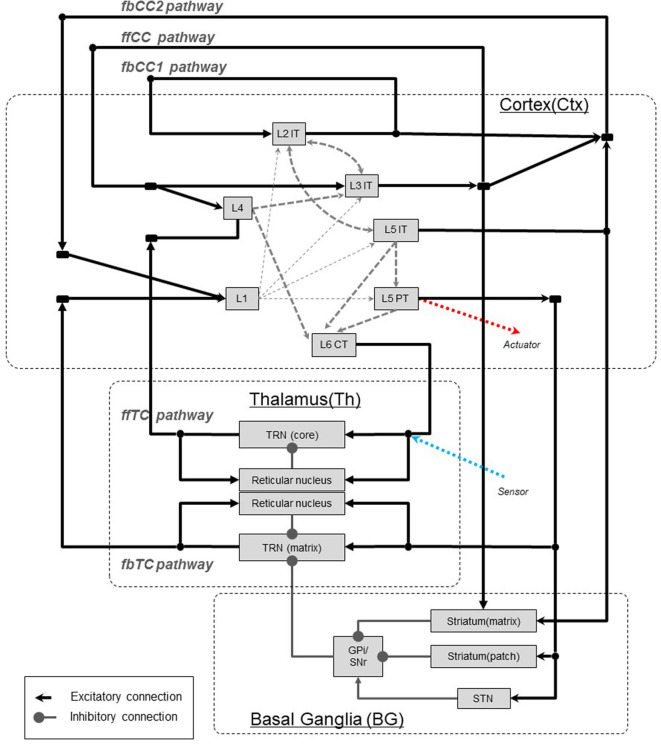
To understand the function of the neocortex, which is a hierarchical distributed network, it is useful giving meaning to the signals transmitted between these areas from the computational viewpoint. The overall anatomical structure or organs related to this network, including the neocortex, thalamus, and basal ganglia, has been roughly revealed, and much physiological knowledge, though often fragmentary, is being accumulated. The computational theories involving the neocortex have also been developed considerably. By introducing the assumption "The signals transmitted by interarea axonal projections of pyramidal cells in the neocortex carry different meanings for each cell type, common to all areas," derived from its nature as a distributed network in the neocortex, allows us to specify the computational meanings of interarea signals. In this paper, first, the types of signals exchanged between neocortical areas are investigated, taking into account biological constraints, and employing theories such as predictive coding, reinforcement learning, representation emulation theory, and BDI logic as theoretical starting points, two types of feedforward signals (observation and deviation) and three types of feedback signals (prediction, plan, and intention) are identified. Next, based on the anatomical knowledge of the neocortex and thalamus, the pathways connecting the areas are organized and summarized as three corticocortical pathways and two thalamocortical pathways. Using this summation as preparation, this paper proposes a hypothesis that gives meaning to each type of signals transmitted in the different pathways in the neocortex, from the viewpoint of their functions. This hypothesis reckons that the feedforward corticocortical pathway transmits observation signals, the feedback corticocortical pathway transmits prediction signals, and the corticothalamic pathway mediated by core relay cells transmits deviation signals. The thalamocortical pathway, which is mediated by matrix relay cells, would be responsible for transmitting the signals that activate a part of prediction signals as intentions, due to the reason that the nature of the other available feedback pathways are not sufficient for conveying plans and intentions as signals. The corticocortical pathway, which is projected from various IT cells to the first layer, would be responsible for transmitting signals that activate a part of prediction signals as plans.
为了理解作为分层分布式网络的新皮层的功能,从计算角度赋予这些区域之间传输的信号以意义是很有用的。与该网络相关的整体解剖结构或器官,包括新皮层、丘脑和基底神经节,已大致揭示,并且正在积累大量生理学知识,尽管这些知识往往是零散的。涉及新皮层的计算理论也有了相当大的发展。通过引入“新皮层中锥体细胞的区域间轴突投射所传输的信号对于每种细胞类型都具有不同的意义,且所有区域都相同”这一假设,基于其作为新皮层分布式网络的性质,使我们能够明确区域间信号的计算意义。在本文中,首先,考虑到生物学限制,研究新皮层区域之间交换的信号类型,并采用预测编码、强化学习、表征仿真理论和BDI逻辑等理论作为理论起点,识别出两种前馈信号(观察和偏差)和三种反馈信号(预测、计划和意图)。接下来,基于新皮层和丘脑的解剖学知识,将连接这些区域的通路进行组织和总结,分为三条皮质 - 皮质通路和两条丘脑 - 皮质通路。以此总结为基础,本文从功能角度提出了一个假设,赋予新皮层中不同通路传输的每种信号以意义。该假设认为,前馈皮质 - 皮质通路传输观察信号,反馈皮质 - 皮质通路传输预测信号,由核心中继细胞介导的皮质 - 丘脑通路传输偏差信号。由基质中继细胞介导的丘脑 - 皮质通路将负责传输作为意图激活部分预测信号的信号,原因是其他可用反馈通路的性质不足以将计划和意图作为信号进行传递。从各种IT细胞投射到第一层的皮质 - 皮质通路将负责传输作为计划激活部分预测信号的信号。