Piesche Matthias, Roos Jessica, Kühn Benjamin, Fettel Jasmin, Hellmuth Nadine, Brat Camilla, Maucher Isabelle V, Awad Omar, Matrone Carmela, Comerma Steffensen Simon Gabriel, Manolikakes Georg, Heinicke Ulrike, Zacharowski Kai D, Steinhilber Dieter, Maier Thorsten J
Biomedical Research Laboratories, Medicine Faculty, Catholic University of Maule, Talca, Chile.
Oncology Center, Medicine Faculty, Catholic University of Maule, Talca, Chile.
Front Pharmacol. 2020 Sep 3;11:1297. doi: 10.3389/fphar.2020.01297. eCollection 2020.
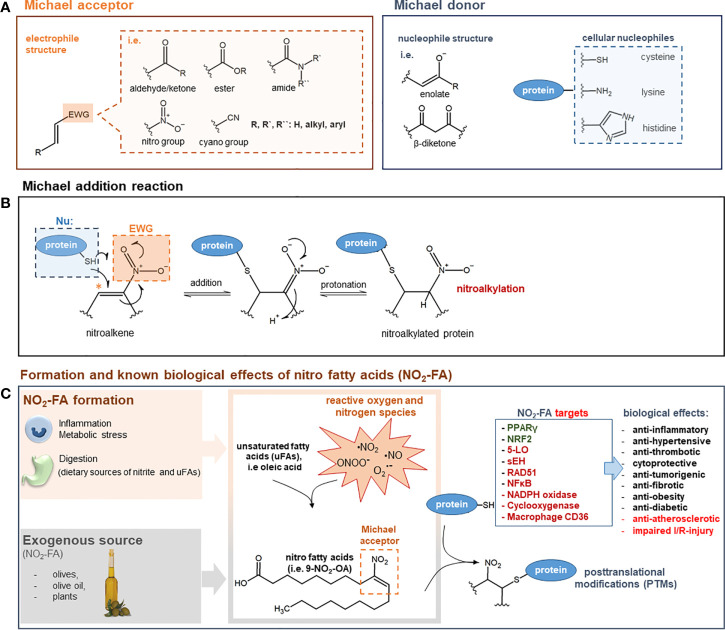
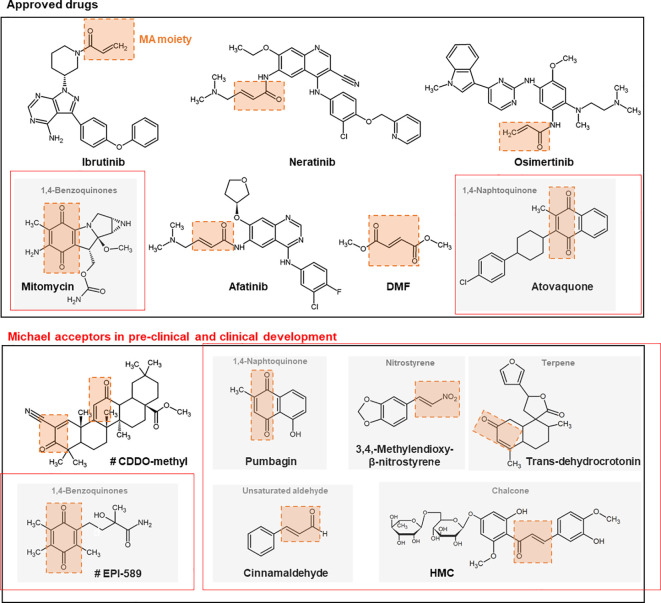
Nitro fatty acids (NFAs) are endogenously generated lipid mediators deriving from reactions of unsaturated electrophilic fatty acids with reactive nitrogen species. Furthermore, Mediterranean diets can be a source of NFA. These highly electrophilic fatty acids can undergo Michael addition reaction with cysteine residues, leading to post-translational modifications (PTM) of selected regulatory proteins. Such modifications are capable of changing target protein function during cell signaling or in biosynthetic pathways. NFA target proteins include the peroxisome proliferator-activated receptor (PPAR-), the pro-inflammatory and tumorigenic nuclear factor-κB (NF-κB) signaling pathway, the pro-inflammatory 5-lipoxygenases (5-LO) biosynthesis pathway as well as soluble epoxide hydrolase (sEH), which is essentially involved in the regulation of vascular tone. In several animal models of inflammation and cancer, the therapeutic efficacy of well-tolerated NFA has been demonstrated. This has already led to clinical phase II studies investigating possible therapeutic effects of NFA in subjects with pulmonary arterial hypertension. Albeit Michael acceptors feature a broad spectrum of bioactivity, they have for a rather long time been avoided as drug candidates owing to their presumed unselective reactivity and toxicity. However, targeted covalent modification of regulatory proteins by Michael acceptors became recognized as a promising approach to drug discovery with the recent FDA approvals of the cancer therapeutics, afatanib (2013), ibrutinib (2013), and osimertinib (2015). Furthermore, the Michael acceptor, neratinib, a dual inhibitor of the human epidermal growth factor receptor 2 and epidermal growth factor receptor, was recently approved by the FDA (2017) and by the EMA (2018) for the treatment of breast cancer. Finally, a number of further Michael acceptor drug candidates are currently under clinical investigation for pharmacotherapy of inflammation and cancer. In this review, we focus on the pharmacology of NFA and other Michael acceptor drugs, summarizing their potential as an emerging class of future antiphlogistics and adjuvant in tumor therapeutics.
硝基脂肪酸(NFAs)是内源性生成的脂质介质,由不饱和亲电脂肪酸与活性氮物质反应产生。此外,地中海饮食可能是NFA的一个来源。这些高度亲电的脂肪酸可与半胱氨酸残基发生迈克尔加成反应,导致特定调节蛋白的翻译后修饰(PTM)。这种修饰能够在细胞信号传导或生物合成途径中改变靶蛋白的功能。NFA的靶蛋白包括过氧化物酶体增殖物激活受体(PPAR-)、促炎和致瘤核因子-κB(NF-κB)信号通路、促炎5-脂氧合酶(5-LO)生物合成途径以及可溶性环氧化物水解酶(sEH),其主要参与血管张力的调节。在几种炎症和癌症动物模型中,已证明耐受性良好的NFA具有治疗效果。这已经导致了临床II期研究,调查NFA对肺动脉高压患者可能的治疗作用。尽管迈克尔受体具有广泛的生物活性,但由于其假定的非选择性反应性和毒性,它们在相当长的一段时间内一直被避免作为候选药物。然而,随着美国食品药品监督管理局(FDA)最近批准了癌症治疗药物阿法替尼(2013年)、伊布替尼(2013年)和奥希替尼(2015年),迈克尔受体对调节蛋白的靶向共价修饰被认为是一种有前景的药物发现方法。此外,迈克尔受体neratinib,一种人表皮生长因子受体2和表皮生长因子受体的双重抑制剂,最近被FDA(2017年)和欧洲药品管理局(EMA,2018年)批准用于治疗乳腺癌。最后,一些其他的迈克尔受体候选药物目前正在进行临床研究,用于炎症和癌症的药物治疗。在这篇综述中,我们聚焦于NFA和其他迈克尔受体药物的药理学,总结它们作为一类新兴的未来抗炎药和肿瘤治疗辅助药物的潜力。