Mosa Alexander I
Department of Cell and Systems Biology, University of Toronto, Toronto, ON, Canada.
Front Immunol. 2020 Sep 11;11:2057. doi: 10.3389/fimmu.2020.02057. eCollection 2020.
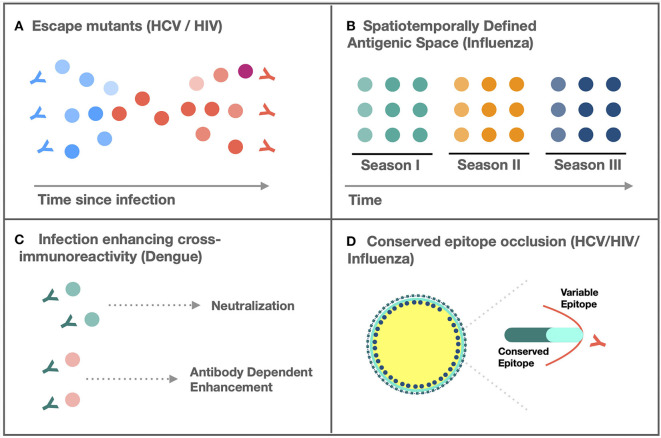
Protective vaccines for hypervariable pathogens are urgently needed. It has been proposed that amputating highly variable epitopes from vaccine antigens would induce the production of broadly protective antibodies targeting conserved epitopes. However, so far, these approaches have failed, partially because conserved epitopes are occluded and partially because co-localizing patterns of immunodominance and antigenic variability render variable epitopes the primary target for antibodies in natural infection. In this Perspective, to recast the challenge of vaccine development for hypervariable pathogens, I evaluate convergent mechanisms of adaptive variation, such as intrahost immune-mediated diversification, spatiotemporally defined antigenic space, and infection-enhancing cross-immunoreactivity. The requirements of broadly protective immune responses targeting variable pathogens are formulated in terms of cross-immunoreactivity, stoichiometric thresholds for neutralization, and the elicitation of antibodies targeting physicochemically conserved signatures within sequence variable domains.
迫切需要针对高变病原体的保护性疫苗。有人提出,从疫苗抗原中切除高变表位将诱导产生针对保守表位的广泛保护性抗体。然而,到目前为止,这些方法都失败了,部分原因是保守表位被遮蔽,部分原因是免疫优势和抗原变异性的共定位模式使可变表位成为自然感染中抗体的主要靶标。在这篇观点文章中,为重新审视高变病原体疫苗开发的挑战,我评估了适应性变异的趋同机制,如宿主体内免疫介导的多样化、时空定义的抗原空间以及感染增强的交叉免疫反应性。针对可变病原体的广泛保护性免疫反应的要求是根据交叉免疫反应性、中和的化学计量阈值以及诱导针对序列可变域内物理化学保守特征的抗体来制定的。