
鼓虾爪部运动特性与空化气泡的研究
Research on Claw Motion Characteristics and Cavitation Bubbles of Snapping Shrimp.
作者信息
Yang Yuliang, Qin Shimu, Di Changchun, Qin Junqi, Wu Dalin, Zhao Jianxin
机构信息
Shijiazhuang Campus, Army Engineering University, Hebei 050003, China.
China Aerodynamics Research and Development Center, Mianyang Sichuan 621000, China.
出版信息
Appl Bionics Biomech. 2020 Sep 20;2020:6585729. doi: 10.1155/2020/6585729. eCollection 2020.
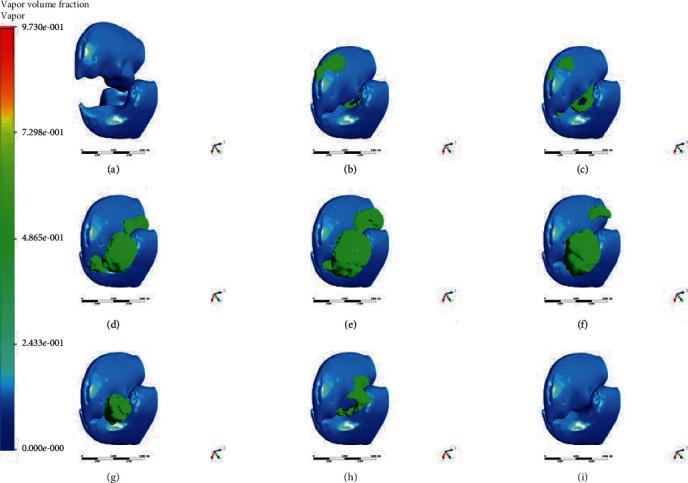
Snapping shrimp produces a high-speed jet through the rapid closure of the snapper claw, which stimulates the formation of cavitation bubbles of various shapes. In order to explore the fast motion characteristics of snapper claw, the formation and change process of cavitation, and the physical principles underlying the biological phenomena, the equivalent model of snapper claw was constructed through CT scanning technology. A high-speed camera was used to capture the claw's motion characteristics, thereby simulating the production of cavitation bubbles by snapping shrimp. The results show that the rotation speeds of different species of snapping shrimps are different, as well as their motion characteristics. Cavitation is formed by the interaction of the pressure drop caused by the vortex at the nozzle with the inertia of the liquid inside the socket. Under the influence of the jet, the shapes of bubbles change from ring to cone, and eventually collapse into bubble clouds.
鼓虾通过迅速闭合螯爪产生高速射流,这会刺激形成各种形状的空化气泡。为了探究螯爪的快速运动特性、空化的形成与变化过程以及这些生物现象背后的物理原理,通过CT扫描技术构建了螯爪的等效模型。使用高速摄像机捕捉螯爪的运动特性,从而模拟鼓虾产生空化气泡的过程。结果表明,不同种类鼓虾的旋转速度不同,其运动特性也不同。空化是由喷嘴处涡旋引起的压降与窝内液体的惯性相互作用形成的。在射流的影响下,气泡形状从环形变为锥形,最终坍塌成气泡云。


 Zotero 插件