Steinert Michael, Ramming Isabell, Bergmann Simone
Institut für Mikrobiologie, Technische Universität Braunschweig, Braunschweig, Germany.
Department of Infection Biology, Helmholtz Center for Infection Diseases, Braunschweig, Germany.
Front Med (Lausanne). 2020 Sep 3;7:543. doi: 10.3389/fmed.2020.00543. eCollection 2020.
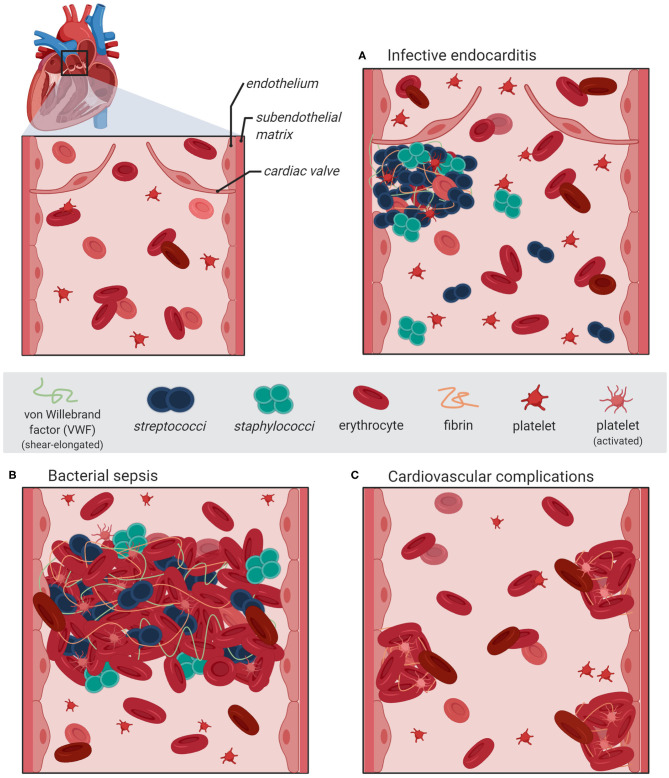
Von Willebrand factor (VWF) is a mechano-sensitive protein with crucial functions in normal hemostasis, which are strongly dependant on the shear-stress mediated defolding and multimerization of VWF in the blood stream. Apart from bleeding disorders, higher plasma levels of VWF are often associated with a higher risk of cardiovascular diseases. Herein, the disease symptoms are attributed to the inflammatory response of the activated endothelium and share high similarities to the reaction of the host vasculature to systemic infections caused by pathogenic bacteria such as and . The bacteria recruit circulating VWF, and by binding to immobilized VWF on activated endothelial cells in blood flow, they interfere with the physiological functions of VWF, including platelet recruitment and coagulation. Several bacterial VWF binding proteins have been identified and further characterized by biochemical analyses. Moreover, the development of a combination of sophisticated cell culture systems simulating shear stress levels of the blood flow with microscopic visualization also provided valuable insights into the interaction mechanism between bacteria and VWF-strings. studies using mouse models of bacterial infection and zebrafish larvae provided evidence that the interaction between bacteria and VWF promotes bacterial attachment, coagulation, and thrombus formation, and thereby contributes to the pathophysiology of severe infectious diseases such as infective endocarditis and bacterial sepsis. This mini-review summarizes the current knowledge of the interaction between bacteria and the mechano-responsive VWF, and corresponding pathophysiological disease symptoms.
血管性血友病因子(VWF)是一种机械敏感蛋白,在正常止血过程中发挥关键作用,这些作用强烈依赖于血流中剪切应力介导的VWF解折叠和多聚化。除了出血性疾病外,较高的VWF血浆水平通常与心血管疾病的较高风险相关。在此,疾病症状归因于活化内皮细胞的炎症反应,并且与宿主脉管系统对由诸如[具体细菌名称1]和[具体细菌名称2]等致病细菌引起的全身感染的反应具有高度相似性。这些细菌募集循环中的VWF,并通过与血流中活化内皮细胞上固定的VWF结合,干扰VWF的生理功能,包括血小板募集和凝血。几种细菌VWF结合蛋白已被鉴定并通过生化分析进一步表征。此外,结合复杂的细胞培养系统模拟血流剪切应力水平与显微镜可视化的发展,也为细菌与VWF链之间的相互作用机制提供了有价值的见解。使用细菌感染小鼠模型和斑马鱼幼虫的研究提供了证据,表明细菌与VWF之间的相互作用促进细菌附着、凝血和血栓形成,从而导致诸如感染性心内膜炎和细菌性败血症等严重感染性疾病的病理生理学。本综述总结了目前关于细菌与机械反应性VWF之间相互作用以及相应病理生理疾病症状的知识。