Pharmacy Department, Medical Security Center, Chinese PLA General Hospital, Beijing 100853, China.
Graduate School, Chinese PLA General Hospital, Beijing 100853, China.
Biomed Res Int. 2020 Sep 14;2020:9742754. doi: 10.1155/2020/9742754. eCollection 2020.
Drug-induced acute kidney injury (D-AKI) is increasingly common and can extend the hospital length of stay and increase mortality. This study is aimed at analyzing the clinical characteristics of hospitalized patients with D-AKI and the associated risk factors in a multidrug environment.
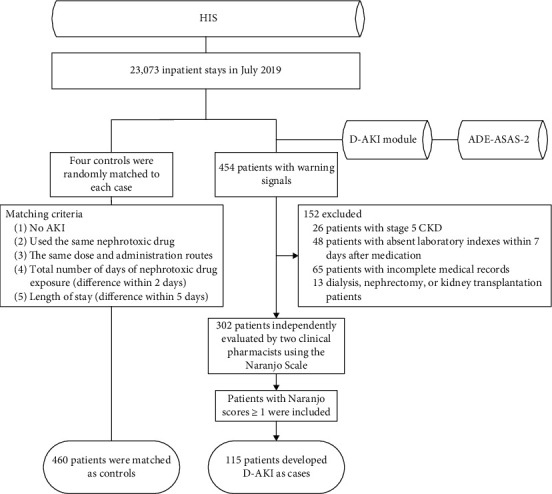
A retrospective study among hospitalized patients was conducted in July 2019 based on the Adverse Drug Events Active Surveillance and Assessment System-2 developed by the authors. Four controls were matched with each case according to the matching criteria. The risk factors for D-AKI were identified by binary multivariate logistic regression.
A total of 23,073 patients were hospitalized in July 2019, 21,131 of whom satisfied the inclusion criteria. The independent risk factors for D-AKI consisted of alcohol abuse (odds ratio (OR), 2.05; 95% confidence interval (CI), 1.04-4.07), nonsteroidal anti-inflammatory drug (NSAID) use (OR, 2.39; 95% CI, 1.25-4.58), diuretic use (OR, 2.64; 95% CI, 1.42-4.92), prior anemia (OR, 4.10; 95% CI, 1.94-8.67), and prior chronic kidney disease (OR, 2.33; 95% CI, 1.07-5.08).
The occurrence of D-AKI in hospitalized patients had significant associations with alcohol abuse, combination therapy with NSAIDs or diuretics, and prior anemia or chronic kidney disease. Clinicians should meticulously follow patients with the above characteristics.
药物引起的急性肾损伤(D-AKI)越来越常见,会延长住院时间并增加死亡率。本研究旨在分析多药环境下住院患者 D-AKI 的临床特征及其相关危险因素。
基于作者开发的药物不良事件主动监测和评估系统-2,对 2019 年 7 月住院患者进行回顾性研究。根据匹配标准,每个病例匹配 4 个对照。采用二元多变量 logistic 回归识别 D-AKI 的危险因素。
2019 年 7 月共有 23073 名患者住院,其中 21131 名符合纳入标准。D-AKI 的独立危险因素包括酗酒(比值比(OR),2.05;95%置信区间(CI),1.04-4.07)、非甾体抗炎药(NSAID)使用(OR,2.39;95% CI,1.25-4.58)、利尿剂使用(OR,2.64;95% CI,1.42-4.92)、既往贫血(OR,4.10;95% CI,1.94-8.67)和既往慢性肾脏病(OR,2.33;95% CI,1.07-5.08)。
住院患者 D-AKI 的发生与酗酒、NSAID 或利尿剂联合治疗以及既往贫血或慢性肾脏病显著相关。临床医生应密切关注具有上述特征的患者。