Fadel Mariam, Wyart Yvan, Moulin Philippe
Aix Marseille Univ, CNRS, Centrale Marseille, M2P2 UMR 7340, Equipe Procédés Membranaires (EPM), Europôle de l'Arbois, BP80, Pavillon Laennec, Hall C, 13545 Aix en Provence CEDEX, France .
Membranes (Basel). 2020 Oct 1;10(10):271. doi: 10.3390/membranes10100271.
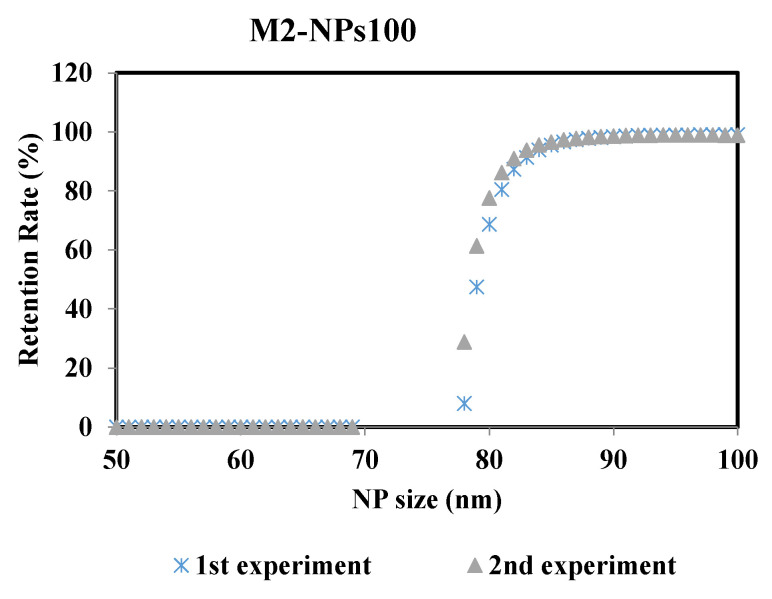
Membrane processes have revolutionized many industries because they are more energy and environmentally friendly than other separation techniques. This initial selection of the membrane for any application is based on its Molecular Weight Cut-Off (MWCO). However, there is a lack of a quantitative, liable, and rapid method to determine the MWCO of the membrane. In this study, a methodology to determine the MWCO, based on the retention of fluorescent silica nanoparticles (NPs), is presented. Optimized experimental conditions (Transmembrane pressure, filtration duration, suspension concentration, etc.) have been performed on different membranes MWCO. Filtrations with suspension of fluorescent NPs of different diameters 70, 100, 200 and 300 nm have been examined. The NPs sizes were selected to cover a wide range in order to study NPs diameters larger, close to, and smaller than the membrane pore size. A particle tracking analysis with a nanosight allows us to calculate the retention curves at all times. The retention rate curves were shifted over the filtration process at different times due to the fouling. The mechanism of fouling of the retained NPs explains the determined value of the MWCO. The reliability of this methodology, which presents a rapid quantitative way to determine the MWCO, is in good agreement with the value given by the manufacturer. In addition, this methodology gives access to the retention curve and makes it possible to determine the MWCO as a function of the desired retention rate.
膜分离过程已经给许多行业带来了变革,因为它们比其他分离技术更节能且更环保。对于任何应用,膜的初始选择都是基于其截留分子量(MWCO)。然而,目前缺乏一种定量、可靠且快速的方法来测定膜的截留分子量。在本研究中,提出了一种基于荧光二氧化硅纳米颗粒(NPs)截留率来测定截留分子量的方法。已针对不同截留分子量的膜进行了优化实验条件(跨膜压力、过滤持续时间、悬浮液浓度等)。对直径分别为70、100、200和300 nm的不同荧光纳米颗粒悬浮液进行了过滤实验。选择这些纳米颗粒尺寸以覆盖较宽范围,以便研究大于、接近和小于膜孔径的纳米颗粒直径。使用纳米视界进行颗粒跟踪分析使我们能够随时计算截留曲线。由于污染,截留率曲线在不同时间的过滤过程中发生了偏移。被截留纳米颗粒的污染机制解释了所测定的截留分子量值。该方法提供了一种快速定量测定截留分子量的可靠方法,其结果与制造商给出的值高度吻合。此外,该方法可以得到截留曲线,并能够根据所需截留率确定截留分子量。