Tobias Deirdre K, Hazra Aditi, Lawler Patrick R, Chandler Paulette D, Chasman Daniel I, Buring Julie E, Lee I-Min, Cheng Susan, Manson JoAnn E, Mora Samia
Division of Preventive Medicine, Department of Medicine, Brigham and Women's Hospital and Harvard Medical School, 900 Commonwealth Avenue, Boston, MA, 02215, USA.
Department of Nutrition, Harvard T.H. Chan School of Public Health, Boston, MA, USA.
Sci Rep. 2020 Oct 6;10(1):16534. doi: 10.1038/s41598-020-73499-x.
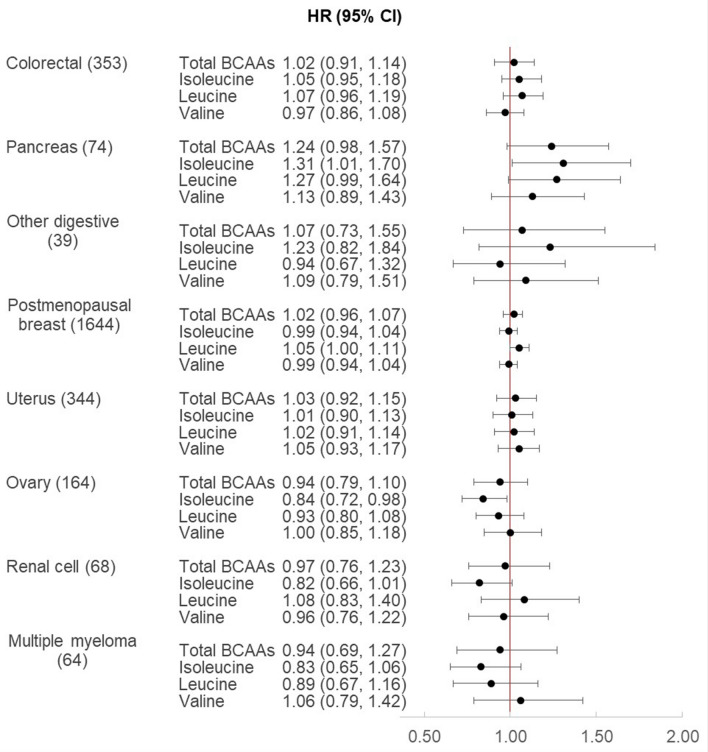
Obesity is a risk factor for > 13 cancer sites, although it is unknown whether there is a common mechanism across sites. Evidence suggests a role for impaired branched-chain amino acid (BCAAs; isoleucine, leucine, valine) metabolism in obesity, insulin resistance, and immunity; thus, we hypothesized circulating BCAAs may be associated with incident obesity-related cancers. We analyzed participants in the prospective Women's Health Study without a history of cancer at baseline blood collection (N = 26,711, mean age = 54.6 years [SD = 7.1]). BCAAs were quantified via NMR spectroscopy, log-transformed, and standardized. We used Cox proportional regression models adjusted for age, race, smoking, diet, alcohol, physical activity, menopausal hormone use, Body Mass Index (BMI), diabetes, and other risk factors. The endpoint was a composite of obesity-related cancers, defined per the International Agency for Research on Cancer 2016 report, over a median 24 years follow-up. Baseline BMI ≥ 30 kg/m compared with BMI 18.5-25.0 kg/m was associated with 23% greater risk of obesity-related cancers (n = 2751 events; multivariable HR 1.23, 95% CI 1.11-1.37). However, BCAAs were not associated with obesity-related cancers (multivariable HR per SD = 1.01 [0.97-1.05]). Results for individual BCAA metabolites suggested a modest association for leucine with obesity-related cancers (1.04 [1.00-1.08]), and no association for isoleucine or valine (0.99 [0.95-1.03] and 1.00 [0.96-1.04], respectively). Exploratory analyses of BCAAs with individual sites included positive associations between leucine and postmenopausal breast cancer, and isoleucine with pancreatic cancer. Total circulating BCAAs were unrelated to obesity-related cancer incidence although an association was observed for leucine with incident obesity-related cancer.
肥胖是超过13种癌症发病部位的风险因素,不过目前尚不清楚各部位之间是否存在共同机制。有证据表明,支链氨基酸(BCAAs;异亮氨酸、亮氨酸、缬氨酸)代谢受损在肥胖、胰岛素抵抗和免疫中发挥作用;因此,我们推测循环中的支链氨基酸可能与肥胖相关癌症的发病有关。我们分析了前瞻性女性健康研究中的参与者,这些参与者在基线采血时无癌症病史(N = 26711,平均年龄 = 54.6岁[标准差 = 7.1])。通过核磁共振波谱法定量支链氨基酸,进行对数转换并标准化。我们使用了Cox比例回归模型,并对年龄、种族、吸烟、饮食、饮酒、体育活动、更年期激素使用、体重指数(BMI)、糖尿病和其他风险因素进行了调整。终点是肥胖相关癌症的综合指标,根据国际癌症研究机构2016年报告定义,随访中位数为24年。与BMI为18.5 - 25.0kg/m²相比,基线BMI≥30kg/m²与肥胖相关癌症风险高23%相关(n = 2751例事件;多变量风险比1.23,95%置信区间1.11 - 1.37)。然而,支链氨基酸与肥胖相关癌症无关(每标准差的多变量风险比 = 1.01[0.97 - 1.05])。个别支链氨基酸代谢物的结果表明,亮氨酸与肥胖相关癌症存在适度关联(1.04[1.00 - 1.08]),而异亮氨酸或缬氨酸无关联(分别为0.99[0.95 - 1.03]和1.00[0.96 - 1.04])。对支链氨基酸与个别部位的探索性分析包括亮氨酸与绝经后乳腺癌之间以及异亮氨酸与胰腺癌之间的正相关。尽管观察到亮氨酸与肥胖相关癌症发病存在关联,但循环中支链氨基酸总量与肥胖相关癌症发病率无关。