
部分医院和强化门诊项目中基于辩证行为疗法的治疗:逐步降低护理的作用。
DBT-informed treatment in a partial hospital and intensive outpatient program: the role of step-down care.
作者信息
Mochrie Kirk D, Lothes Ii John, Guender Eric, St John Jane
机构信息
Triangle Area Psychology Clinic, Durham, NC.
University of North Carolina Wilmington, Wilmington, NC.
出版信息
Res Psychother. 2020 Sep 7;23(2):461. doi: 10.4081/ripppo.2020.461.
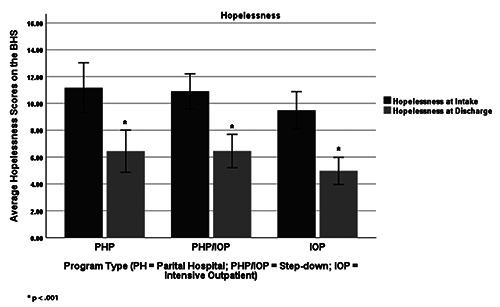
Few studies to date have examined Partial Hospital (PH) and Intensive Outpatient (IOP) programs that utilize a Dialectical Behavior Therapy (DBT)-informed model. Preliminary findings suggest that DBT-informed PH programs are effective in reducing clinical symptoms; however, less is known about IOP programs as well as step-down care models. The present study utilized clinically relevant outcome indices and included a heterogeneous clinical sample. Specifically, the present study assessed pre-post data to examine changes in symptoms of depression, anxiety, hopelessness, and overall degree of suffering from intake to discharge in DBT-informed PH and IOP programs as well as a step-down condition (PH to IOP). Participants included 205 adults (ages = 35.28, = 12.49). The sample was predominantly female (N = 139, 67.8%) and Caucasian (N = 181, 88.3%). The sample was divided into three distinct groups: PH program patients, PH to IOP program step-down patients, and IOP patients. Findings indicated significant symptom reduction from intake to discharge for all three conditions. There were no significant differences in mean change scores in symptom reduction between the three groups. Severity of depression symptoms at intake predicted program placement. However, type of program did not predict significant changes in symptoms from intake to discharge. This DBT-informed PH and IOP program was successful at reducing various psychiatric symptoms in the sample. Clinicians might consider the advantages of placing patients with higher symptoms of depression into PH programs with the intention of transitioning to step-down care through IOP programs that utilize DBT.
迄今为止,很少有研究考察采用辩证行为疗法(DBT)指导模式的部分住院(PH)和强化门诊(IOP)项目。初步研究结果表明,采用DBT指导的PH项目在减轻临床症状方面是有效的;然而,对于IOP项目以及逐步降级护理模式的了解较少。本研究使用了临床相关的结果指标,并纳入了一个异质性的临床样本。具体而言,本研究评估了入院到出院期间的前后数据,以考察采用DBT指导的PH和IOP项目以及逐步降级情况(从PH到IOP)中抑郁、焦虑、绝望症状以及总体痛苦程度的变化。参与者包括205名成年人(年龄 = 35.28,标准差 = 12.49)。样本中女性占主导(N = 139,67.8%),白种人占主导(N = 181,88.3%)。样本被分为三个不同的组:PH项目患者、从PH到IOP项目的逐步降级患者以及IOP患者。研究结果表明,所有三种情况从入院到出院症状均有显著减轻。三组之间在症状减轻的平均变化分数上没有显著差异。入院时抑郁症状的严重程度可预测项目安置。然而,项目类型并不能预测从入院到出院症状的显著变化。这种采用DBT指导的PH和IOP项目成功地减轻了样本中的各种精神症状。临床医生可能会考虑将抑郁症状较高的患者安置到PH项目中的优势,以便通过采用DBT的IOP项目过渡到逐步降级护理。



 Zotero 插件