Yeon S Y, Seto S W, Chan G H H, Low M, Kiat H, Wang N, Liu J, Chang D
NICM Health Research Institute, Western Sydney University, Penrith, NSW 2751, Australia.
Department of Applied Biology and Chemical Technology, The Hong Kong Polytechnic University, Hung Hom, Kowloon, Hong Kong SAR, China.
Evid Based Complement Alternat Med. 2020 Sep 22;2020:8125805. doi: 10.1155/2020/8125805. eCollection 2020.
Sailuotong (SLT) is a standardized three-herb formulation consisting of extracts of , , and for the treatment of vascular dementia (VaD). Although SLT has been shown to increase cerebral blood flow, the direct effects of SLT on vascular reactivity have not been explored. This study aims to examine the vasodilatory effects of SLT and the underlying mechanisms in rat isolated tail artery.
Male (250-300 g) Wistar Kyoto (WKY) rat tail artery was isolated for isometric tension measurement. The effects of SLT on the influx of calcium through the cell membrane calcium channels were determined in Ca-free solution experiments.
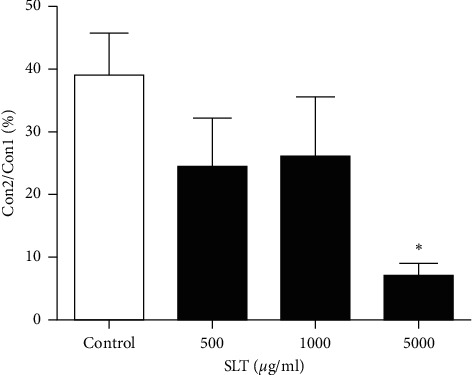
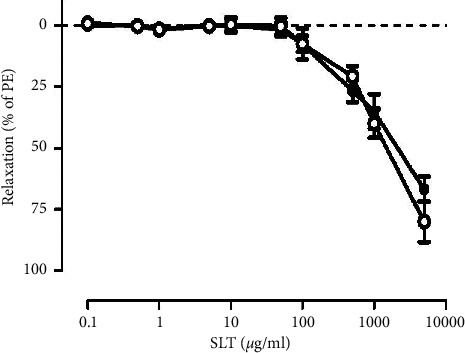
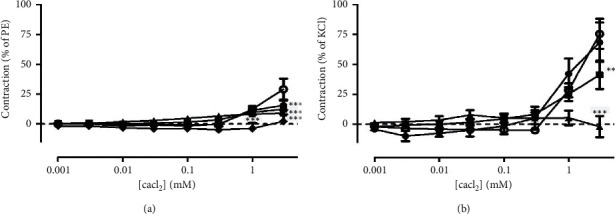
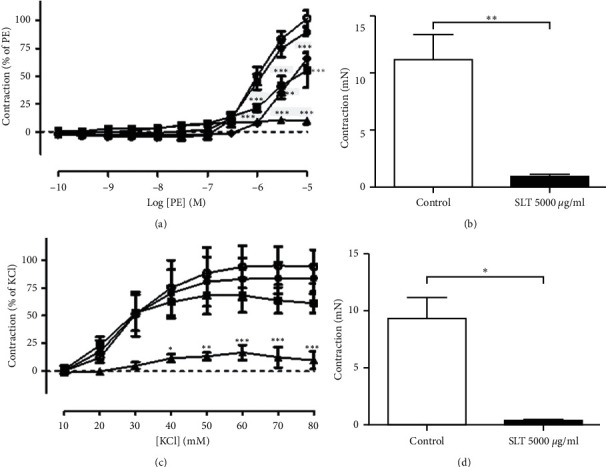
SLT (0.1-5,000 g/ml) caused a concentration-dependent relaxation in rat isolated tail artery precontracted by phenylephrine. In the contraction experiments, SLT (500, 1,000, and 5,000 g/mL) significantly inhibited phenylephrine (0.001 to 10 M)- and KCl (10-80 mM)-induced contraction, in a concentration-dependent manner. In Ca-free solution, SLT (500, 1,000, and 5,000 g/mL) markedly suppressed Ca-induced (0.001-3 mM) vasoconstriction in a concentration-dependent manner in both phenylephrine (10 M) or KCl (80 mM) stimulated tail arteries. L-type calcium channel blocker nifedipine (10 M) inhibited PE-induced contraction. Furthermore, SLT significantly reduced phenylephrine-induced transient vasoconstriction in the rat isolated tail artery.
SLT induces relaxation of rat isolated tail artery through endothelium-independent mechanisms. The SLT-induced vasodilatation appeared to be jointly meditated by blockages of extracellular Ca influx receptor-gated and voltage-gated Ca channels and inhibition of the release of Ca from the sarcoplasmic reticulum.
塞络通(SLT)是一种标准化的三味草药配方,由[草药1]、[草药2]和[草药3]的提取物组成,用于治疗血管性痴呆(VaD)。尽管已证明塞络通可增加脑血流量,但尚未探讨其对血管反应性的直接影响。本研究旨在研究塞络通在大鼠离体尾动脉中的舒张血管作用及其潜在机制。
分离雄性(250 - 300 g)Wistar Kyoto(WKY)大鼠的尾动脉用于等长张力测量。在无钙溶液实验中测定塞络通对通过细胞膜钙通道的钙内流的影响。
塞络通(0.1 - 5000 μg/ml)使去氧肾上腺素预收缩的大鼠离体尾动脉产生浓度依赖性舒张。在收缩实验中,塞络通(500、1000和5000 μg/mL)以浓度依赖性方式显著抑制去氧肾上腺素(0.001至10 μM)和氯化钾(10 - 80 mM)诱导的收缩。在无钙溶液中,塞络通(500、1000和5000 μg/mL)在去氧肾上腺素(10 μM)或氯化钾(80 mM)刺激的尾动脉中均以浓度依赖性方式显著抑制钙诱导(0.001 - 3 mM)的血管收缩。L型钙通道阻滞剂硝苯地平(10 μM)抑制去氧肾上腺素诱导的收缩。此外,塞络通显著降低大鼠离体尾动脉中去氧肾上腺素诱导的短暂血管收缩。
塞络通通过非内皮依赖机制诱导大鼠离体尾动脉舒张。塞络通诱导的血管舒张似乎是由细胞外钙内流的阻断(受体门控和电压门控钙通道)以及肌浆网钙释放的抑制共同介导的。