Higashikawa Toshihiro, Shigemoto Kenji, Goshima Kenichi, Horii Takeshi, Usuda Daisuke, Morita Takuro, Moriyama Manabu, Inujima Hiromi, Hangyou Masahiro, Usuda Kimiko, Morimoto Shigeto, Matsumoto Tadami, Takashima Shigeki, Kanda Tsugiyasu, Okuro Masashi, Sawaguchi Takeshi
Department of Geriatric Medicine, Kanazawa Medical University Himi Municipal Hospital, 1130, Kurakawa, Himi, Toyama 935-8531, Japan.
Department of Geriatric Medicine, Kanazawa Medical University, Uchinada, Kahoku-gun, Ishikawa 920-0293, Japan.
J Clin Med Res. 2020 Oct;12(10):668-673. doi: 10.14740/jocmr4292. Epub 2020 Sep 21.
The main purpose of this study is to exhaustively explore risk factors, including age, gender, and several clinical indices, for mortality in elderly patients with femoral neck fracture and to evaluate some of them using survival analyses.
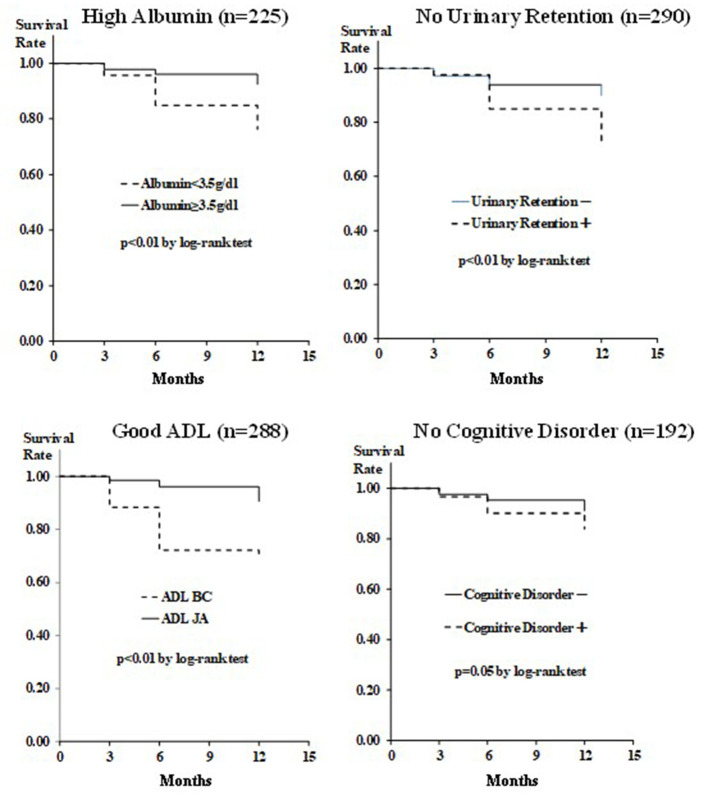
This was a retrospective study tracking 1 year for vital prognosis. Data were collected at post-operation from medical records of the cases. Survival analysis was conducted to investigate the risk factors for death, including albumin, urinary retention, activity of daily living (ADL), and cognitive disorder.
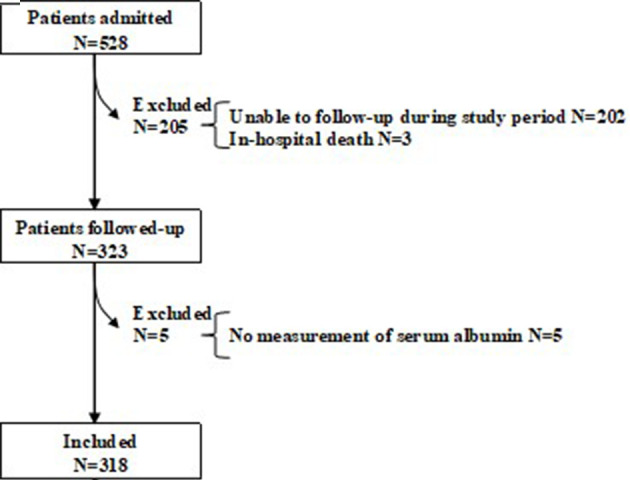
We recruited 318 patients with a history of hip surgery carried out at Toyama Municipal Hospital, in which 39 patients died for 1 year after discharge. The results showed a significant decrease in survival rate in low albumin, positive urinary retention, and low ADL (P < 0.01, by log-rank test). The hazard ratios (95% confidence interval) of albumin, urinary retention, ADL, and cognitive disorder were 0.36 (0.19 - 0.69), 0.4 (0.2 - 0.8), 0.29 (0.15 - 0.58) and 0.65 (0.32 - 1.29), respectively.
This study demonstrated that albumin, urinary retention and ADL were the important risk factors for mortality, and suggested that the postoperative management of albumin, urinary retention and ADL is important, especially in elderly female patients receiving surgery of femoral neck and trochanteric fractures.
本研究的主要目的是详尽探究老年股骨颈骨折患者死亡的风险因素,包括年龄、性别和若干临床指标,并通过生存分析对其中一些因素进行评估。
这是一项为期1年追踪生命预后的回顾性研究。术后从病例的医疗记录中收集数据。进行生存分析以调查死亡的风险因素,包括白蛋白、尿潴留、日常生活活动能力(ADL)和认知障碍。
我们招募了318例在富山市立医院接受髋关节手术的患者,其中39例在出院后1年内死亡。结果显示,低白蛋白、尿潴留阳性和低ADL患者的生存率显著降低(对数秩检验,P<0.01)。白蛋白、尿潴留、ADL和认知障碍的风险比(95%置信区间)分别为0.36(0.19 - 0.69)、0.4(0.2 - 0.8)、0.29(0.15 - 0.58)和0.65(0.32 - 1.29)。
本研究表明白蛋白、尿潴留和ADL是死亡的重要风险因素,并提示白蛋白、尿潴留和ADL的术后管理很重要,尤其是在接受股骨颈和转子间骨折手术的老年女性患者中。