Chen Si, Xu Zhonghuang, Liu Hongju, Zhang Yuelun, Zhang Jiao, Chen Yuexin, Zheng Yuehong, Huang Yuguang
Department of Anesthesiology, Peking Union Medical College Hospital, Beijing, China.
Medical Research Center, Peking Union Medical College Hospital, Beijing, China.
BMJ Open. 2020 Oct 8;10(10):e037879. doi: 10.1136/bmjopen-2020-037879.
Both regional analgesia and intravenous analgesia are frequently used perioperatively for patients with critical limb ischaemia (CLI). Nevertheless, the comparison of perioperative effect of regional and intravenous analgesia has not yet been thoroughly illustrated. This study will comprehensively compare patient-controlled regional analgesia (PCRA) and patient-controlled intravenous analgesia (PCIA) as two different perioperative analgesia approaches for patients with CLI. It investigates their effects on analgesia, reperfusion and the quality of recovery perioperatively, also aims to provide clinical evidence to those non-surgical patients with non-reconstructable arteries.
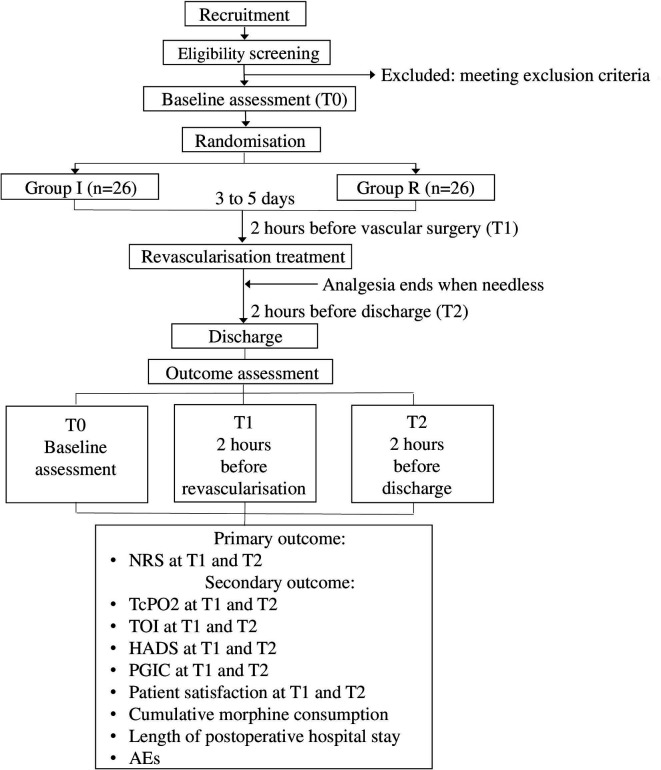
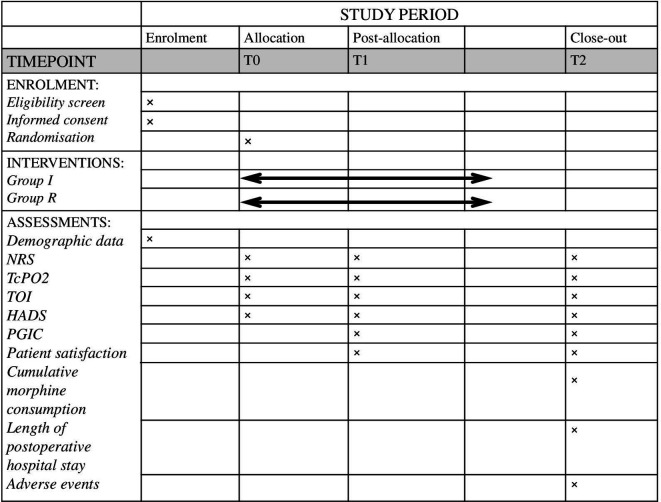
This trial is a randomised, single-centre, open-label, parallel trial with target sample size of 52 in total. Eligible participants will be randomly allocated to the PCRA group (group R) or the PCIA group (group I) after admission. Participants in group R will receive ultrasound-guided subgluteal sciatic catheterisation, followed by continuous PCRA infusion (0.2% ropivacaine 15 mL as loading dose, 8 mL/hour as background with a patient-controlled bolus of 6 mL). Participants in group I will receive PCIA (morphine is given in boluses of 1 mg as needed, background infusion at 1 mg/hour). Data will be collected at baseline (T0), 2 hours before revascularisation treatment (T1) and 2 hours before discharge (T2). The primary outcomes include the Numerical Rating Scale pain score at T1 and T2. The secondary outcomes include the perioperative transcutaneous oxygen pressure, the Tissue Haemoglobin Index, Hospital Anxiety and Depression Scale at T1 and T2; the Patient Global Impression of Change and patient satisfaction at T1 and T2; the perioperative cumulative morphine consumption, the length of postoperative hospital stay and adverse events.
This study received authorisation from the Institutional Review Board of Peking Union Medical College Hospital on 21 March 2017 (approval no. ZS-1289X). Study findings will be disseminated through presentations at scientific conferences or publications in peer-reviewed journals.
Chinese Clinical Trial Registry (ChiCTR2000029298).
V.4CP.B2 (15 June 2020).
区域镇痛和静脉镇痛在围手术期常用于严重肢体缺血(CLI)患者。然而,区域镇痛和静脉镇痛围手术期效果的比较尚未得到充分阐明。本研究将全面比较患者自控区域镇痛(PCRA)和患者自控静脉镇痛(PCIA)这两种不同的围手术期镇痛方法对CLI患者的效果。研究它们对镇痛、再灌注及围手术期恢复质量的影响,也旨在为那些动脉不可重建的非手术患者提供临床证据。
本试验是一项随机、单中心、开放标签的平行试验,目标样本量共52例。符合条件的参与者入院后将被随机分配至PCRA组(R组)或PCIA组(I组)。R组参与者将接受超声引导下臀下坐骨神经置管,随后持续PCRA输注(0.2%罗哌卡因15 mL作为负荷剂量,8 mL/小时作为背景剂量,患者自控推注剂量为6 mL)。I组参与者将接受PCIA(按需静脉推注吗啡1 mg,背景输注速度为1 mg/小时)。数据将在基线(T0)、血运重建治疗前2小时(T1)和出院前2小时(T2)收集。主要结局包括T1和T2时的数字评分量表疼痛评分。次要结局包括围手术期经皮氧分压、组织血红蛋白指数、T1和T2时的医院焦虑抑郁量表;T1和T2时的患者整体印象变化和患者满意度;围手术期吗啡累积用量、术后住院时间和不良事件。
本研究于2017年3月21日获得北京协和医院机构审查委员会批准(批准号:ZS - 1289X)。研究结果将通过在科学会议上报告或在同行评审期刊上发表进行传播。
中国临床试验注册中心(ChiCTR200002D9298)。
V.4CP.B2(2020年6月15日)。