Cowie Bradley E, Douair Iskander, Maron Laurent, Love Jason B, Arnold Polly L
EaStCHEM School of Chemistry , The University of Edinburgh , Joseph Black Building, The King's Buildings , Edinburgh , EH9 3FJ , UK.
Université de Toulouse , INSA , UPS , CNRS , UMR 5215 , LPCNO , 135 Avenue de Rangueil , F-31077 Toulouse , France.
Chem Sci. 2020 Jun 12;11(27):7144-7157. doi: 10.1039/d0sc02297g. eCollection 2020 Jul 21.
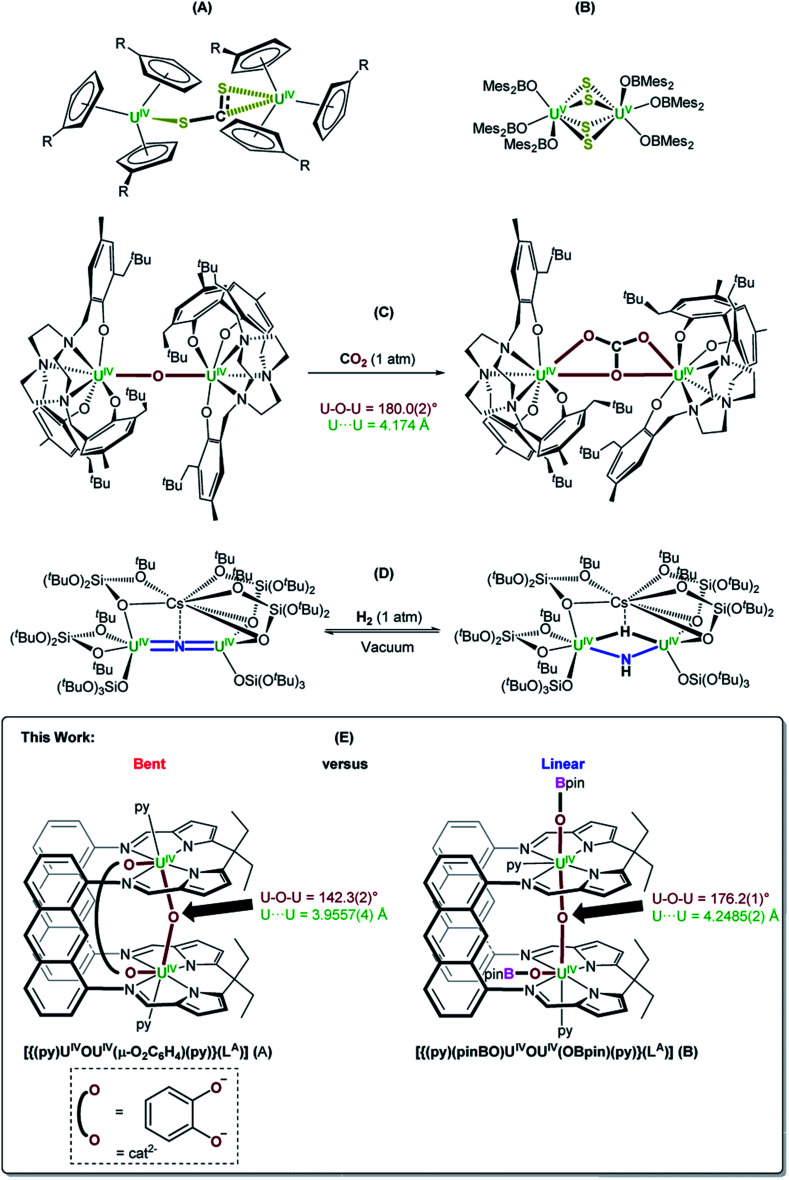
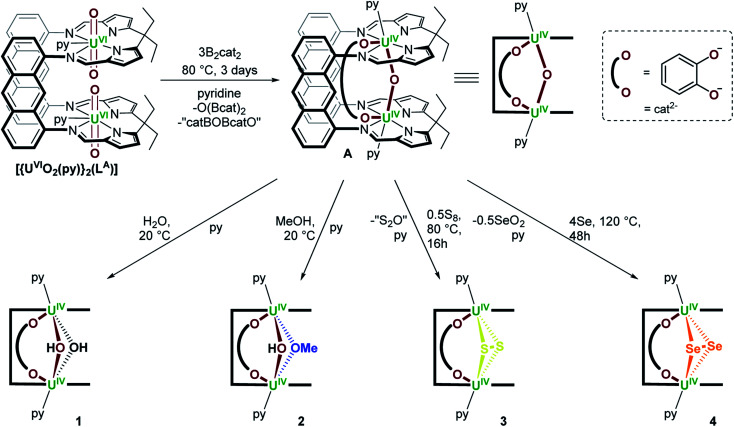
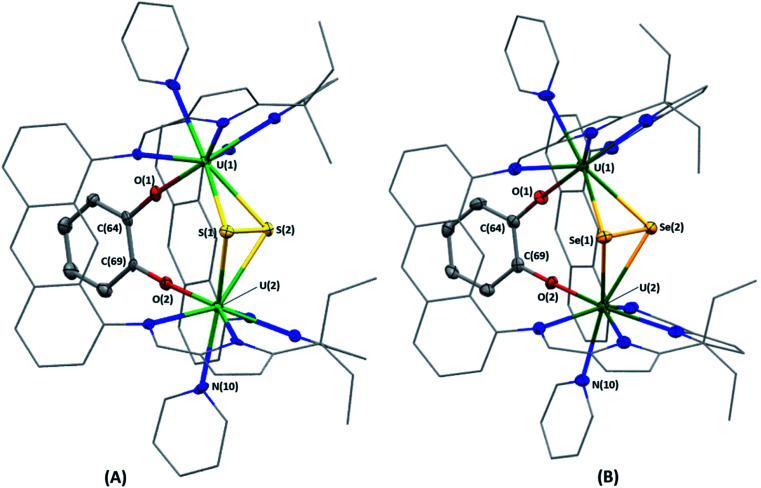
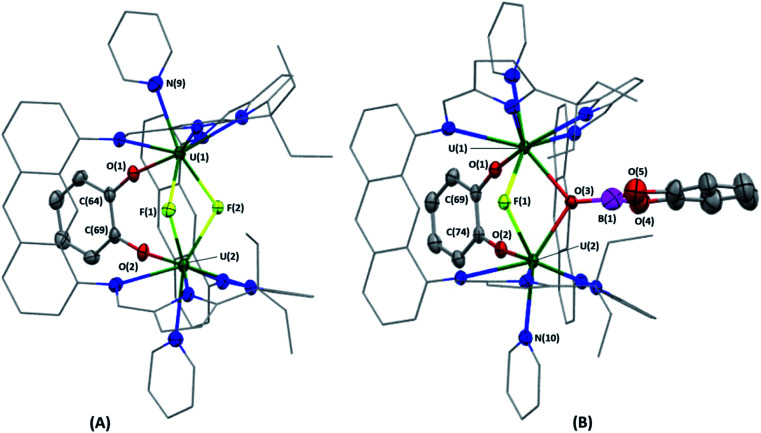
The oxo- and catecholate-bridged U/U Pacman complex [{(py)UOU(μ-OCH)(py)}(L)] (L = a macrocyclic "Pacman" ligand; anthracenylene hinge between N-donor pockets, ethyl substituents on -carbon atom of each N-donor pocket) featuring a bent U-O-U oxo bridge readily reacts with small molecule substrates to undergo either oxo-atom functionalisation or substitution. Complex reacts with HO or MeOH to afford [{(py)U(μ-OH)U(μ-OCH)(py)}(L)] () and [{(py)U(μ-OH)(μ-OMe)U(μ-OCH)(py)}(L)] (), respectively, in which the bridging oxo ligand in is substituted for two bridging hydroxo ligands or one bridging hydroxo and one bridging methoxy ligand, respectively. Alternatively, reacts with either 0.5 equiv. of S or 4 equiv. of Se to provide [{(py)U(μ-η:η-E)U(μ-OCH)(py)}(L)] (E = S (), Se ()) respectively, in which the [E] ion bridges the two U centres. To the best of our knowledge, complex is the first example of either a d- or f-block bimetallic μ-oxo complex that activates elemental chalcogens. Complex also reacts with XeF or 2 equiv. of MeSiCl to provide [{(py)U(μ-X)U(μ-OCH)(py)}(L)] (X = F (), Cl ()), in which the oxo ligand has been substituted for two bridging halido ligands. Reacting with either XeF or MeSiCl in the presence of O(Bcat) at room temperature forms [{(py)U(μ-X)(μ-OBcat)U(μ-OCH)(py)}(L)] (X = F (), Cl ()), which upon heating to 80 °C is converted to and , respectively. In order to probe the importance of the bent U-O-U motif in on the observed reactivity, the bis(boroxido)-U/U complex, [{(py)(pinBO)UOU(OBpin)(py)}(L)] (), featuring a linear U-O-U bond angle was treated with HO and MeSiCl. Complex reacts with two equiv. of either HO or MeSiCl to provide [{(py)HOUOUOH(py)}(L)] () and [{(py)ClUOUCl(py)}(L)] (), respectively, in which reactions occur preferentially at the boroxido ligands, with the μ-oxo ligand unchanged. The formal U oxidation state is retained in all of the products , and selective reactions at the bridging oxo ligand in is facilitated by: (1) its highly nucleophilic character which is a result of a non-linear U-O-U bond angle causing an increase in U-O bond covalency and localisation of the lone pairs of electrons on the μ-oxo group, and (2) the presence of the bridging catecholate ligand, which destabilises a linear oxo-bridging geometry and stabilises the resulting products.
具有弯曲的U - O - U氧桥的氧代和儿茶酚盐桥联的U/U“吃豆人”配合物[{(py)UOU(μ - OCH)(py)}(L)](L = 一种大环“吃豆人”配体;N供体口袋之间的蒽撑铰链,每个N供体口袋的 - 碳原子上有乙基取代基)很容易与小分子底物反应,进行氧原子官能化或取代反应。配合物 与HO或MeOH反应,分别得到[{(py)U(μ - OH)U(μ - OCH)(py)}(L)]()和[{(py)U(μ - OH)(μ - OMe)U(μ - OCH)(py)}(L)](),其中 中的桥连氧配体分别被两个桥连羟基配体或一个桥连羟基和一个桥连甲氧基配体取代。或者, 与0.5当量的S或4当量的Se反应,分别提供[{(py)U(μ - η:η - E)U(μ - OCH)(py)}(L)](E = S(),Se()),其中[E]离子桥连两个U中心。据我们所知,配合物 是第一个激活元素硫族元素的d或f族双金属μ - 氧配合物实例。配合物 还与XeF或2当量的MeSiCl反应,提供[{(py)U(μ - X)U(μ - OCH)(py)}(L)](X = F(),Cl()),其中氧配体被两个桥连卤化物配体取代。在室温下,在O(Bcat)存在下, 将 与XeF或MeSiCl反应形成[{(py)U(μ - X)(μ - OBcat)U(μ - OCH)(py)}(L)](X = F(),Cl()),加热至80°C时分别转化为 和 。为了探究 中弯曲的U - O - U结构对观察到的反应性的重要性,用HO和MeSiCl处理具有线性U - O - U键角的双(硼氧代)-U/U配合物[{(py)(pinBO)UOU(OBpin)(py)}(L)]()。配合物 与两当量的HO或MeSiCl反应,分别提供[{(py)HOUOUOH(py)}(L)]()和[{(py)ClUOUCl(py)}(L)](),其中反应优先发生在硼氧代配体上,μ - 氧配体不变。所有产物 中U的形式氧化态得以保留,并且 在桥连氧配体处的选择性反应得益于:(1) 其高度亲核性,这是由于非线性的U - O - U键角导致U - O键共价性增加以及μ - 氧基团上孤对电子的定位,以及(2) 桥连儿茶酚盐配体的存在,它使线性氧桥连几何结构不稳定并稳定了所得产物。