John Innes Centre, Colney Lane, Norwich NR4 7UH, UK.
John Innes Centre, Colney Lane, Norwich NR4 7UH, UK.
Curr Biol. 2020 Dec 21;30(24):4999-5006.e3. doi: 10.1016/j.cub.2020.09.036. Epub 2020 Oct 8.
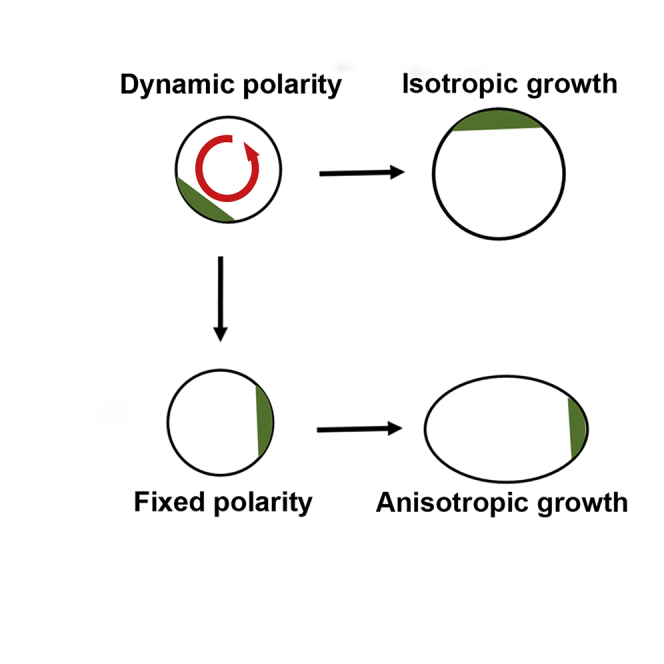
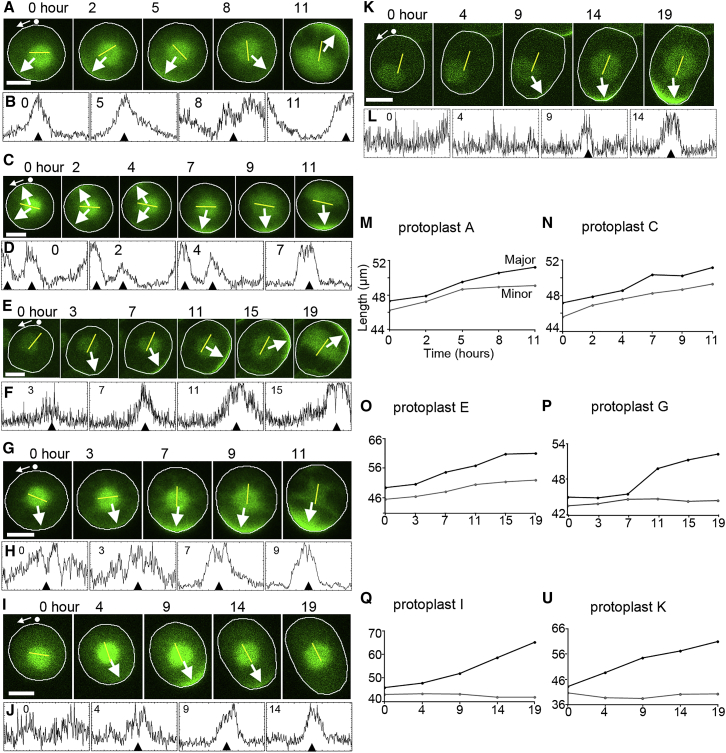
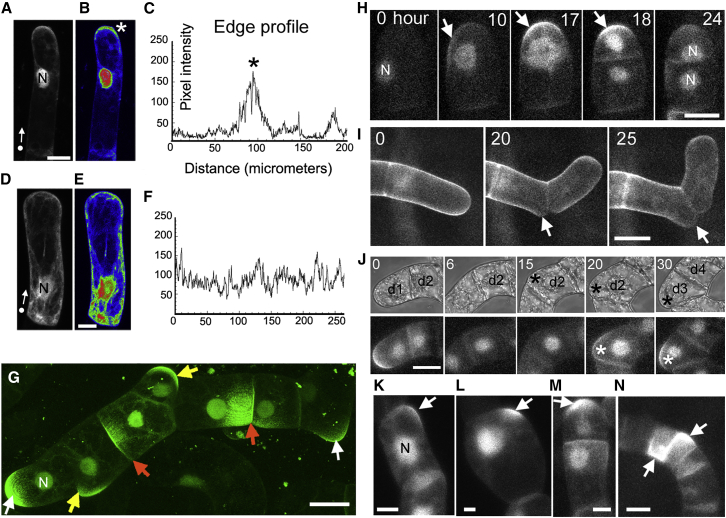
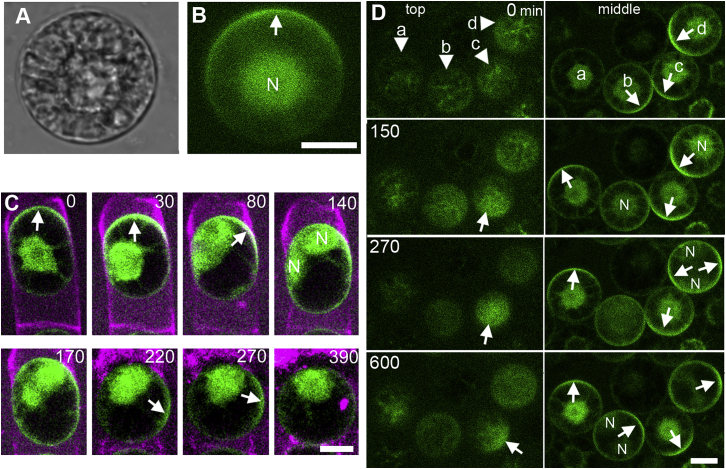
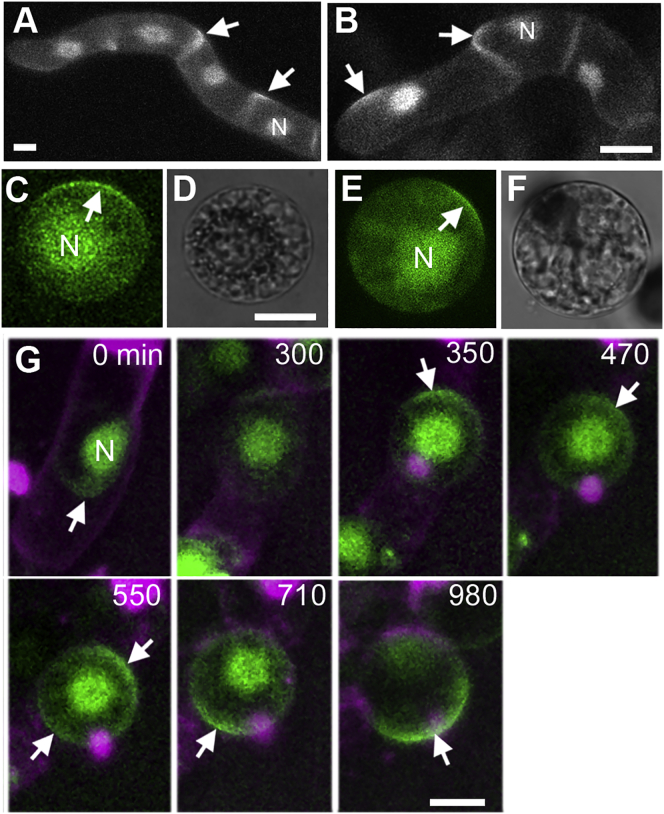
Several plant proteins are preferentially localized to one end of a cell, allowing a polarity to be assigned to the cell. These cell polarity proteins often exhibit coordinated patterns between neighboring cells, termed tissue cell polarity. Tissue cell polarity is widespread in plants and can influence how cells grow, divide, and differentiate [1-5]. However, it is unclear whether cell polarity is established through cell-intrinsic or -extrinsic mechanisms and how polarity is coupled to growth. To address these issues, we analyzed the behavior of a tissue cell polarity protein BASL (BREAKING OF ASYMMETRY IN THE STOMATAL LINEAGE) in the simplifying context of cultured cell filaments and in protoplasts before and during regeneration. We show that BASL is polarly localized when ectopically expressed in tobacco BY-2 cell cultures. Ectopic BASL is found preferentially at the developing tips of cell filaments, likely marking a polarized molecular address. Polarity can shift during the cell cycle and is resistant to treatment with microtubule, actin or auxin transport inhibitors. BASL also exhibits polar localization in spherical protoplasts, in contrast to other polarity proteins so far tested. BASL polarity within protoplasts is dynamic and resistant to auxin transport inhibitors. As protoplasts regenerate, polarity remains dynamic in isotropically growing cells but becomes fixed in anisotropic cells and aligns with the axis of cell growth. Our findings suggest that plant cells have an intrinsic ability to polarize and that environmental or developmental cues may act by biasing the direction of this polarity and thus the orientation of anisotropic growth.
几种植物蛋白优先定位于细胞的一端,从而使细胞具有极性。这些细胞极性蛋白通常在相邻细胞之间表现出协调的模式,称为组织细胞极性。组织细胞极性在植物中广泛存在,可影响细胞的生长、分裂和分化[1-5]。然而,目前尚不清楚细胞极性是通过细胞内在还是外在机制建立的,以及极性如何与生长相关联。为了解决这些问题,我们分析了 BASL(STOMATAL LINEAGE 不对称性破坏)在培养细胞丝状和原生质体中的简化背景下的行为,以及在再生前后的行为。我们发现,当 BASL 在烟草 BY-2 细胞培养物中异位表达时,它是极化定位的。异位 BASL 优先存在于细胞丝状的发育尖端,可能标志着极化的分子地址。极性可以在细胞周期中发生变化,并且对微管、肌动蛋白或生长素运输抑制剂的处理具有抗性。BASL 也在球形原生质体中表现出极性定位,与迄今为止测试的其他极性蛋白形成对比。原生质体中 BASL 的极性是动态的,并且对生长素运输抑制剂具有抗性。随着原生质体的再生,极性在各向同性生长的细胞中保持动态,但在各向异性细胞中固定,并与细胞生长的轴对齐。我们的发现表明,植物细胞具有内在的极化能力,环境或发育线索可能通过偏向这种极性的方向来发挥作用,从而确定各向异性生长的方向。