Department of Neurology, University Hospital Würzburg, 97080 Würzburg, Germany.
Department of Neuroradiology, University Hospital Würzburg, 97080 Würzburg, Germany.
Int J Mol Sci. 2020 Oct 7;21(19):7387. doi: 10.3390/ijms21197387.
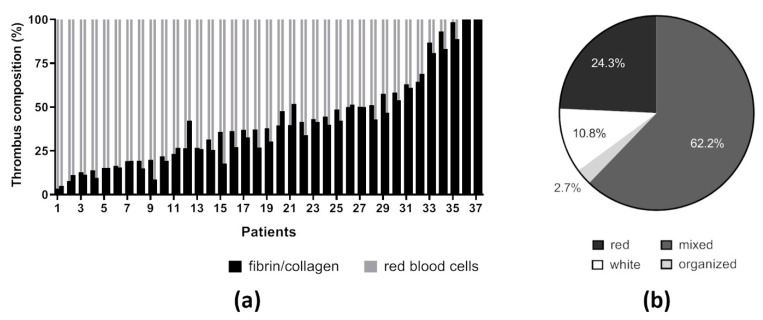
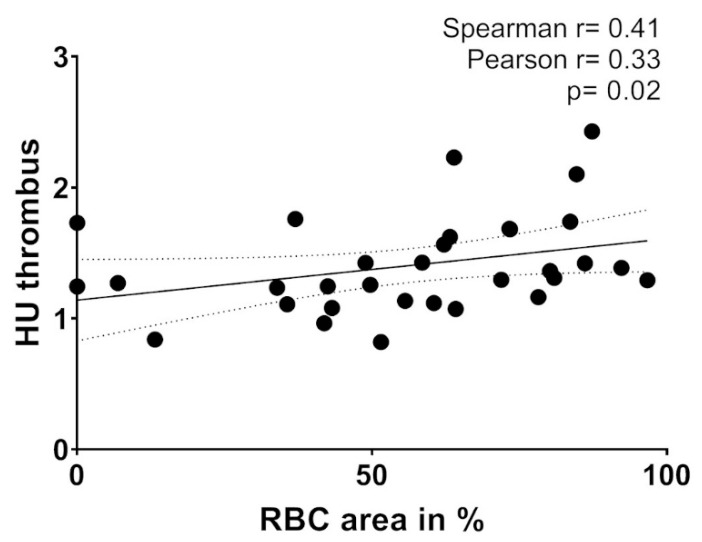
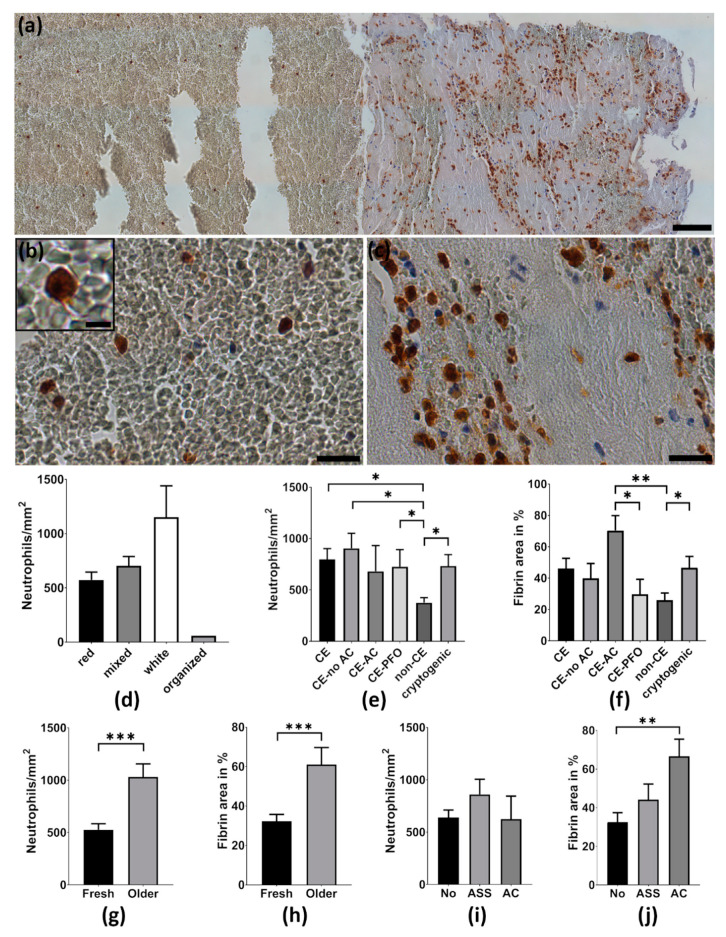
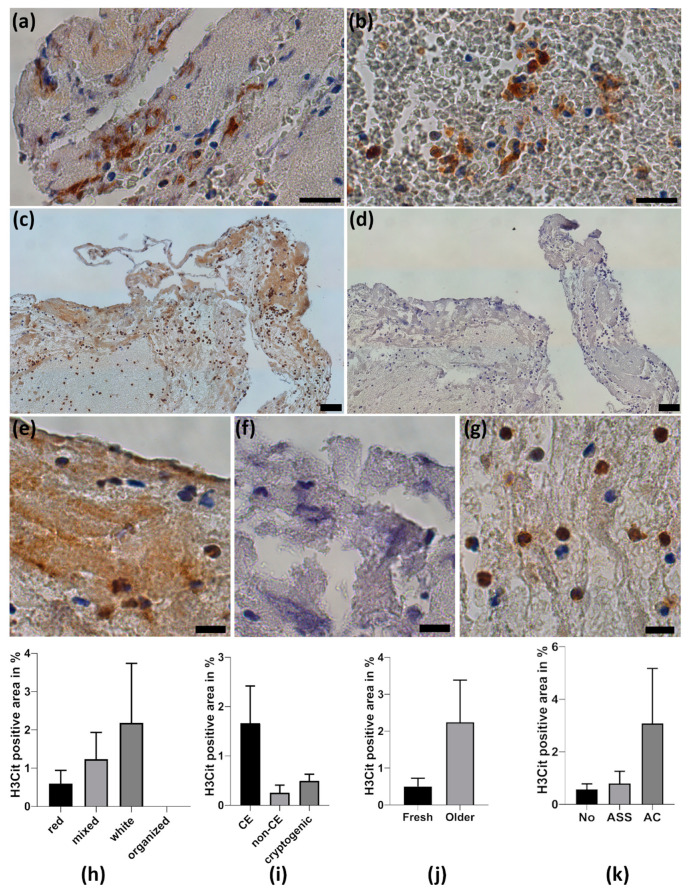
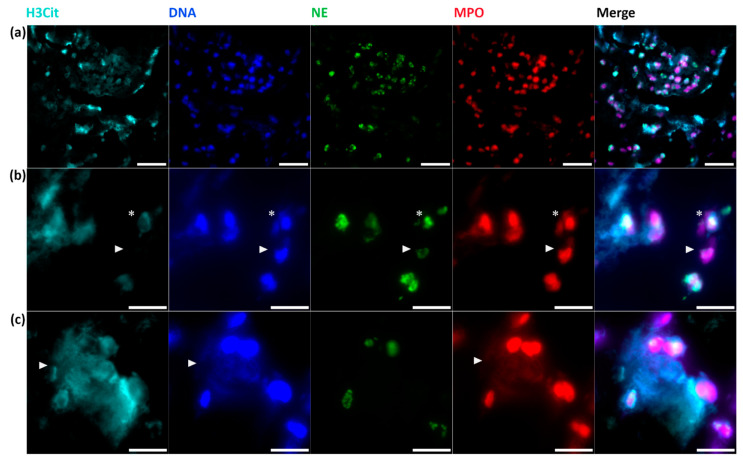
Ischemic stroke caused by thromboembolic occlusion of large cerebral arteries, such as the internal carotid (ICA) and/or the middle cerebral artery (MCA), is treated by mechanical thrombectomy (MT). MT allows salvage of the vessel-occluding thrombemboli, which most frequently originate from the left atrium or the left ventricle of the heart or from sites of plaque rupture within large arteries above the heart. Clot composition may influence the efficacy of (intravenous) thrombolysis and MT, respectively. We analyzed 37 human thrombemboli obtained from acute ischemic stroke patients during MT with special emphasis on histological staining of neutrophils and neutrophil extracellular traps (NETs). We found neutrophils as the main cellular component of cerebral thrombemboli but encountered considerable morphological heterogeneity. Neutrophils accumulated in the border region of fibrin-rich structures indicating possible interaction of neutrophils with distinct structural thrombembolus components. Web-like NETs were found in 35 of 37 thrombemboli in varying amounts. NETs were almost exclusively found within fibrin-rich areas. Importantly, stroke etiology, age and present oral anticoagulation was associated with morphological patterns and the amount of neutrophils. Correlation of histological data and imaging data revealed that relative Hounsfield units of cerebral thrombemboli positively correlated with the amount of red blood cells. In summary, our results demonstrate that neutrophils and NETs are substantial constituents of cerebral thrombemboli and contribute to their structural complexity.
由大脑大动脉(如颈内动脉 [ICA] 和/或大脑中动脉 [MCA])血栓栓塞性闭塞引起的缺血性脑卒中,采用机械血栓切除术(MT)进行治疗。MT 可以挽救血管闭塞性血栓栓塞物,这些血栓栓塞物最常来源于心脏的左心房或左心室,或来源于心脏上方大动脉内的斑块破裂部位。血栓形成的组成可能分别影响(静脉)溶栓和 MT 的疗效。我们分析了 37 例在 MT 期间从急性缺血性脑卒中患者中获得的血栓栓塞物,特别强调了对中性粒细胞和中性粒细胞胞外陷阱(NETs)的组织学染色。我们发现中性粒细胞是脑血栓栓塞物的主要细胞成分,但存在相当大的形态异质性。中性粒细胞聚集在富含纤维蛋白的结构边界区域,表明中性粒细胞可能与不同的结构血栓栓塞物成分相互作用。在 37 例血栓栓塞物中有 35 例发现了网状 NETs,数量不等。NETs 几乎仅存在于富含纤维蛋白的区域。重要的是,脑卒中病因、年龄和目前的口服抗凝治疗与中性粒细胞的形态模式和数量有关。组织学数据和影像学数据的相关性表明,脑血栓栓塞物的相对亨斯菲尔德单位与红细胞数量呈正相关。总之,我们的研究结果表明,中性粒细胞和 NETs 是脑血栓栓塞物的重要组成部分,有助于其结构复杂性。