Biswas Soumyajyoti, Fernandez Castellanos David, Zaiser Michael
WW8-Materials Simulation, Department of Materials Science, Friedrich-Alexander-Universität Erlangen-Nürnberg, Dr.-Mack-Str. 77, 90762, Fürth, Germany.
Department of Physics, SRM University - AP, Guntur, Andhra Pradesh, 522502, India.
Sci Rep. 2020 Oct 9;10(1):16910. doi: 10.1038/s41598-020-72969-6.
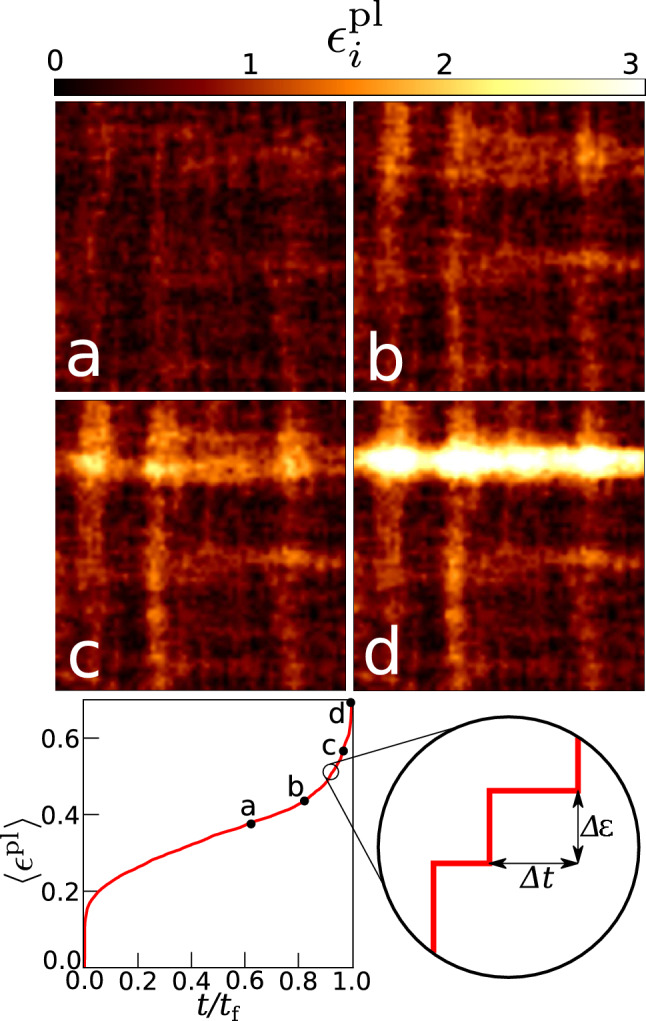
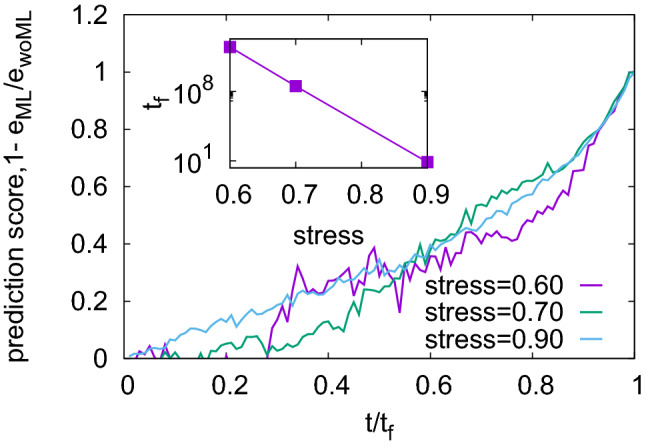
A subcritical load on a disordered material can induce creep damage. The creep rate in this case exhibits three temporal regimes viz. an initial decelerating regime followed by a steady-state regime and a stage of accelerating creep that ultimately leads to catastrophic breakdown. Due to the statistical regularities in the creep rate, the time evolution of creep rate has often been used to predict residual lifetime until catastrophic breakdown. However, in disordered samples, these efforts met with limited success. Nevertheless, it is clear that as the failure is approached, the damage become increasingly spatially correlated, and the spatio-temporal patterns of acoustic emission, which serve as a proxy for damage accumulation activity, are likely to mirror such correlations. However, due to the high dimensionality of the data and the complex nature of the correlations it is not straightforward to identify the said correlations and thereby the precursory signals of failure. Here we use supervised machine learning to estimate the remaining time to failure of samples of disordered materials. The machine learning algorithm uses as input the temporal signal provided by a mesoscale elastoplastic model for the evolution of creep damage in disordered solids. Machine learning algorithms are well-suited for assessing the proximity to failure from the time series of the acoustic emissions of sheared samples. We show that materials are relatively more predictable for higher disorder while are relatively less predictable for larger system sizes. We find that machine learning predictions, in the vast majority of cases, perform substantially better than other prediction approaches proposed in the literature.
无序材料上的亚临界载荷会引发蠕变损伤。在这种情况下,蠕变速率呈现出三个时间阶段,即初始减速阶段,随后是稳态阶段以及加速蠕变阶段,最终导致灾难性破坏。由于蠕变速率存在统计规律,蠕变速率的时间演化常被用于预测直至灾难性破坏的剩余寿命。然而,在无序样本中,这些努力取得的成功有限。尽管如此,很明显随着破坏临近,损伤在空间上的相关性越来越强,而作为损伤累积活动替代指标的声发射时空模式很可能反映出这种相关性。然而,由于数据的高维度性以及相关性的复杂性质,识别上述相关性以及由此确定破坏的前兆信号并非易事。在此,我们使用监督式机器学习来估计无序材料样本的剩余失效时间。机器学习算法将无序固体中蠕变损伤演化的中尺度弹塑性模型提供的时间信号作为输入。机器学习算法非常适合从剪切样本的声发射时间序列评估接近破坏的程度。我们表明,对于更高的无序度,材料的可预测性相对更高,而对于更大的系统尺寸,可预测性相对更低。我们发现,在绝大多数情况下,机器学习预测的表现明显优于文献中提出的其他预测方法。