Department of Pediatrics, National Jewish Health, Denver, CO, USA.
Department of Pediatrics, Anschutz Medical Center, University of Colorado Denver, Aurora, CO, USA.
Physiol Rep. 2020 Oct;8(19):e14603. doi: 10.14814/phy2.14603.
One method for assessing the in vitro response to CFTR-modulating compounds is by analysis of epithelial monolayers in an Ussing chamber, where the apical and basolateral surfaces are isolated and the potential difference, short-circuit current, and transepithelial resistance can be monitored. The effect of a chloride ion gradient across airway epithelia on transepithelial chloride transport and the magnitude of CFTR modulator efficacy were examined.
CFTR-mediated changes in the potential difference and transepithelial currents of primary human nasal epithelial cell cultures were quantified in Ussing chambers with either symmetrical solutions or reduced chloride solutions in the apical chamber. CFTR activity in homozygous F508del CFTR epithelia was rescued by treatment with VX-661, C4/C18, 4-phenylbutyrate (4-PBA) for 24 hr at 37°C or by incubation at 29°C for 48 hr.
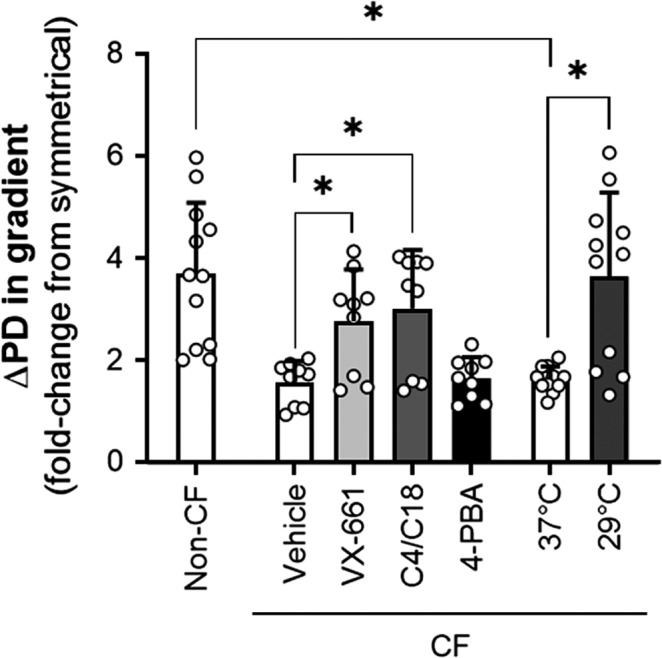
Imposing a chloride gradient increased CFTR-mediated and CaCC-mediated ion transport. Treatment of F508del CFTR homozygous cells with CFTR modulating compounds increased CFTR activity, which was significantly more evident in the presence of a chloride gradient. This observation was recapitulated with temperature-mediated F508del CFTR correction.
Imposing a chloride gradient during Ussing chamber measurements resulted in increased CFTR-mediated ion transport in expanded non-CF and F508del CFTR homozygous epithelia. In F508del CFTR homozygous epithelia, the magnitude of response to CFTR modulating compounds or low temperature was greater when assayed with a chloride gradient compared to symmetrical chloride, resulting in an apparent increase in measured efficacy. Future work may direct which methodologies utilized to quantify CFTR modulator response in vitro are most appropriate for the estimation of in vivo efficacy.
评估 CFTR 调节剂体外反应的一种方法是通过在 Ussing 室中分析上皮单层,其中隔离了顶侧和基底外侧表面,可以监测电势差、短路电流和跨上皮电阻。本文研究了气道上皮氯离子梯度对跨上皮氯离子转运的影响以及 CFTR 调节剂功效的大小。
在 Ussing 室中,使用顶侧腔中具有对称溶液或降低氯离子溶液的方法,对原代人鼻上皮细胞培养物中 CFTR 介导的电势差和跨上皮电流变化进行定量分析。用 VX-661、C4/C18、4-苯丁酸(4-PBA)处理 37°C 24 小时或在 29°C 孵育 48 小时可恢复纯合 F508del CFTR 上皮中的 CFTR 活性。
施加氯离子梯度可增加 CFTR 介导和 CaCC 介导的离子转运。用 CFTR 调节剂处理 F508del CFTR 纯合细胞可增加 CFTR 活性,在存在氯离子梯度的情况下,这一作用更为明显。这一观察结果与通过温度介导的 F508del CFTR 校正得到了重现。
在 Ussing 室测量过程中施加氯离子梯度会导致非 CF 和 F508del CFTR 纯合上皮中 CFTR 介导的离子转运增加。在 F508del CFTR 纯合上皮中,与对称氯离子相比,用氯离子梯度检测 CFTR 调节剂或低温对 CFTR 调节剂的反应幅度更大,从而导致测量功效的表观增加。未来的研究可能会指导在体外量化 CFTR 调节剂反应的方法中,哪种方法最适合估计体内疗效。