ARCUS Sportklinik, Rastatterstr. 17-19, 75179, Pforzheim, Germany.
Department of Orthopedics and Orthopedic Surgery, University Medicine Greifswald, Ferdinand-Sauerbruch-Straße, 17475, Greifswald, Germany.
Arch Orthop Trauma Surg. 2022 Feb;142(2):189-195. doi: 10.1007/s00402-020-03623-z. Epub 2020 Oct 12.
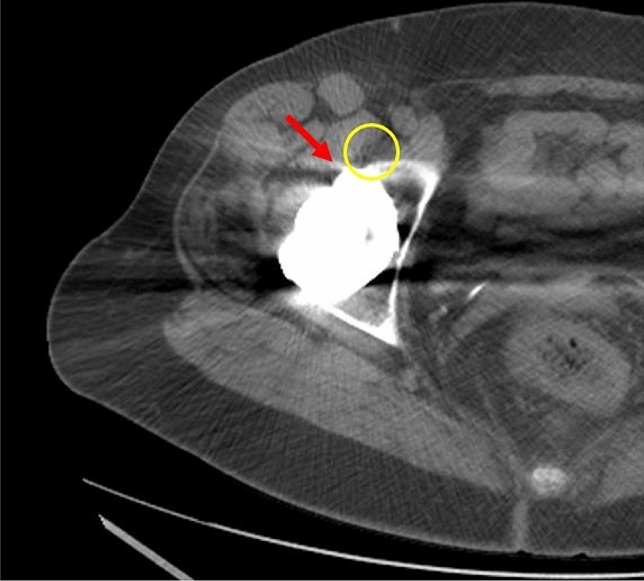
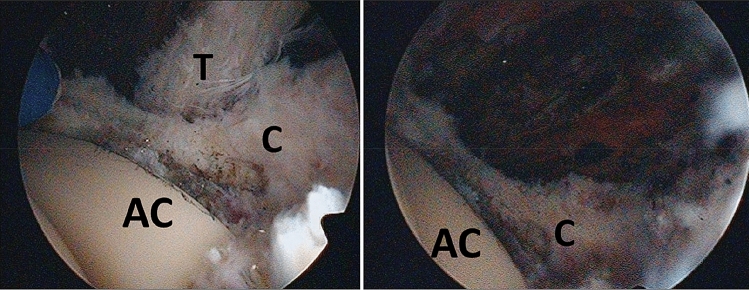
A cause of groin pain after total hip arthroplasty (THA) is mechanical irritation or impingement of the iliopsoas tendon. The incidence is about 4%. If conservative therapy fails, an arthroscopic release of the iliopsoas tendon can be performed. The aim of the study was to assess the mid-term clinical outcome after arthroscopic release. We hypothesize that good results can be achieved by a minimally invasive endoscopic procedure.
Using our in-house database, all patients who received an endoscopic release of the iliopsoas tendon due to mechanical irritation after THA were identified. Inclusion criteria were mechanical irritation of the iliopsoas tendon after cementless THA with minimal acetabular component prominence. Exclusion criteria were marked prominence of the acetabular component and groin pain after THA for any other reason. In these patients, the modified Harris Hip Score (mHHS), the pain level using the numerical analogue scale and the UCLA Activity Score were measured. The mean follow-up period was 7 ± 3.8 (2.6-11.7) years.
25 patients were identified in whom an arthroscopic release of the iliopsoas tendon had been performed since 2007. The data of 20 patients were available at follow-up. The gender ratio was 1:1, the average age at the time of arthroscopy was 59 ± 27.7 (52-78) years. The average interval between THA and arthroscopy was 6.3 ± 4.0 (1.7-15) years. The mHHS showed a significant improvement from preoperative 31.2 ± 9.8 (17.6-47.3) to 82.0 ± 9.8 (46.2-100) points (p = 0.001). The pain level on the NAS decreased significantly from 8.5 ± 1.2 (7-10) to 2.5 ± 1.8 (0-6) points (p = 0.001). The activity level based on the UCLA Activity Score raised from 4.0 ± 2.7 (0-7) to 6.5 ± 1.8 (3-9) (p = 0.09).
Mechanical irritation and impingement of the iliopsoas tendon is an important diagnosis to be considered in persistent groin pain after total hip arthroplasty. In failure of non-operative treatment, good clinical results can be achieved with arthroscopic release and the pain level can be significantly reduced.
IV.
全髋关节置换术后(THA)引起的腹股沟疼痛的一个原因是髂腰肌肌腱的机械性刺激或撞击。发病率约为 4%。如果保守治疗失败,可以进行关节镜下髂腰肌肌腱松解术。本研究的目的是评估关节镜下释放后的中期临床结果。我们假设通过微创内镜手术可以取得良好的效果。
使用我们的内部数据库,确定了所有因 THA 后机械性刺激而接受关节镜下髂腰肌肌腱松解术的患者。纳入标准为非骨水泥 THA 后髂腰肌肌腱机械性刺激,髋臼部件最小突出。排除标准为髋臼部件明显突出和 THA 后任何其他原因引起的腹股沟疼痛。在这些患者中,采用改良 Harris 髋关节评分(mHHS)、数字模拟量表疼痛程度和 UCLA 活动评分进行测量。平均随访时间为 7 ± 3.8(2.6-11.7)年。
2007 年以来,共发现 25 例患者行关节镜下髂腰肌肌腱松解术。20 例患者的随访资料完整。性别比例为 1:1,关节镜检查时的平均年龄为 59 ± 27.7(52-78)岁。THA 与关节镜检查之间的平均间隔为 6.3 ± 4.0(1.7-15)年。mHHS 从术前的 31.2 ± 9.8(17.6-47.3)分显著改善至 82.0 ± 9.8(46.2-100)分(p = 0.001)。数字模拟量表疼痛评分从 8.5 ± 1.2(7-10)显著降至 2.5 ± 1.8(0-6)分(p = 0.001)。UCLA 活动评分的活动水平从 4.0 ± 2.7(0-7)提高至 6.5 ± 1.8(3-9)(p = 0.09)。
机械性刺激和髂腰肌肌腱撞击是全髋关节置换术后持续性腹股沟疼痛的重要诊断。对于非手术治疗失败的患者,关节镜下松解术可取得良好的临床效果,并显著减轻疼痛程度。
IV 级。