Division of Cardiology, Department of Internal Medicine, Cardiovascular Center, Keimyung University Dongsan Hospital, Keimyung University College of Medicine, Daegu, Korea.
Division of Infectious Disease, Department of Internal Medicine, Keimyung University Dongsan Hospital, Keimyung University College of Medicine, Daegu, Korea.
J Korean Med Sci. 2020 Oct 12;35(39):e349. doi: 10.3346/jkms.2020.35.e349.
The severe acute respiratory syndrome-coronavirus 2 (SARS-CoV-2) has spread worldwide. Cardiac injury after SARS-CoV-2 infection is a major concern. The present study investigated impact of the biomarkers indicating cardiac injury in coronavirus disease 2019 (COVID-19) on patients' outcomes.
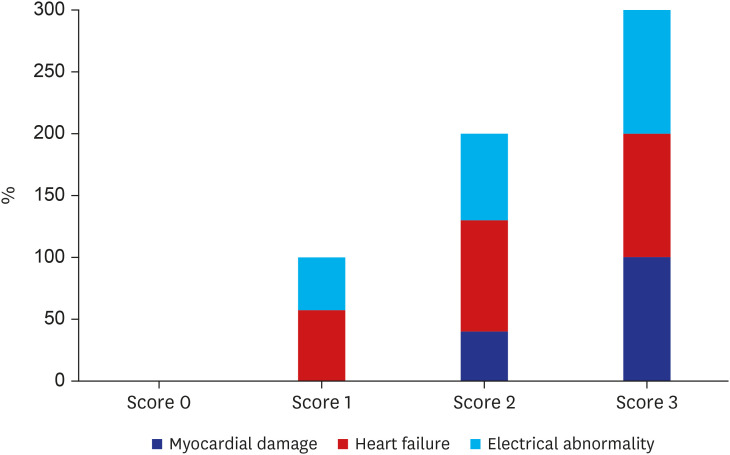
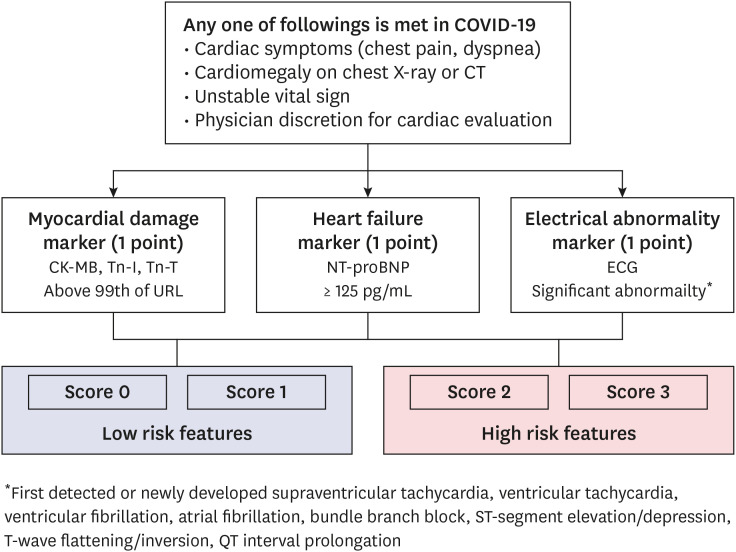
This study enrolled patients who were confirmed to have COVID-19 and admitted at a tertiary university referral hospital between February 19, 2020 and March 15, 2020. Cardiac injury was defined as an abnormality in one of the following result markers: 1) myocardial damage marker (creatine kinase-MB or troponin-I), 2) heart failure marker (N-terminal-pro B-type natriuretic peptide), and 3) electrical abnormality marker (electrocardiography). The relationship between each cardiac injury marker and mortality was evaluated. Survival analysis of mortality according to the scoring by numbers of cardiac injury markers was also performed.
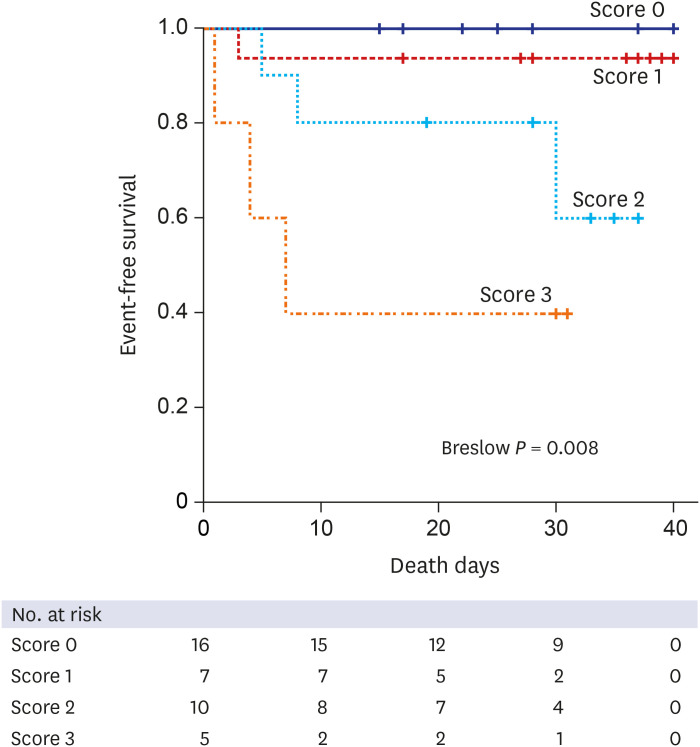
A total of 38 patients with COVID-19 were enrolled. Twenty-two patients (57.9%) had at least one of cardiac injury markers. The patients with cardiac injuries were older (69.6 ± 14.9 vs. 58.6 ± 13.9 years old, = 0.026), and were more male (59.1% vs. 18.8%, = 0.013). They showed lower initial oxygen saturation (92.8 vs. 97.1%, = 0.002) and a trend toward higher mortality (27.3 vs. 6.3%, = 0.099). The increased number of cardiac injury markers was significantly related to a higher incidence of in-hospital mortality which was also evidenced by Kaplan-Meier survival analysis ( = 0.008).
The increased number of cardiac injury markers is related to in-hospital mortality in patients with COVID-19.
严重急性呼吸综合征冠状病毒 2(SARS-CoV-2)已在全球范围内传播。SARS-CoV-2 感染后的心脏损伤是一个主要关注点。本研究调查了表明 2019 年冠状病毒病(COVID-19)患者心脏损伤的生物标志物对患者结局的影响。
本研究纳入了 2020 年 2 月 19 日至 2020 年 3 月 15 日期间在一家三级大学转诊医院确诊为 COVID-19 并入院的患者。心脏损伤定义为以下结果标志物之一异常:1)心肌损伤标志物(肌酸激酶-MB 或肌钙蛋白 I),2)心力衰竭标志物(N 末端 pro B 型利钠肽)和 3)电异常标志物(心电图)。评估了每种心脏损伤标志物与死亡率之间的关系。还根据心脏损伤标志物数量进行评分,对死亡率进行生存分析。
共纳入 38 例 COVID-19 患者。22 例(57.9%)至少有一种心脏损伤标志物。有心脏损伤的患者年龄更大(69.6 ± 14.9 岁 vs. 58.6 ± 13.9 岁, = 0.026),且更多为男性(59.1% vs. 18.8%, = 0.013)。他们的初始氧饱和度较低(92.8% vs. 97.1%, = 0.002),且死亡率有升高趋势(27.3% vs. 6.3%, = 0.099)。心脏损伤标志物数量的增加与住院期间死亡率的升高显著相关,Kaplan-Meier 生存分析也证明了这一点( = 0.008)。
COVID-19 患者心脏损伤标志物数量的增加与住院期间死亡率相关。