• 文献检索
  • 文档翻译
  • 深度研究
  • 学术资讯
  • Suppr Zotero 插件Zotero 插件
  • 邀请有礼
  • 套餐&价格
  • 历史记录
应用&插件
Suppr Zotero 插件Zotero 插件浏览器插件Mac 客户端Windows 客户端微信小程序
定价
高级版会员购买积分包购买API积分包
服务
文献检索文档翻译深度研究API 文档MCP 服务
关于我们
关于 Suppr公司介绍联系我们用户协议隐私条款
关注我们

Suppr 超能文献

核心技术专利:CN118964589B侵权必究
粤ICP备2023148730 号-1Suppr @ 2026

文献检索

告别复杂PubMed语法,用中文像聊天一样搜索,搜遍4000万医学文献。AI智能推荐,让科研检索更轻松。

立即免费搜索

文件翻译

保留排版,准确专业,支持PDF/Word/PPT等文件格式,支持 12+语言互译。

免费翻译文档

深度研究

AI帮你快速写综述,25分钟生成高质量综述,智能提取关键信息,辅助科研写作。

立即免费体验

胫骨骨干骨折的现代治疗:闭合治疗今天还有作用吗?

Modern treatment of tibial shaft fractures: Is there a role today for closed treatment?

机构信息

University of Massachusetts, Department of Orthopaedic Surgery, Worcester MA, United States of America.

University of Massachusetts, Department of Orthopaedic Surgery, Worcester MA, United States of America.

出版信息

Injury. 2021 Jun;52(6):1522-1528. doi: 10.1016/j.injury.2020.10.018. Epub 2020 Oct 5.

DOI:10.1016/j.injury.2020.10.018
PMID:33046252
原文链接:https://pmc.ncbi.nlm.nih.gov/articles/PMC7534823/
Abstract

PURPOSE

The decision to attempt closed treatment on tibial shaft fractures can be challenging. At our institution, we attempt treatment of nearly all closed, isolated tibial shaft fractures. The purpose of this study was to report the results of 10 years of experience to develop a tool to identify patients for whom non-operative treatment of tibial shaft fractures may be a viable option METHOD: This was a retrospective review of patients with tibial shaft fracture seen at a level 1 trauma center over 10 years. Patients with closed, isolated injuries underwent sedation, closed reduction, long-leg casting, and outpatient follow-up. Patients were converted to surgery for inability to obtain or maintain acceptable alignment or patient intolerance. Radiographic characteristics and patient demographics were extracted. Logistic regression analysis was used to develop a model to predict which patient and injury characteristics determined success of nonoperative treatment.

RESULTS

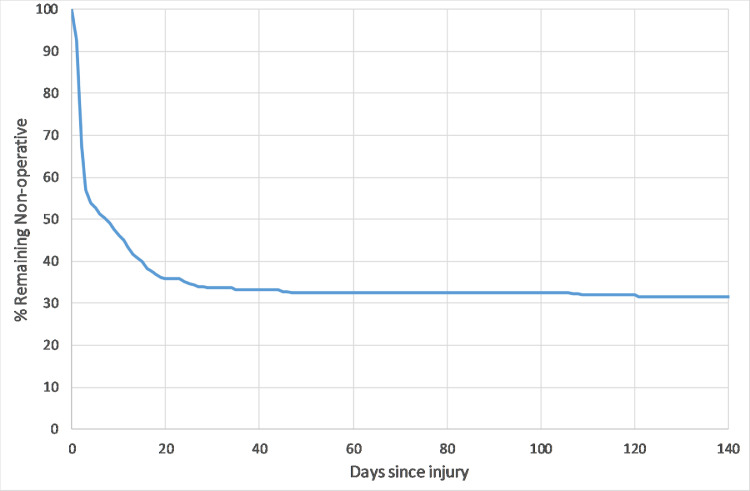
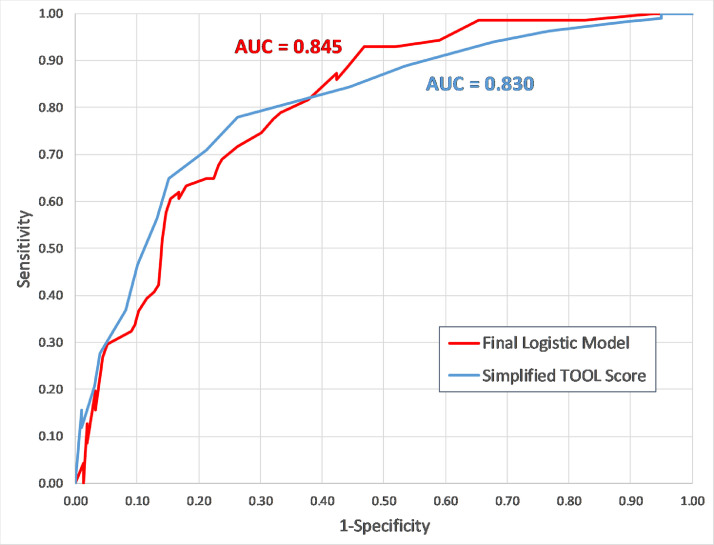
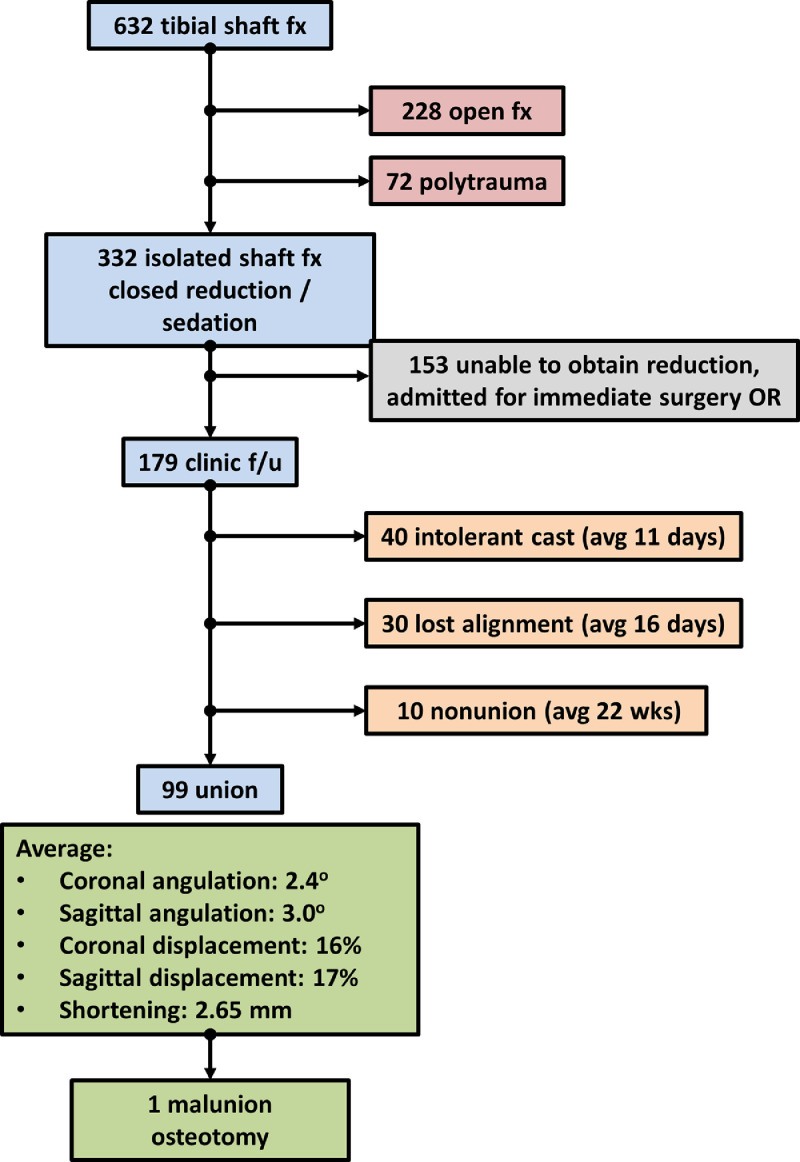
334 patients were identified with isolated, closed tibial shaft fractures, who were reduced and treated in a long leg cast. 234 patients (70%) converted to surgical treatment due to inability to maintain alignment, patient intolerance, and nonunion. In a regression model, coronal/sagittal translation, sagittal angulation, fracture morphology, and smoking status were shown to be significant predictors of success of nonoperative treatment (p < 0.05). We developed a Tibial Operative Outcome Likelihood (TOOL) score designed to help predict success or failure of closed treatment. The TOOL score can be used to identify a subsegment of patients with injuries amenable to closed treatment (38% of injuries) with a nonoperative success rate over 60%.

CONCLUSION

Non-operative treatment of tibial shaft fractures is feasible, although there is a relatively high conversion rate to operative treatment. However, it is possible to use injury characteristics to identify a cohort of patients with a higher chance of success with closed treatment, which is potentially useful in a resource-constrained setting or for patients who wish to avoid surgery.

LEVEL OF EVIDENCE

Prognostic Level 3.

摘要

目的

尝试闭合治疗胫骨骨干骨折的决策具有挑战性。在我们的机构中,我们尝试治疗几乎所有闭合性、孤立性胫骨骨干骨折。本研究的目的是报告 10 年经验的结果,以开发一种工具,以确定非手术治疗胫骨骨干骨折可能是可行选择的患者。

方法

这是对 10 年来在 1 级创伤中心就诊的胫骨骨干骨折患者的回顾性研究。闭合性、孤立性损伤的患者接受镇静、闭合复位、长腿石膏固定和门诊随访。对于无法获得或维持可接受的对线或患者不耐受的患者,转换为手术治疗。提取患者的影像学特征和人口统计学资料。使用逻辑回归分析来建立一个模型,以预测哪些患者和损伤特征决定非手术治疗的成功。

结果

确定了 334 例孤立性、闭合性胫骨骨干骨折患者,他们接受了复位和长腿石膏固定治疗。234 例(70%)由于无法维持对线、患者不耐受和不愈合而转换为手术治疗。在回归模型中,冠状/矢状面平移、矢状面成角、骨折形态和吸烟状况被证明是非手术治疗成功的显著预测因素(p<0.05)。我们开发了一个胫骨手术结果可能性(TOOL)评分,旨在帮助预测闭合治疗的成功或失败。TOOL 评分可用于识别具有闭合治疗适应证的亚段患者(38%的损伤),非手术成功率超过 60%。

结论

胫骨骨干骨折的非手术治疗是可行的,尽管手术治疗的转化率相对较高。然而,使用损伤特征来识别具有更高闭合治疗成功率的患者队列是可能的,这在资源有限的环境中或对于希望避免手术的患者可能是有用的。

证据水平

预后 3 级。

https://cdn.ncbi.nlm.nih.gov/pmc/blobs/28ec/7534823/dbe8125cbb2c/gr3_lrg.jpg
https://cdn.ncbi.nlm.nih.gov/pmc/blobs/28ec/7534823/c246f56364f2/gr1_lrg.jpg
https://cdn.ncbi.nlm.nih.gov/pmc/blobs/28ec/7534823/00918e92659e/gr2_lrg.jpg
https://cdn.ncbi.nlm.nih.gov/pmc/blobs/28ec/7534823/dbe8125cbb2c/gr3_lrg.jpg
https://cdn.ncbi.nlm.nih.gov/pmc/blobs/28ec/7534823/c246f56364f2/gr1_lrg.jpg
https://cdn.ncbi.nlm.nih.gov/pmc/blobs/28ec/7534823/00918e92659e/gr2_lrg.jpg
https://cdn.ncbi.nlm.nih.gov/pmc/blobs/28ec/7534823/dbe8125cbb2c/gr3_lrg.jpg

相似文献

1
Modern treatment of tibial shaft fractures: Is there a role today for closed treatment?胫骨骨干骨折的现代治疗:闭合治疗今天还有作用吗?
Injury. 2021 Jun;52(6):1522-1528. doi: 10.1016/j.injury.2020.10.018. Epub 2020 Oct 5.
2
Not Just Small Adults: Operative Versus Nonoperative Treatment in Adolescent Tibial Shaft Fractures.不仅仅是小大人:青少年胫骨骨干骨折的手术与非手术治疗。
J Pediatr Orthop. 2024 Apr 1;44(4):e316-e322. doi: 10.1097/BPO.0000000000002610. Epub 2024 Jan 5.
3
Immediate intramedullary flexible nailing of open pediatric tibial shaft fractures.开放性小儿胫骨干骨折的即刻髓内弹性钉固定
J Pediatr Orthop. 2012 Dec;32(8):770-6. doi: 10.1097/BPO.0b013e318270468b.
4
Open Reduction of Closed Pediatric Tibial Shaft Fractures Treated With Intramedullary Stabilization Does Not Increase Risk of Postoperative Complications.闭合性儿童胫骨骨干骨折切开复位髓内固定并不会增加术后并发症风险。
J Orthop Trauma. 2020 Sep;34(9):482-487. doi: 10.1097/BOT.0000000000001762.
5
A prospective multi-center study of intramedullary nailing vs casting of stable tibial shaft fractures.一项关于稳定型胫骨干骨折髓内钉固定与石膏固定的前瞻性多中心研究。
J Orthop Traumatol. 2017 Mar;18(1):69-76. doi: 10.1007/s10195-016-0429-4. Epub 2016 Oct 21.
6
Displaced Tibial Shaft Fractures With Intact Fibula in Children: Nonoperative Management Versus Operative Treatment With Elastic Stable Intramedullary Nailing.儿童腓骨完整的移位胫骨干骨折:非手术治疗与弹性稳定髓内钉手术治疗的对比
J Pediatr Orthop. 2016 Oct-Nov;36(7):667-72. doi: 10.1097/BPO.0000000000000528.
7
Prevalence and distribution of air in the leg on preoperative multidetector high-resolution computed tomography in closed and low-grade open tibial shaft fractures.闭合性及低级别开放性胫骨干骨折术前多排高分辨率计算机断层扫描中腿部空气的患病率及分布情况
J Orthop Surg (Hong Kong). 2019 Jan-Apr;27(1):2309499019825585. doi: 10.1177/2309499019825585.
8
Percutaneous or Open Reduction of Closed Tibial Shaft Fractures During Intramedullary Nailing Does Not Increase Wound Complications, Infection or Nonunion Rates.髓内钉固定期间经皮或切开复位闭合性胫骨干骨折不会增加伤口并发症、感染或骨不连发生率。
J Orthop Trauma. 2017 Apr;31(4):215-219. doi: 10.1097/BOT.0000000000000777.
9
Does open reduction increase the chance of infection during intramedullary nailing of closed tibial shaft fractures?切开复位会增加闭合性胫骨干骨折髓内钉固定期间的感染几率吗?
J Orthop Trauma. 2006 May;20(5):317-22. doi: 10.1097/00005131-200605000-00004.
10
Individual risk factors for deep infection and compromised fracture healing after intramedullary nailing of tibial shaft fractures: a single centre experience of 480 patients.胫骨干骨折髓内钉固定术后深部感染和骨折愈合不良的个体风险因素:480例患者的单中心经验
Injury. 2015 Apr;46(4):740-5. doi: 10.1016/j.injury.2014.12.018. Epub 2014 Dec 27.

引用本文的文献

1
Evaluation of the effectiveness of suprapatellar versus infrapatellar approach in intramedullary nailing for the treatment of tibial fractures.髌上入路与髌下入路在胫骨骨折髓内钉固定治疗中的有效性评估。
Eur J Med Res. 2025 Jul 9;30(1):599. doi: 10.1186/s40001-025-02865-0.
2
Static versus dynamic intramedullary nailing for femoral and tibial shaft fractures: a double-blind, randomized clinical trial.股骨和胫骨干骨折的静态与动态髓内钉固定:一项双盲随机临床试验
Ann Med Surg (Lond). 2025 Mar 27;87(4):2006-2013. doi: 10.1097/MS9.0000000000003108. eCollection 2025 Apr.
3
Impact of Surgical Timing on Fracture Healing in Tibial Shaft Injuries: A Comparative Review of Intramedullary Nailing Techniques.
手术时机对胫骨干骨折愈合的影响:髓内钉技术的比较性综述
Cureus. 2024 Oct 7;16(10):e70978. doi: 10.7759/cureus.70978. eCollection 2024 Oct.
4
WEDGE FRAGMENT VARIATIONS OF TIBIAL SHAFT FRACTURES WITH INTRAMEDULLARY NAILING.带髓内钉固定的胫骨干骨折的楔形骨折块变异
Acta Ortop Bras. 2023 Sep 8;31(spe3):e268124. doi: 10.1590/1413-785220233103e268124. eCollection 2023.
5
Closed Fracture Treatment in Adults, When is it Still Relevant?成人闭合性骨折的治疗,何时仍具相关性?
Spartan Med Res J. 2022 Feb 24;7(1):28060. doi: 10.51894/001c.28060. eCollection 2022.
6
Mortality and morbidity following operative management of tibial shaft fractures in octogenarians.80 岁以上老年人胫骨骨干骨折手术治疗后的死亡率和发病率。
Eur J Orthop Surg Traumatol. 2023 Feb;33(2):299-304. doi: 10.1007/s00590-021-03180-0. Epub 2022 Jan 15.