González-González Ana Isabel, Perestelo-Pérez Lilisbeth, Koatz Débora, Ballester Marta, Pacheco-Huergo Valeria, Ramos-García Vanesa, Torres-Castaño Alezandra, Rivero-Santana Amado, Toledo-Chávarri Ana, Valcárcel-Nazco Cristina, Mateos-Rodilla Juana, Obaya-Rebollar Juan Carlos, García-García Javier, Díaz-Sánchez Santiago, Morales-Cobos Luis, Bosch-Fontcuberta Josep María, Vallejo-Camazón Nuria, Rodríguez-Almodovar Ana, Del Castillo José Carlos, Muñoz-Balsa Marcos, Del Rey-Granado Yolanda, Garrido-Elustondo Sofía, Tello-Bernabé María-Eugenia, Ramírez-Puerta Ana Belén, Orrego Carola
Goethe-Universitat Frankfurt am Main Institut fur Allgemeinmedizin, Frankfurt am Main, Hessen, Germany
Red de Investigación en Servicios de Salud en Enfermedades Crónicas (REDISSEC), Gerencia Asistencial de Atención Primaria, Servicio Madrileño de Madrid, Madrid, Spain.
BMJ Open. 2020 Oct 12;10(10):e037374. doi: 10.1136/bmjopen-2020-037374.
Virtual Communities of Practice (VCoP) or knowledge-sharing virtual communities offer ubiquitous access to information and exchange possibilities for people in similar situations, which might be especially valuable for the self-management of patients with chronic diseases. In view of the scarce evidence on the clinical and economic impact of these interventions on chronic conditions, we aim to evaluate the effectiveness and cost-effectiveness of a VCoP in the improvement of the activation and other patient empowerment measures in patients with ischaemic heart disease (IHD).
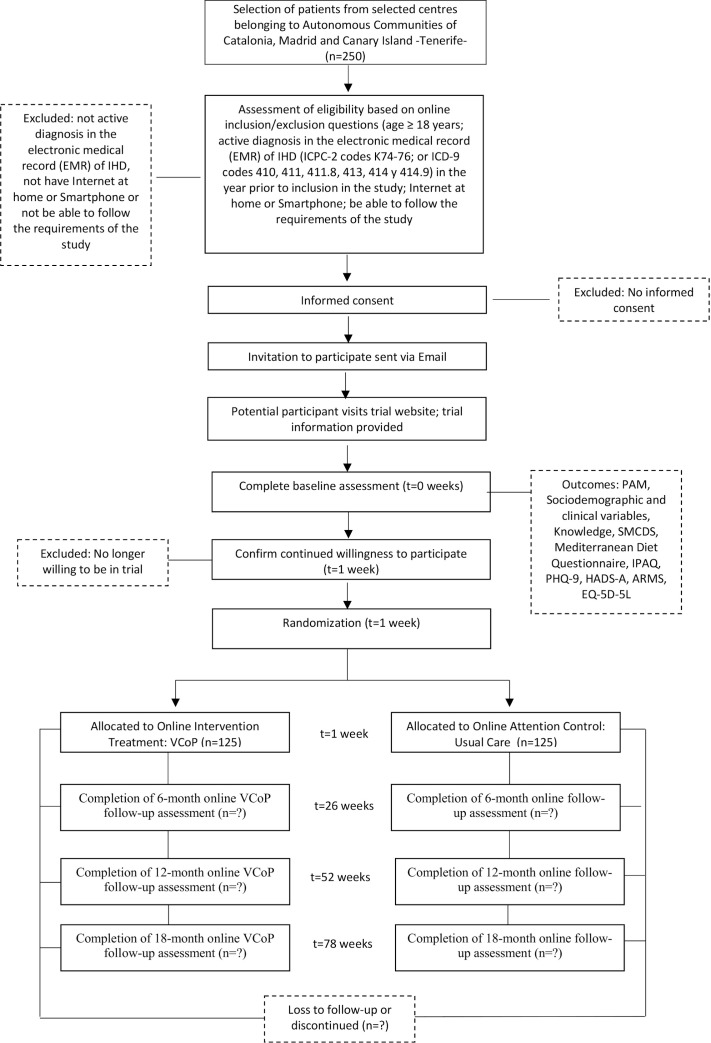
A pragmatic randomised controlled trial will be performed in Catalonia, Madrid and Canary Islands, Spain. Two hundred and fifty patients with a recent diagnosis of IHD attending the participating centres will be selected and randomised to the intervention or control group. The intervention group will be offered participation for 12 months in a VCoP based on a gamified web 2.0 platform where there is interaction with other patients and a multidisciplinary professional team. Intervention and control groups will receive usual care. The primary outcome will be measured with the Patient Activation Measure questionnaire at baseline, 6, 12 and 18 months. Secondary outcomes will include: clinical variables; knowledge (Questionnaire of Cardiovascular Risk Factors), attitudes (Self-efficacy Managing Chronic Disease Scale), adherence to the Mediterranean diet (Mediterranean Diet Questionnaire), level of physical activity (International Physical Activity Questionnaire), depression (Patient Health Questionnaire), anxiety (Hospital Anxiety Scale-A), medication adherence (Adherence to Refill Medication Scale), quality of life (EQ-5D-5L) and health resources use. Data will be collected from self-reported questionnaires and electronic medical records.
The trial was approved by Clinical Research Ethics Committee of Gregorio Marañón University Hospital in Madrid, Nuestra Señora de Candelaria University Hospital in Santa Cruz de Tenerife and IDIAP Jordi Gol in Barcelona. The results will be disseminated through workshops, policy briefs, peer-reviewed publications, local/international conferences.
ClinicalTrials.gov Registry (NCT03959631). Pre-results.
实践虚拟社区(VCoP)或知识共享虚拟社区为处于相似情况的人们提供了无处不在的信息获取途径和交流机会,这对于慢性病患者的自我管理可能特别有价值。鉴于关于这些干预措施对慢性病的临床和经济影响的证据稀少,我们旨在评估一个实践虚拟社区在改善缺血性心脏病(IHD)患者的激活状态及其他患者赋权措施方面的有效性和成本效益。
将在西班牙加泰罗尼亚、马德里和加那利群岛进行一项实用随机对照试验。将选择250名近期诊断为IHD且在参与中心就诊的患者,并随机分为干预组或对照组。干预组将被提供在一个基于游戏化网络2.0平台的实践虚拟社区中参与12个月的机会,在该平台上患者可与其他患者及多学科专业团队进行互动。干预组和对照组将接受常规护理。主要结局将在基线、6个月、12个月和18个月时使用患者激活度量表问卷进行测量。次要结局将包括:临床变量;知识(心血管危险因素问卷)、态度(慢性病自我效能量表)、对地中海饮食的依从性(地中海饮食问卷)、身体活动水平(国际身体活动问卷)、抑郁(患者健康问卷)、焦虑(医院焦虑量表-A)、药物依从性(药物续方依从性量表)、生活质量(EQ-5D-5L)以及卫生资源利用。数据将从自我报告问卷和电子病历中收集。
该试验已获得马德里格雷戈里奥·马拉尼翁大学医院、圣克鲁斯-德特内里费的圣母坎德拉利亚大学医院以及巴塞罗那的IDIAP Jordi Gol临床研究伦理委员会的批准。研究结果将通过研讨会、政策简报、同行评审出版物、地方/国际会议进行传播。
ClinicalTrials.gov注册库(NCT03959631)。预结果。