The Third Hospital of Hebei Medical University, Shijiazhuang, China.
Key Laboratory of Biomechanics of Hebei Province, Orthopaedic Research Institution of Hebei Province, Shijiazhuang, China.
Orthop Surg. 2020 Dec;12(6):1768-1775. doi: 10.1111/os.12812. Epub 2020 Oct 12.
To investigate whether closed suction drainage (CSD) is related to accelerated rehabilitation of patients after open reduction and internal fixation (ORIF) for closed distal femur fractures.
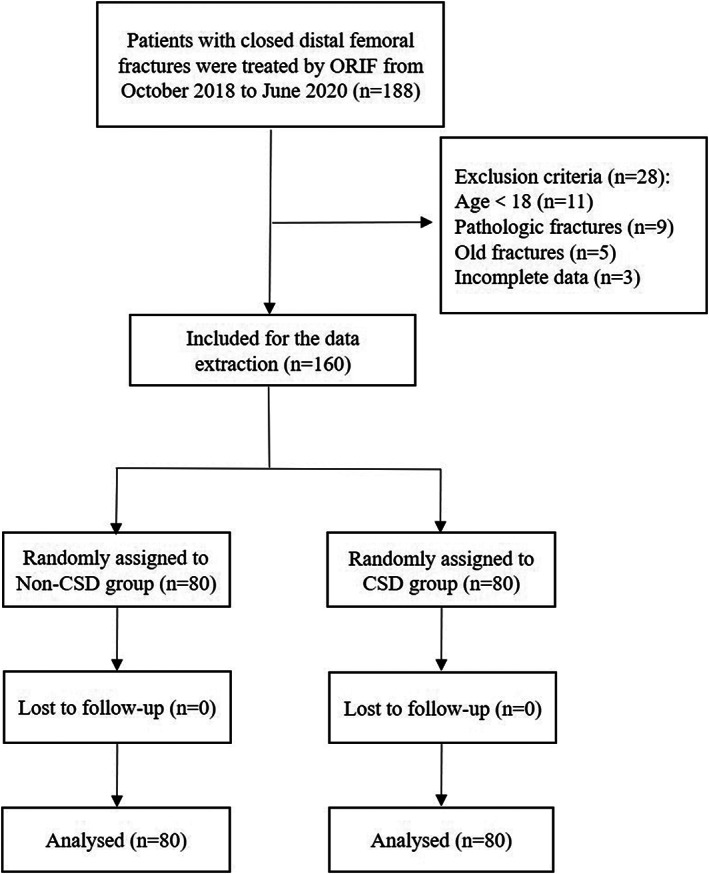
This study was a prospective, randomized controlled clinical trial. Between October 2018 and June 2020, 160 closed distal femur fracture patients who were prepared for ORIF were prospectively randomized into two groups: a CSD group with the mean age of 57.91 ± 14.38 years (32 [40%] men and 48 [60%] women) and a non-CSD group with the mean age of 59.73 ± 17.55 years (27 [34%] men and 54 [66%] women). Wound visual analogue scale (VAS) pain scores, peri-wound skin temperature, hematocrit (Hct), hemoglobin (Hb) concentrations, hidden blood loss (HBL), dressing change, period of wound oozing, postoperative blood transfusion, and length of postoperative hospital stay were recorded. Postoperative wound complications, namely wound infections, wound haematoma, wound dehiscence, erythema of wound, and lower limb deep vein thrombosis (DVT) were collected. All the patients were administrated by a single surgical team and followed up for 1 month after the ORIF.
The patients without CSD were identified with lower peri-wound skin temperature and wound VAS pain scores during the first three postoperative days (36.69 ± 0.33 vs 36.86 ± 0.38 °C, P = 0.002; 1.88 ± 0.82 vs 3.15 ± 1.15, P = 0.000). However, both the peri-wound skin temperature and wound VAS pain scores did not differ significantly between the two groups on the fifth postoperative day. In addition, patients with CSD had a longer length of postoperative hospitalization time (11.45 ± 5.95 vs 9.78 ± 4.64 days, P = 0.049). There was no statistically significant difference between CSD and non-CSD groups within 1 month after the ORIF regarding blood loss, period of wound oozing, and postoperative complications, such as incidence of wound infection, haematoma, erythema, dehiscence, and lower limb DVT.
Prophylactic CSD after primary ORIF for closed distal femur fractures not only had no significant advantage to minimize blood loss and wound complications, but increased local inflammation and postoperative hospital stay, and thus we suggest that prophylactic CSD after primary ORIF for closed distal femur fractures is not recommended for optimized clinical pathways and accelerated recovery.
探讨闭合复位内固定(ORIF)术后应用持续冲洗引流(CSD)是否会影响闭合性股骨远端骨折患者的康复。
本研究为前瞻性、随机对照临床试验。2018 年 10 月至 2020 年 6 月,前瞻性随机将 160 例拟行 ORIF 的闭合性股骨远端骨折患者分为两组:CSD 组(n=80),平均年龄 57.91±14.38 岁(男 32 例,占 40%;女 48 例,占 60%);非 CSD 组(n=80),平均年龄 59.73±17.55 岁(男 27 例,占 34%;女 54 例,占 66%)。记录两组患者术后伤口视觉模拟评分(VAS)疼痛评分、切口周围皮肤温度、红细胞压积(Hct)、血红蛋白(Hb)浓度、隐性失血量(HBL)、换药时间、切口渗血时间、术后输血、术后住院时间。术后伤口并发症(感染、血肿、切口裂开、切口红肿、下肢深静脉血栓形成)。所有患者均由同一手术团队治疗,并在 ORIF 后随访 1 个月。
与非 CSD 组相比,CSD 组患者术后第 1~3 天切口周围皮肤温度和伤口 VAS 疼痛评分较低[(36.69±0.33)℃比(36.86±0.38)℃,P=0.002;(1.88±0.82)比(3.15±1.15),P=0.000]。但术后第 5 天,两组切口周围皮肤温度和伤口 VAS 疼痛评分差异无统计学意义。此外,CSD 组患者术后住院时间较长[(11.45±5.95)d 比(9.78±4.64)d,P=0.049]。两组患者在 ORIF 后 1 个月内的失血量、切口渗血时间及伤口感染、血肿、红肿、切口裂开、下肢深静脉血栓形成等并发症发生率差异均无统计学意义。
在初次 ORIF 治疗闭合性股骨远端骨折后预防性应用 CSD 不仅不能显著减少出血量和伤口并发症,反而会增加局部炎症反应和术后住院时间,因此我们建议不推荐在初次 ORIF 治疗闭合性股骨远端骨折后预防性应用 CSD,以优化临床路径和加速康复。