Laboratorio de Oncología, Unidad de Medicina Molecular, Centro Regional de Investigaciones Biomédicas, Unidad Asociada de Biomedicina UCLM, Unidad Asociada al CSIC, Universidad de Castilla-La Mancha, 02008 Albacete, Spain.
Departamento de Ciencias Médicas, Facultad de Medicina de Albacete, Universidad de Castilla-La Mancha, 02008 Albacete, Spain.
Int J Mol Sci. 2020 Oct 12;21(20):7524. doi: 10.3390/ijms21207524.
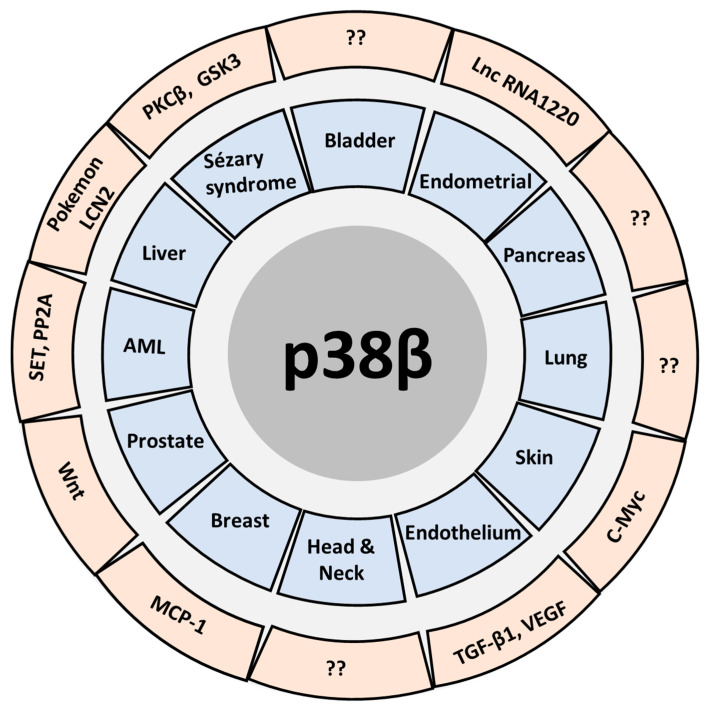
The p38 mitogen-activated protein kinase (MAPK) signaling pathway is implicated in cancer biology and has been widely studied over the past two decades as a potential therapeutic target. Most of the biological and pathological implications of p38MAPK signaling are often associated with p38α (MAPK14). Recently, several members of the p38 family, including p38γ and p38δ, have been shown to play a crucial role in several pathologies including cancer. However, the specific role of p38β (MAPK11) in cancer is still elusive, and further investigation is needed. Here, we summarize what is currently known about the role of p38β in different types of tumors and its putative implication in cancer therapy. All evidence suggests that p38β might be a key player in cancer development, and could be an important therapeutic target in several pathologies, including cancer.
p38 丝裂原活化蛋白激酶(MAPK)信号通路与癌症生物学有关,在过去的二十年中,它已被广泛研究作为一种潜在的治疗靶点。p38MAPK 信号的大多数生物学和病理学意义通常与 p38α(MAPK14)相关。最近,p38 家族的几个成员,包括 p38γ 和 p38δ,已被证明在包括癌症在内的几种疾病中发挥关键作用。然而,p38β(MAPK11)在癌症中的具体作用仍不清楚,需要进一步研究。在这里,我们总结了目前已知的 p38β 在不同类型肿瘤中的作用及其在癌症治疗中的潜在意义。所有证据表明,p38β 可能是癌症发展的关键因素,并且可能是包括癌症在内的几种疾病中的一个重要治疗靶点。