Department of Health Economics and Health Services Research, University Medical Center Hamburg-Eppendorf, Hamburg Center for Health Economics, Martinistraße 52, 20246, Hamburg, Germany.
Network Aging Research, Heidelberg University, Heidelberg, Germany.
BMC Geriatr. 2020 Oct 14;20(1):401. doi: 10.1186/s12877-020-01802-6.
Previous research has shown that not only falls, but also fear of falling (FoF) influences health-related quality of life (HrQoL) negatively. The EQ-5D (consisting of an index and a visual analogue scale [EQ-VAS]) is a frequently used instrument to determine HrQoL in clinical studies and economic evaluations, but no previous study compared the association between FoF and the EQ-5D index with the association between FoF and the EQ-VAS. Moreover, factors that influence the association between FoF and HrQoL are rarely examined. Thus, this study aimed to examine the association between FoF and HrQoL and to examine factors that mediate the association.
FoF (Short Falls Efficacy Scale International) and HrQoL (EQ-5D descriptive system, EQ-5D index, and EQ-VAS) were assessed in a sample of community-dwelling older persons (≥70 years) participating in the baseline assessment of a randomized controlled trial (N = 309). Linear and logistic regression analyses were performed, adjusting for sociodemographic variables, frequency of falls, number of chronic conditions, functional mobility (Timed up-and-go test), and subjective functional capacity (LLFDI function and disability scales). Multiple regression models were used to test the mediating effects.
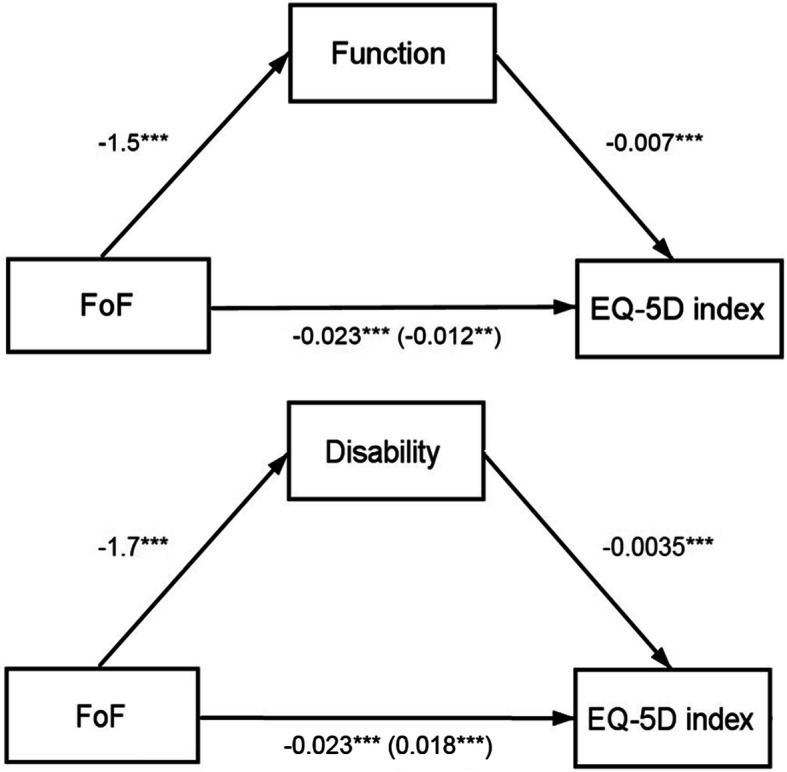
Moderate or high FoF was prevalent in 66% of the sample. After adjusting for covariates, FoF was negatively associated with the EQ-5D index, but not with the descriptive system or the EQ-VAS. Subjective functional capacity partly mediated the association between FoF and the EQ-5D index and completely mediated the association between FoF and the EQ-VAS.
FoF was negatively associated with the EQ-5D index. As subjective functional capacity mediated the association between FoF and HrQoL, future interventions should account for subjective functional capacity in their design.
先前的研究表明,不仅跌倒,而且对跌倒的恐惧(FoF)也会对健康相关生活质量(HrQoL)产生负面影响。EQ-5D(由指数和视觉模拟量表[EQ-VAS]组成)是临床研究和经济评估中常用的测定 HrQoL 的工具,但以前没有研究比较 FoF 与 EQ-5D 指数之间的关联与 FoF 与 EQ-VAS 之间的关联。此外,很少检查影响 FoF 与 HrQoL 之间关联的因素。因此,本研究旨在检验 FoF 与 HrQoL 之间的关联,并检查中介该关联的因素。
在参加一项随机对照试验(N=309)基线评估的社区居住的老年人样本中评估 FoF(简短跌倒效能量表国际版)和 HrQoL(EQ-5D 描述性系统、EQ-5D 指数和 EQ-VAS)。进行线性和逻辑回归分析,调整了社会人口统计学变量、跌倒频率、慢性疾病数量、功能性移动性(计时起坐测试)和主观功能能力(LLFDI 功能和残疾量表)。使用多元回归模型检验中介效应。
在样本中,中度或高度 FoF 发生率为 66%。调整了协变量后,FoF 与 EQ-5D 指数呈负相关,但与描述性系统或 EQ-VAS 无关。主观功能能力部分中介了 FoF 与 EQ-5D 指数之间的关联,完全中介了 FoF 与 EQ-VAS 之间的关联。
FoF 与 EQ-5D 指数呈负相关。由于主观功能能力中介了 FoF 与 HrQoL 之间的关联,因此未来的干预措施应在设计中考虑到主观功能能力。