Department of Thoracic and Cardiovascular Surgery, Hallym University Sacred Heart Hospital, Hallym University College of Medicine, Anyang, Republic of Korea.
Department of Pathology, Hallym University Sacred Heart Hospital, Hallym University College of Medicine, Gwanpyeong-ro 170 beon-gil 22, Dongan-gu, Anyang-si, Gyeonggi-do, 14068, Republic of Korea.
Diagn Pathol. 2020 Oct 14;15(1):126. doi: 10.1186/s13000-020-01045-4.
Esophageal squamous cell carcinoma (ESCC) still remains intractable disease with few therapeutic options. Programmed death-ligand 1 (PD-L1), which is essential for immune evasion, is involved in the pathogenesis of ESCC and thus is a potential therapeutic target. PIK3CA, KRAS, and BRAF mutations, microsatellite instability (MSI) caused by deficient mismatch repair (dMMR), and human papillomavirus (HPV) can potentially upregulate PD-L1 expression, which might contribute to the clinical outcome of patients with ESCC.
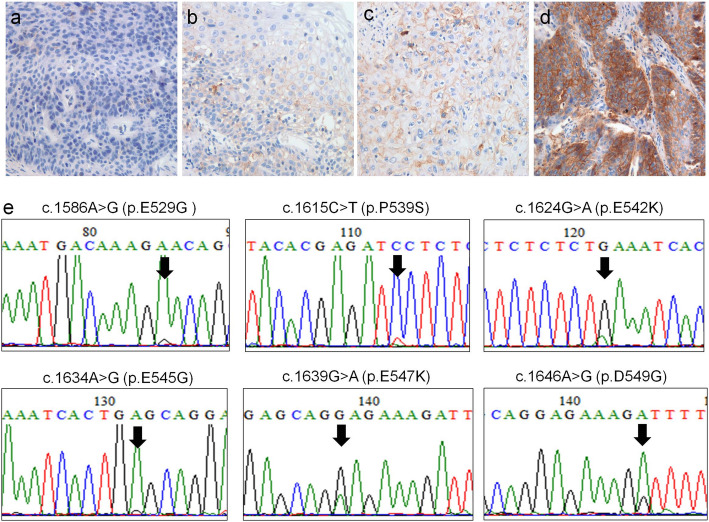
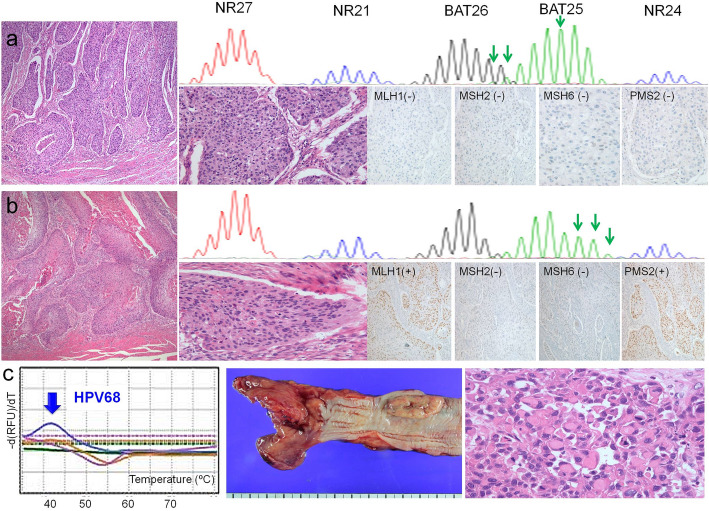
We investigated the significance of the present druggable markers [PD-L1, PIK3CA, KRAS, and BRAF mutations, MSI caused by deficient dMMR, and HPV] in 64 curatively resected ESCCs, using immunohistochemistry (PD-L1 and MMR protein expression), direct sequencing (KRAS, BRAF, and PIK3CA mutations), real-time PCR (HPV infection), and MSI using quasi-monomorphic markers.
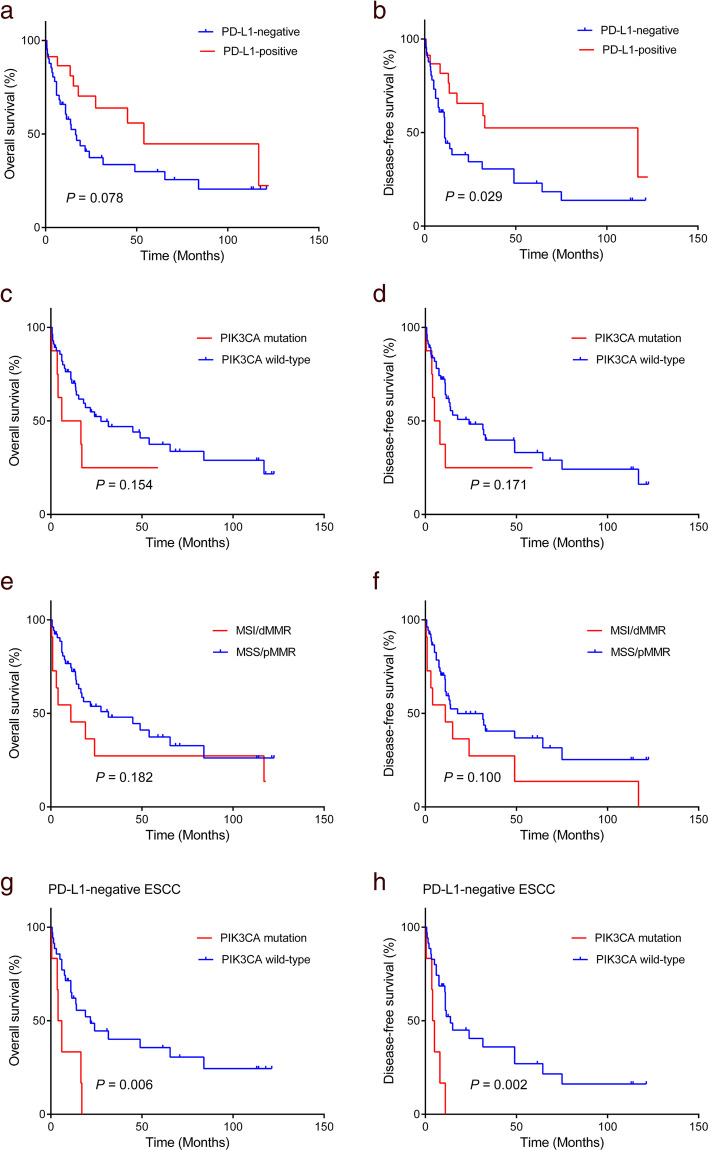
PD-L1 expression, PIK3CA mutation, and MSI/dMMR were detected in 35.9, 12.5, and 17.2% of ESCCs, respectively. HPV was rarely detected (1.6%) (high-risk HPV68), whereas KRAS and BRAF mutations were not detected in ESCCs. PD-L1-positive tumors were not correlated with PIK3CA mutation or MSI/dMMR (all P > 0.05). PD-L1, PIK3CA mutation, and MSI/dMMR characterized the patients associated with light smoking, female and younger age, and younger age and well-differentiated tumors, respectively (all P < 0.05). In multivariate analysis, only PD-L1-positivity was an independent favorable prognostic factor for overall survival (OS) and disease-free survival (DFS) (P = 0.023, P = 0.014). In the PD-L1-negative ESCCs, PIK3CA mutation had a poor prognostic impact on both OS and DFS (P = 0.006, P = 0.002).
PIK3CA mutation may be an alternative prognostic biomarker in PD-L1-negative curatively resected ESCCs that can be optional to identify high-risk patients with worse clinical outcome who require more intensive therapy and follow-up.
食管鳞状细胞癌(ESCC)仍然是一种难治性疾病,治疗选择有限。程序性死亡配体 1(PD-L1)对于免疫逃逸至关重要,它参与 ESCC 的发病机制,因此是一个潜在的治疗靶点。PIK3CA、KRAS 和 BRAF 突变、由错配修复缺陷(dMMR)引起的微卫星不稳定性(MSI)以及人乳头瘤病毒(HPV)可能会上调 PD-L1 的表达,这可能有助于 ESCC 患者的临床结局。
我们使用免疫组织化学(PD-L1 和 MMR 蛋白表达)、直接测序(KRAS、BRAF 和 PIK3CA 突变)、实时 PCR(HPV 感染)和准单态标记物检测 64 例可治愈性切除的 ESCC 中目前可用药的标志物 [PD-L1、PIK3CA、KRAS 和 BRAF 突变、MSI 由 dMMR 引起和 HPV] 的意义。
ESCC 中分别检测到 35.9%、12.5%和 17.2%的 PD-L1 表达、PIK3CA 突变和 MSI/dMMR。HPV 很少被检出(1.6%)(高危 HPV68),而 KRAS 和 BRAF 突变在 ESCC 中未被检出。PD-L1 阳性肿瘤与 PIK3CA 突变或 MSI/dMMR 无相关性(均 P>0.05)。PD-L1、PIK3CA 突变和 MSI/dMMR 分别代表与轻度吸烟、女性和年轻年龄、年轻年龄和分化良好的肿瘤相关的患者(均 P<0.05)。多变量分析显示,只有 PD-L1 阳性是总生存期(OS)和无病生存期(DFS)的独立有利预后因素(P=0.023,P=0.014)。在 PD-L1 阴性的 ESCC 中,PIK3CA 突变对 OS 和 DFS 均有不良预后影响(P=0.006,P=0.002)。
PIK3CA 突变可能是 PD-L1 阴性可治愈性切除 ESCC 的另一种预后生物标志物,可选择识别临床结局较差的高危患者,这些患者需要更强化的治疗和随访。