Aquatic Toxicology Lab, Department of Zoology, Guru Nanak Dev University, Amritsar, Punjab, 143005, India.
Plant Stress Physiology Lab, Department of Botanical and Environmental Sciences, Guru Nanak Dev University, Amritsar, Punjab, 143005, India.
Sci Rep. 2020 Oct 14;10(1):17322. doi: 10.1038/s41598-020-73042-y.
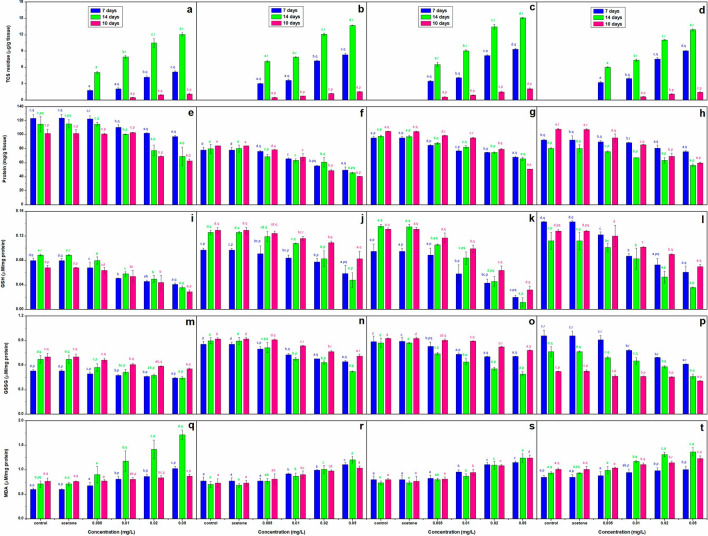
Accumulation, contents of protein, non-enzymatic antioxidant glutathione (GSH and GSSG), lipid peroxidation product (melondialdehyde-MDA) and organic acids (fumarate, succinate, malate and citrate), and activities of neurological (acetylcholinesterase-AChE), detoxification (glutathione S-transferase-GST) and metabolic (lactate dehydrogenase-LDH, aspartate transaminase-AST and alanine transaminase-ALT) enzymes were recorded in the hatchlings of Cyprinus carpio, Ctenopharyngodon idella, Labeo rohita and Cirrhinus mrigala after 7 and 14 days exposure and 10 days post exposure (recovery period) to sublethal concentrations (0.005, 0.01, 0.02 and 0.05 mg/L) of triclosan, a highly toxic and persistent biocide used in personal care products. Accumulation was maximum between 7-14 days at 0.01 mg/L for C. carpio and L. rohita but at 0.005 mg/L for C. idella and C. mrigala. No triclosan was observed at 0.005 mg/L in C. carpio and C. mrigala after recovery. Significant decline in protein, glutathione and acetylcholinesterase but increase in glutathione S-transferase, lactate dehydrogenase, aspartate transaminase, alanine transaminase, melondialdehyde and organic acids over control during exposure continued till the end of recovery period. Integrated biomarker response (IBR) analysis depicted higher star plot area for glutathione and glutathione S-transferase during initial 7 days of exposure, thereafter, during 7-14 days of exposure and the recovery period, higher star plot area was observed for acetylcholinesterase, aspartate transaminase, alanine transaminase and organic acids. Higher star plot area was observed for protein in all the species throughout the study. The study shows that L. rohita is most sensitive and glutathione, acetylcholinesterase, aspartate transaminase and alanine transaminase are the biomarkers for the toxicity of sublethal concentrations of TCS.
在暴露于低致死浓度(0.005、0.01、0.02 和 0.05 毫克/升)三氯生后,鲤鱼、草鱼、罗非鱼和圆口铜鱼的幼鱼分别经过 7 天和 14 天的暴露以及 10 天的恢复期(恢复阶段),记录了其幼鱼的生物积累、蛋白质含量、非酶抗氧化剂谷胱甘肽(GSH 和 GSSG)、脂质过氧化产物(丙二醛-MDA)和有机酸(富马酸、琥珀酸、苹果酸和柠檬酸)、以及神经(乙酰胆碱酯酶-AChE)、解毒(谷胱甘肽 S-转移酶-GST)和代谢(乳酸脱氢酶-LDH、天冬氨酸转氨酶-AST 和丙氨酸转氨酶-ALT)酶的活性。在鲤鱼和罗非鱼中,0.01 毫克/升的三氯生在 7-14 天之间的积累量最大,但在草鱼和圆口铜鱼中,0.005 毫克/升的三氯生的积累量最大。在恢复阶段,鲤鱼和圆口铜鱼中没有观察到 0.005 毫克/升的三氯生。在暴露期间,蛋白质、谷胱甘肽和乙酰胆碱酯酶显著下降,但谷胱甘肽 S-转移酶、乳酸脱氢酶、天冬氨酸转氨酶、丙氨酸转氨酶、丙二醛和有机酸的含量比对照增加,这种情况一直持续到恢复期结束。综合生物标志物反应(IBR)分析显示,在暴露的最初 7 天内,谷胱甘肽和谷胱甘肽 S-转移酶的星点面积较大,此后,在 7-14 天的暴露和恢复期,乙酰胆碱酯酶、天冬氨酸转氨酶、丙氨酸转氨酶和有机酸的星点面积较大。在整个研究过程中,所有物种的蛋白质星点面积都较高。研究表明,罗非鱼最为敏感,谷胱甘肽、乙酰胆碱酯酶、天冬氨酸转氨酶和丙氨酸转氨酶是三氯生亚致死浓度毒性的生物标志物。